A Landau quasiparticle is a fermionic excitation connected continuously to a Fermi gas particle when interactions preserve the phase. Near an isotropic Fermi surface, its energy relative to the chemical potential is , with Fermi momentum and Fermi velocity .[ref]
The Theory of a Fermi Liquid by Lev Davidovich Landau. Section 1, pp.921–922
The Pauli exclusion principle restricts decay. For a three-dimensional normal Fermi liquid with regular short-range interactions, a representative low-energy lifetime model isHere is an energy scale and is dimensionless; sharpness requires at zero temperature.[ref]
Renormalization Group Approach to Interacting Fermions by Ramamurti Shankar. Section VIII, manuscript p.114, quadratic lifetime corrections
For an original example, stipulate and . At , the decay energy is , just of the excitation energy; halving reduces that ratio to . Approaching the Fermi surface improves the particle description even though the microscopic interaction has not weakened. This quadratic illustration is three-dimensional; low-dimensional corrections require separate analysis.

Changing one Landau quasiparticle occupation changes the energies of others. To second order around equilibrium,Here is volume, occupations are per momentum and spin state, and has units of energy times volume.[ref]
On the Theory of the Fermi Liquid by Lev Davidovich Landau. p.70, equation (1); integrate the energy shift to obtain the quadratic functional
For a toy two-state change at fixed volume, take , , , and unperturbed energies . The expression gives . The factor counts the interaction of the same pair once; it does not halve each excitation's energy. This finite-state illustration only explains the bookkeeping of the Landau quasiparticle energy functional.
For a three-dimensional isotropic unpolarized spin-one-half Fermi liquid, define and . Dimensionless Landau parameters use the spin-summed density of states per volume: is a Legendre polynomial; label spin symmetry. No extra multiplies this expansion.[ref]
Renormalization Group Approach to Interacting Fermions by Ramamurti Shankar. Section VIII, angular interaction function; normalization stated explicitly here
The superscript on is unrelated to the dimensionless wave speed below.In a three-dimensional uniform isotropic continuum obeying the Principle of Galilean relativity, with one bare particle mass , the Fermi-liquid effective mass satisfiesA band effective mass need not satisfy this relation.[ref]
The Theory of a Fermi Liquid by Lev Davidovich Landau. Section 2, equations (8)–(11), metallic-quasimomentum footnote
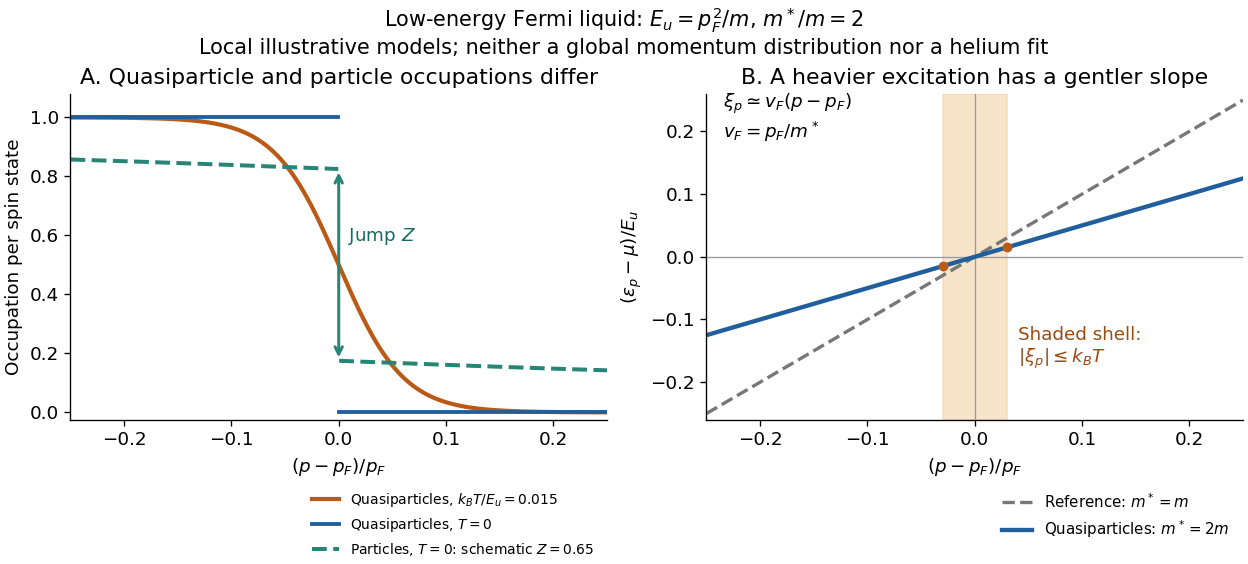
For the stipulated in the occupation figure, this relation requires if those assumptions apply. At fixed , is half its free-particle value, so moving by from the Fermi surface costs approximately instead of . The factor of three belongs to the three-dimensional angular average, not to a universal definition of effective mass.
The quasiparticle residue is the coherent pole weight of the single-particle Green's function. Its coherent spectral term contributes to the zero-temperature momentum occupation. A smooth remainder leaves a jump at the Fermi surface; Landau quasiparticle occupations have a unit step.[ref]
For the local illustrative distribution in the figure, put and is the Heaviside step function. Its one-sided limits are and , giving . The smooth term is stipulated; this local curve does not specify a normalized distribution over all momenta. In particular, is neither the fraction of atoms above the Fermi surface nor .
Articles by others on the same topic
There are currently no matching articles.