Compton scattering is a quantum mechanical phenomenon that describes the elastic scattering of X-rays or gamma rays off charged particles, most commonly electrons. This effect is significant because it demonstrates the particle-like behavior of photons, the quantum particles of light. The process occurs when a photon collides with a free or loosely bound electron. During the collision, energy and momentum are conserved, leading to an increase in the wavelength of the scattered photon (which corresponds to a decrease in its energy).
Articles by others on the same topic

Compton scattering redistributes photon energy and momentum in a collision with a charged subatomic particle, here an electron. For a free electron initially at rest in the chosen inertial frame, an incident photon of energy leaves with energy after deflection through . The angle is between the incident and outgoing photon directions; it is not the electron recoil angle. Four-momentum conservation giveswhere is the electron rest mass and its final kinetic energy. The photon energy loss pays for the electron recoil: neither energy nor momentum disappears.
For an original worked example, stipulate , the rounded electron rest energy , and the rounded Compton wavelength ; means electronvolts. Treat these rounded inputs as the example's constants. They give the following calculated values, with energies rounded to three decimal places:
| Photon deflection | Outgoing photon energy in | Electron kinetic energy in | Wavelength increase in |
|---|
Since , every outgoing photon has and . At zero deflection there is no recoil; backscattering transfers the most energy. At fixed , the absolute wavelength increase is independent of incident energy, while the fractional energy loss grows with . This makes Compton scattering useful for inferring energy transfers from directions in photon detectors.
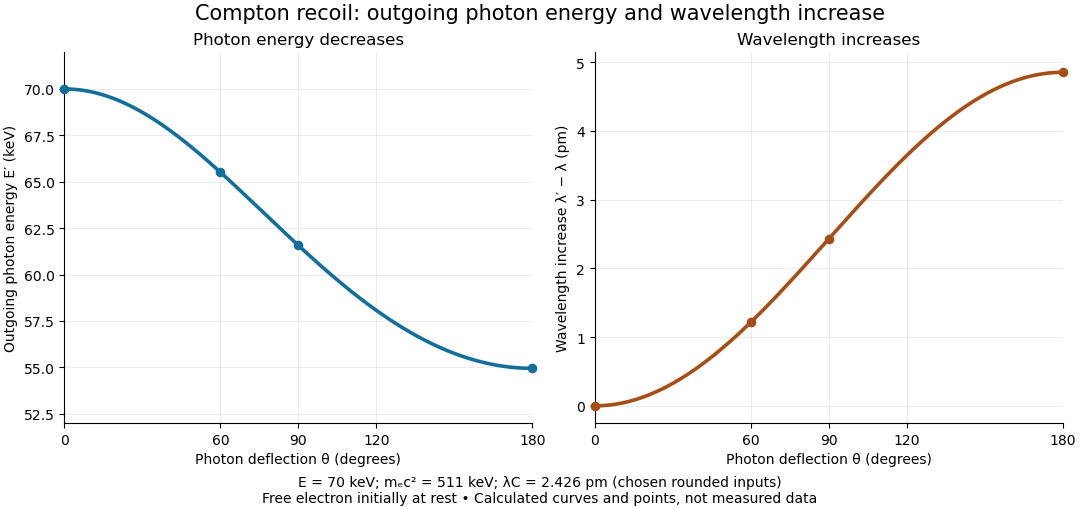
The free-electron-at-rest assumption matters. An electron in a bound state has binding energy and an initial momentum distribution. Neglecting these is useful when the transferred energy is large compared with the relevant binding energy and the initial momentum is small compared with the resolved momentum transfer. Otherwise the outgoing photon energies can broaden or depart from the stationary-target formula; an initially moving electron can even give energy to the photon.
A material may also scatter X-rays through a coherent elastic scattering channel with an effectively unshifted component. When an intact chemical atom of mass takes the recoil, the corresponding Compton wavelength is much smaller than the electron value. The single free-electron curve does not predict that component's weight. More generally, energy versus angle is a kinematic constraint; angular wave intensity requires a differential scattering cross-section, together with target and detector information.


Classic theory predicts that the output frequency must be the same as the input one since the electromagnetic wave makes the electron vibrate with same frequency as itself, which then irradiates further waves.
But the output waves are longer because photons are discrete and energy is proportional to frequency:
The formula is exactly that of two relativistic billiard balls colliding.
Compton Scattering by Compton Scattering (2017)
Source. Experiment with a caesium-137 source.