In linear algebra and functional analysis, the concept of a dual basis is tied to the idea of dual spaces.
Articles by others on the same topic

For a basis of a finite-dimensional vector space , its dual basis consists of linear functionals satisfyingThe Kronecker delta means that each rule gives one on its own basis vector and zero on the others. These rules extract coordinates:Applying to a linear combination removes every term except the th. Consequently the dual basis is a basis of the dual space, and every linear functional has expansion . [ref]
Linear Algebra Done Right by Sheldon Axler (4th edition). Axler, Linear Algebra Done Right, fourth edition, §3F, definitions and results 3.112–3.116
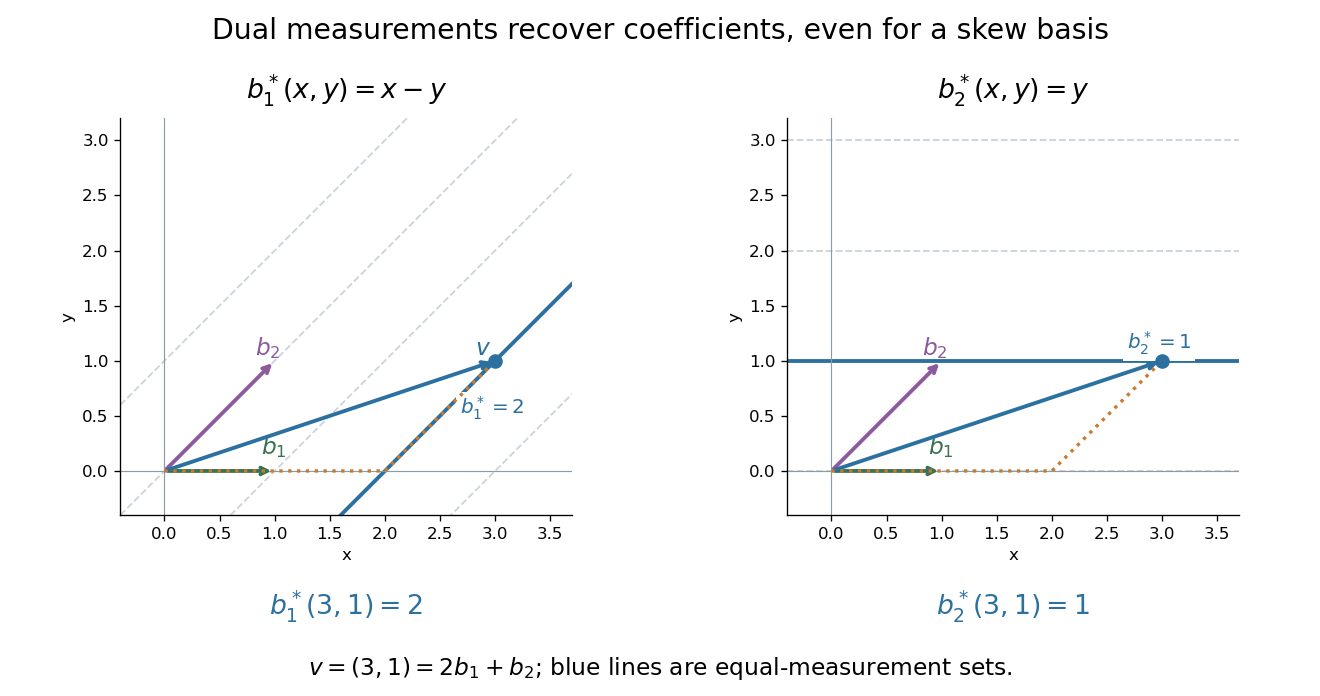
.Coordinate extraction works for a nonorthogonal basis too. With and , the dual basis isThe checks , , , and fix the two rules. For they give coordinates , so . The usual dot products with instead give and do not extract these coordinates: simple projection formulas depend on an orthonormal basis.

The same idea explains polynomial interpolation. On polynomials of polynomial degree at most , evaluation at distinct interpolation nodes gives the dual basis to the Lagrange cardinal polynomials, because . Samples are coordinates in this basis, so the reconstruction is a dual-basis expansion. Differentiation weights from nodal evaluations and factorial monomial basis for polynomial differentiation apply the same principle to different measurements.