For a basis of a finite-dimensional vector space , its dual basis consists of linear functionals satisfyingThe Kronecker delta means that each rule gives one on its own basis vector and zero on the others. These rules extract coordinates:Applying to a linear combination removes every term except the th. Consequently the dual basis is a basis of the dual space, and every linear functional has expansion . [ref]
Linear Algebra Done Right by Sheldon Axler (4th edition). Axler, Linear Algebra Done Right, fourth edition, §3F, definitions and results 3.112–3.116
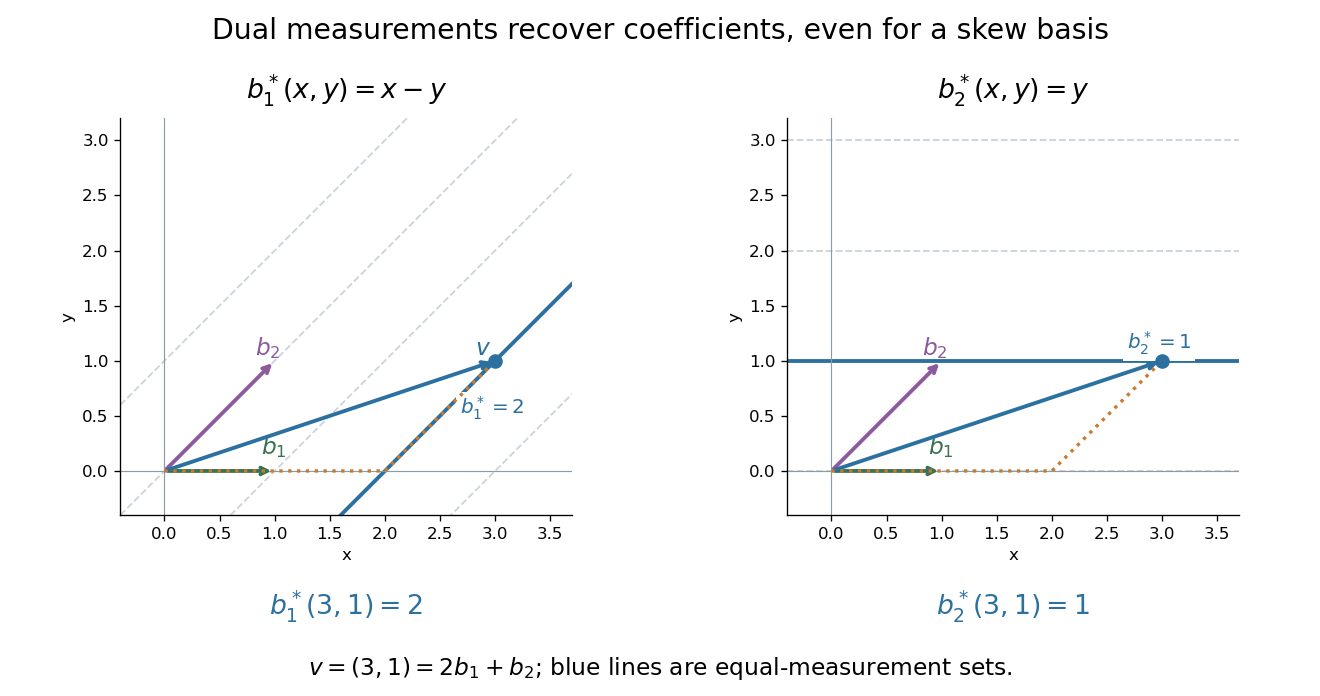
.Coordinate extraction works for a nonorthogonal basis too. With and , the dual basis isThe checks , , , and fix the two rules. For they give coordinates , so . The usual dot products with instead give and do not extract these coordinates: simple projection formulas depend on an orthonormal basis.
The same idea explains polynomial interpolation. On polynomials of polynomial degree at most , evaluation at distinct interpolation nodes gives the dual basis to the Lagrange cardinal polynomials, because . Samples are coordinates in this basis, so the reconstruction is a dual-basis expansion. Differentiation weights from nodal evaluations and factorial monomial basis for polynomial differentiation apply the same principle to different measurements.
For , the three point evaluation functionals at form a basis of the dual space of real polynomials of degree at most two. The displayed recovery formulas express the coordinate functionals, hence the dual basis to , as linear combinations of these evaluations. More generally distinct-node polynomial interpolation identifies values with coefficient data through an invertible Vandermonde matrix.
For the basis obtained from a basis , the dual basis is obtained by successive differences of the original dual basis. Indeed, if , its original coordinates are . Hence for , and . These are precisely the new coordinate linear functionals. This gives an elementary example of the inverse relation between change of basis and covector transformation under a change of basis.
A coordinate functional extracts one coefficient in a specified finite basis. It is an element of that basis's dual basis, rather than a coordinate rule independent of the basis. For the standard basis of , the th coordinate functional sends to .
On polynomials of degree at most , the derivative-evaluation functionals are dual to , since . Differentiation maps to , with mapped to zero. Its matrix is a single nilpotent Jordan block with ones above the diagonal, and its dual has the transpose matrix.
Articles by others on the same topic


In linear algebra and functional analysis, the concept of a dual basis is tied to the idea of dual spaces.