Articles by others on the same topic

An elastic collision preserves total kinetic energy between the incoming and outgoing states. For isolated colliding bodies, momentum conservation also holds. The kinetic energy condition supplies information beyond momentum conservation alone. [ref]
Consider a stipulated one-dimensional example with rightward positive: , , incoming velocities and . The total momentum is and total kinetic energy is . In SI numerical values, outgoing velocities satisfySubstituting gives . The root , repeats the incoming state; the outgoing separating state is , . Its momenta add to and its kinetic energies add to . The incoming and outgoing relative velocities both have magnitude , consistent with coefficient of restitution .
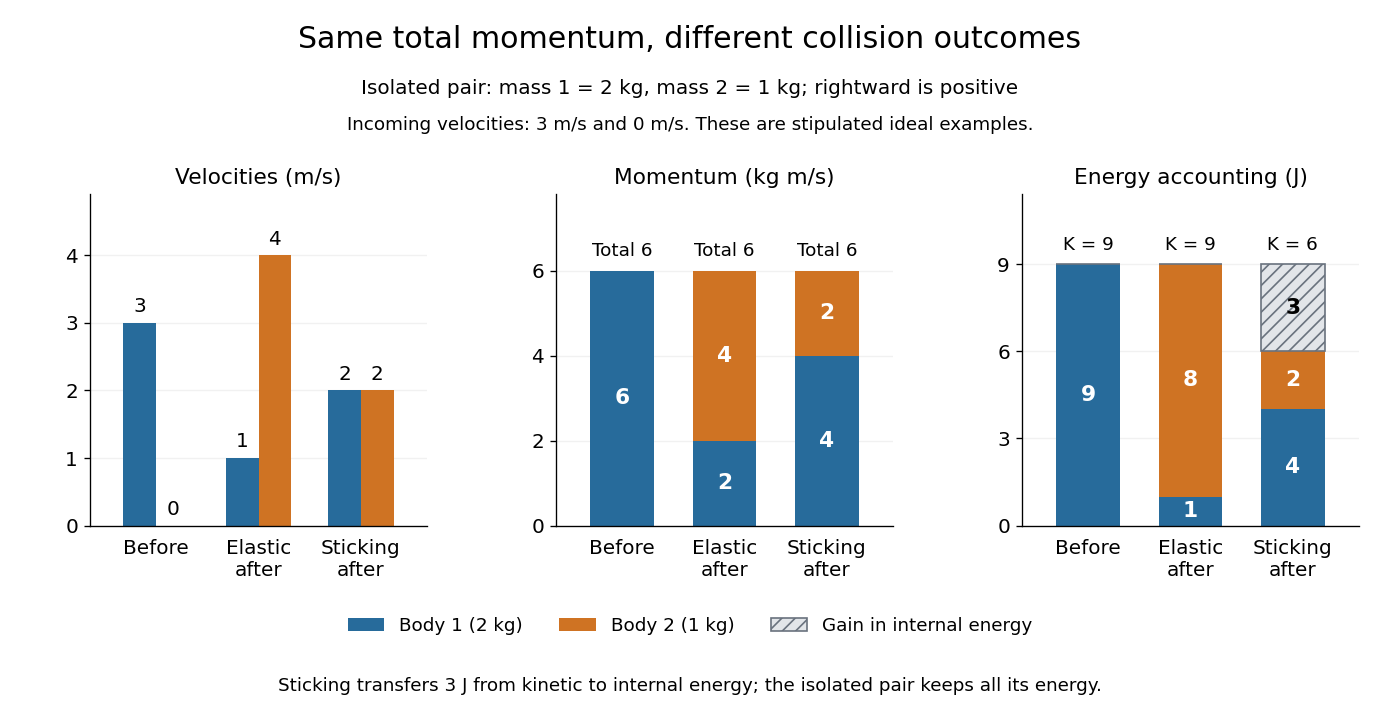
The inelastic collision example below uses exactly these incoming data. Both outcomes preserve total momentum, while only the elastic collision preserves total kinetic energy. These are ideal numerical examples, not experimental measurements.

