A linear combination is a mathematical expression constructed from a set of elements, typically vectors or functions, where each element is multiplied by a coefficient (a scalar, which can be any real or complex number) and then summed together.
Articles by others on the same topic

Let be a vector space over a specified field , and let . A linear combination is a finite sumThe coefficients are scalars from that same field; each term uses scalar multiplication, and the terms are joined by vector addition. For coefficients in the real numbers, negative values reverse arrows and fractional values scale them by fractional amounts. The collection of attainable vectors is the linear span. The column picture in Strang's MIT notes interprets solving a linear system as choosing coefficients to reach a target vector.[ref]
https://ocw.mit.edu/courses/18-06sc-linear-algebra-fall-2011/6913aa2f37dada8fdda334168b30339b_MIT18_06SCF11_Ses1.1sum.pdf. MIT 18.06SC, Strang lecture summary 1, pp. 2–3: the column picture
For a concrete calculation over the real numbers, takeThen . More generally, solving and givesEvery vector in the Euclidean plane is therefore a linear combination of , so their linear span is all of . The target has coefficients ; the target has coefficients , since . The displayed formula also makes the coefficients unique. Consequently is an ordered basis, with coordinate vector .
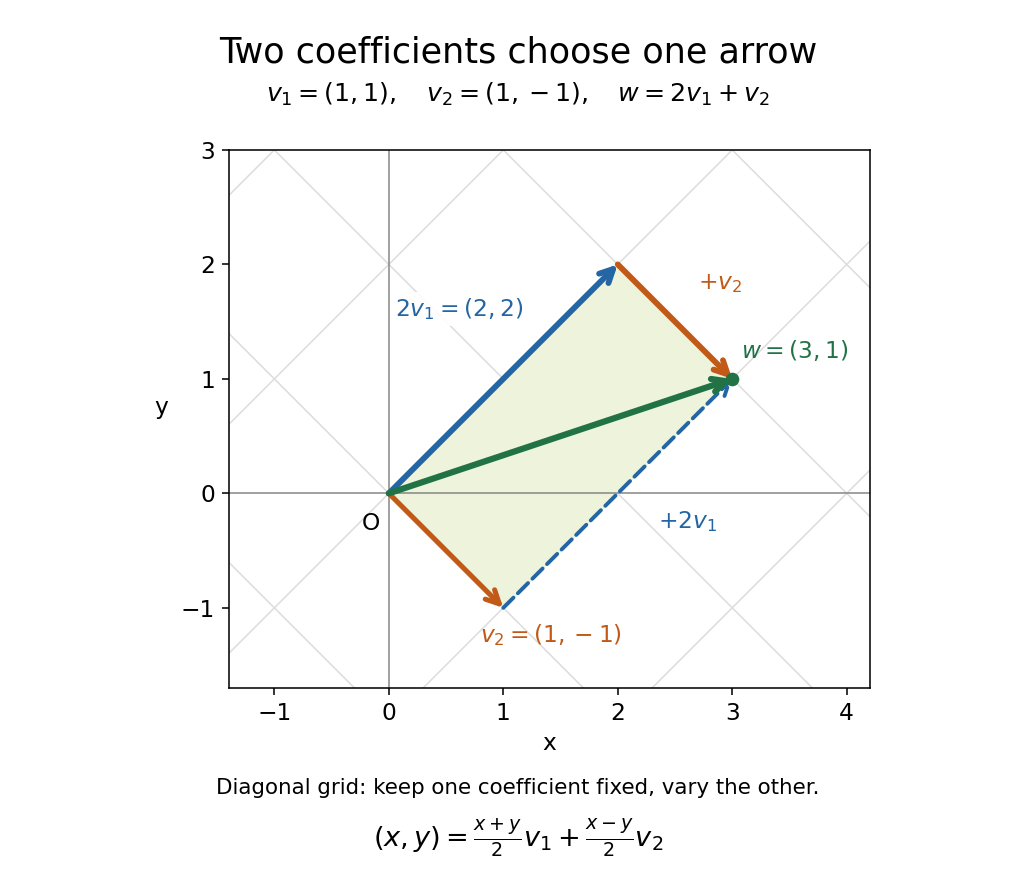

The payoff is a reusable language for synthesis: linear combinations build vectors from chosen ingredients, linear span decides which targets are reachable, and linear independence decides whether the coefficients are unique. The ingredients can also be polynomials or functions, as long as they belong to a vector space over the specified field.