Articles by others on the same topic

The mean value theorem says that an average rate of change is attained as an instantaneous rate somewhere between the endpoints. Let and let the real-valued function be continuous on the closed interval and differentiable on the open interval . Then there exists such thatThe right-hand side is the slope of the secant line joining to ; the left-hand side is the slope of the tangent line at . The derivative need not be continuous, and the function need not be differentiable at the endpoints. [ref]
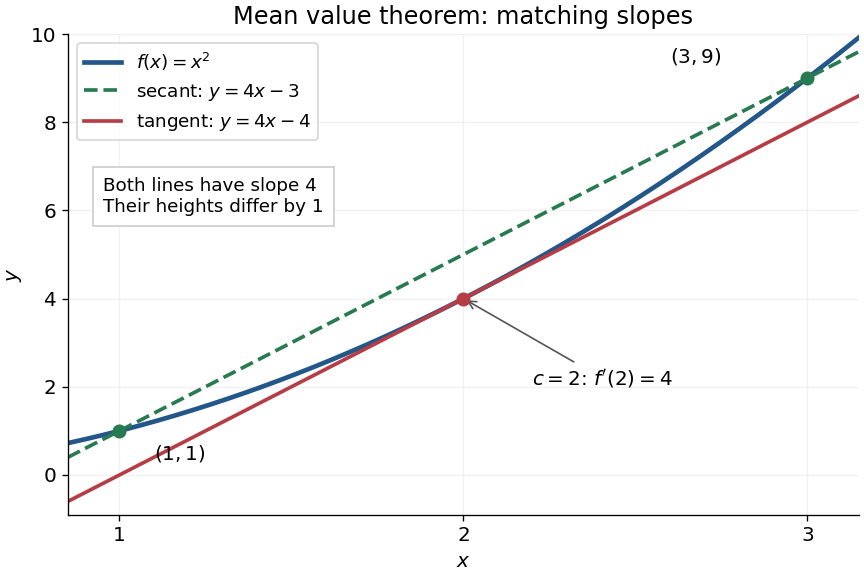
For the polynomial on , the secant line has slope . Since the derivative is , the required interior point is . The tangent line there is , whereas the secant line is . Their equal slopes make them parallel, but they are distinct straight lines: the theorem equates rates, not heights.

The practical strength is that the unknown point can disappear from an estimate. Under the same hypotheses, if the derivative satisfies throughout , where , thenApplying this to every subinterval proves Lipschitz continuity with Lipschitz bound . For example, on has , so an input change of size at most changes its output by at most , as long as both inputs lie in that interval. A local derivative bound therefore controls finite changes without computing an integral. The sign of the derivative similarly gives the derivative criterion for monotonicity.
Taking shows that a function with zero derivative throughout a real interval is a constant function, provided it is continuous at any included endpoints. The interval condition is essential: on the domain of a function , the function equal to zero on the left interval and one on the right interval has zero derivative everywhere. It is a locally constant function, yet not a constant function on the whole domain of a function. The mean value theorem cannot cross the gap.
A concise proof subtracts the secant line: set and . Then , and Rolle's theorem gives an interior point with . The geometric idea is to remove the average trend and find a horizontal tangent line in what remains.