The Pythagorean theorem is a fundamental principle in geometry that describes the relationship between the sides of a right triangle. It states that in a right triangle, the square of the length of the hypotenuse (the side opposite the right angle) is equal to the sum of the squares of the lengths of the other two sides.
Articles by others on the same topic

For a right triangle in Euclidean geometry with perpendicular side lengths and hypotenuse , the Pythagorean theorem statesGeometrically, the area of the square on the hypotenuse equals the sum of the areas of the squares on the other two sides. Euclid's Elements, Book I, Proposition 47 states this area equality; Proposition 48 states its converse: a triangle satisfying the equality has a right angle opposite side .[ref][ref]
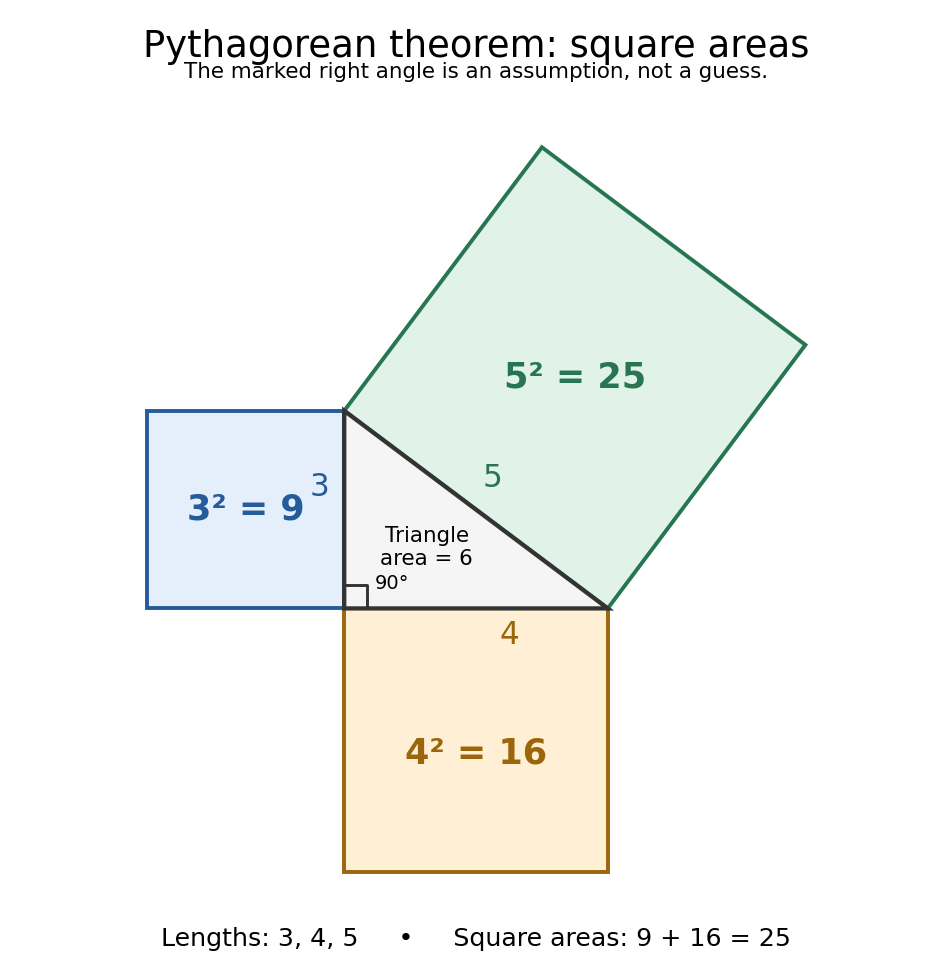
For and , we compute . The triangle has area , and its side lengths form a Pythagorean triple. Conversely, a triangle measured to have sides must have a right angle between the sides and . This makes the equality both a calculation tool and a test for perpendicularity.
The three squares in the next figure have areas , and in squared length units. These are different from the central right triangle's area . The Pythagorean theorem adds the areas of the attached squares, not their side lengths and not the area of the triangle. The square on the hypotenuse is tilted, but a rotation preserves its area. This makes the formula visible without suggesting that the hypotenuse has to align with an axis.
Historically, Euclid's Elements records an organized proof of the Pythagorean theorem as an equality of areas, rather than the modern equation between numbers representing lengths. Its placement in Book I makes it available before the treatment of similar triangles in Book VI. This is evidence of how the result was established within that text; the name Pythagorean theorem alone does not establish who first discovered or proved it. The precise historical anchor here is the surviving proposition, rather than an unsupported story of a single inventor.[ref]
https://mathcs.clarku.edu/~djoyce/elements/bookI/propI47.html. Euclid, Elements I.47, statement and proof
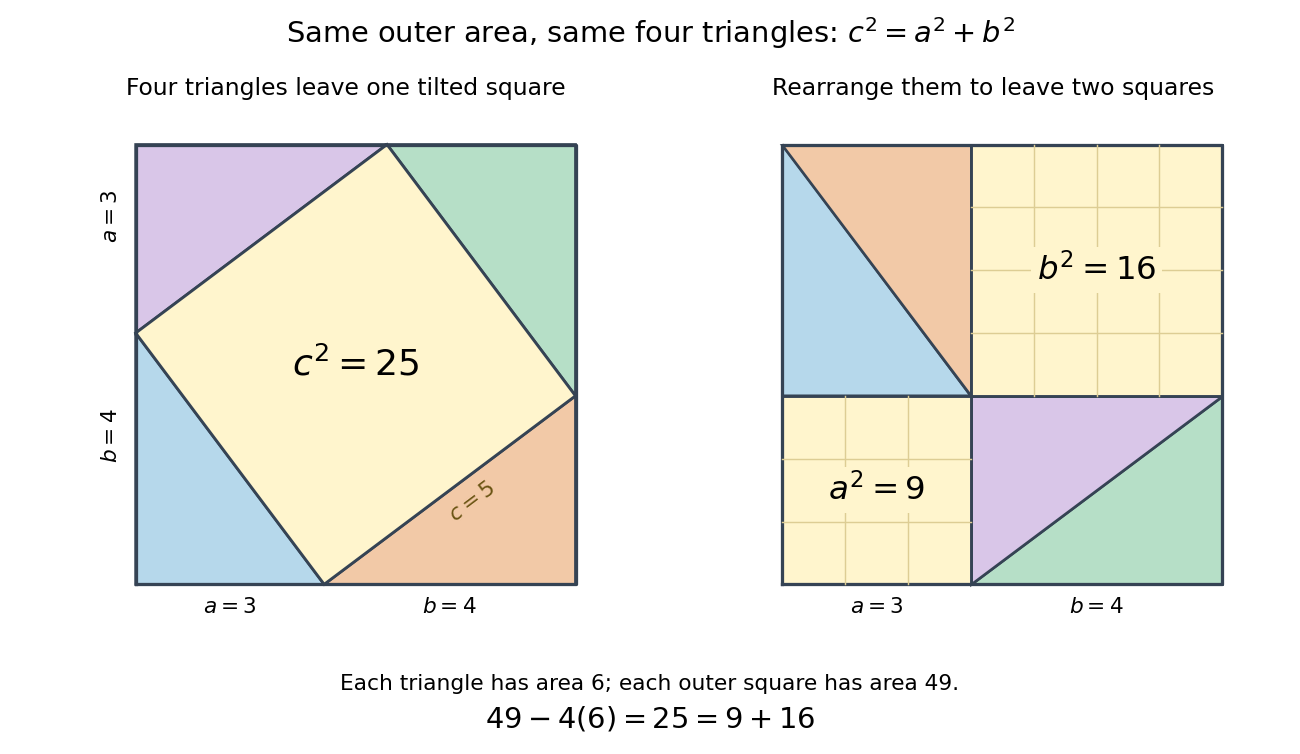
The dissection below makes the general identity tangible. Both outer squares have side and contain the same four congruent right triangles. In the first arrangement, their hypotenuses bound a square of side : adjacent acute angles together make a right angle. In the second, the uncovered regions are squares of sides and . Subtracting the same total triangle area from equal outer areas givesFor the pictured dimensions, the shared uncovered area is .
The same mechanism survives in inner product spaces: for orthogonal vectors , expanding the inner product gives . This is why orthogonal projection separates a squared distance into independent contributions. The familiar right triangle is the simplest picture of a much more reusable principle.


