"Radiance" can refer to several different concepts depending on the context. Here are a few common interpretations: 1. **Physics and Optics**: In the field of physics, radiance is a measure of the amount of electromagnetic energy (such as light) emitted from a surface in a particular direction per unit solid angle per unit area. It is expressed in units like watts per square meter per steradian (W/m²/sr).
Articles by others on the same topic

Radiance resolves both position and direction: it is radiant flux per projected area and per solid angle. For a surface element of area , and a small outgoing cone at angle to its outward unit normal,Here locates the patch and is a unit vector along the outgoing direction. The factor is the patch's apparent area viewed along that direction. The same local definition applies to transmitted or received radiation, choosing the positive projected area for the crossing direction. [ref]
https://labs.phys.utk.edu/mbreinig/phys421/modules/m5/Radiometry.html. Marianne Breinig, University of Tennessee, Radiometry: radiance and Lambert's law
.For a planar patch of area with spatially uniform, direction-independent radiance , integrating over the patch givesTake and . The radiant intensities are and . A sufficiently narrow cone therefore carries approximately or , respectively. Both views have the same radiance : the oblique view presents half the projected area. This is Lambert's cosine law, not a loss of radiance with viewing angle.
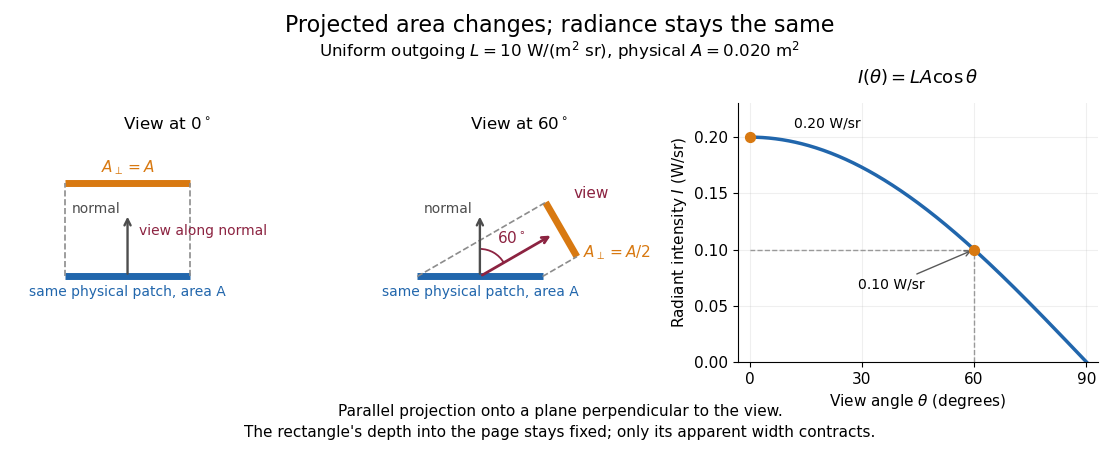

Radiance is useful because it separates a source's local directional output from the geometry of an observation. Integrating over outgoing directions gives radiant exitance; integrating incoming radiance at a receiver gives irradiance. In the stationary vacuum setting of vacuum conservation of specific intensity, a resolved uniform source retains its radiance along each light ray, while the radiant flux received from the whole source can decrease as its apparent solid angle shrinks.