Spherical geometry is a branch of mathematics that deals with geometric shapes and figures on the surface of a sphere, as opposed to the flat surfaces typically studied in Euclidean geometry. It is a non-Euclidean geometry, meaning that it does not abide by some of the postulates of Euclidean geometry, particularly the parallel postulate.
Articles by others on the same topic

Spherical geometry studies lengths and angles measured along the surface of a sphere, rather than through its interior. It is a useful model whenever travel is constrained to a round surface. Its straightest paths are great circle arcs: they are geodesics, even though they appear curved in the surrounding Euclidean space. Two distinct great circles meet at an antipodal pair, so the parallel-line picture of Euclidean geometry does not apply.
For a sphere of radius , write two positions as , with unit vectors. Their shorter surface route has great-circle distancewhere the dot product gives the central angle in radians. The straight chord through the surrounding Euclidean space instead has length . For a quarter-circle separation these are and : specifying which distance we mean has a measurable effect. On the unit sphere, and great-circle distance equals the central angle.
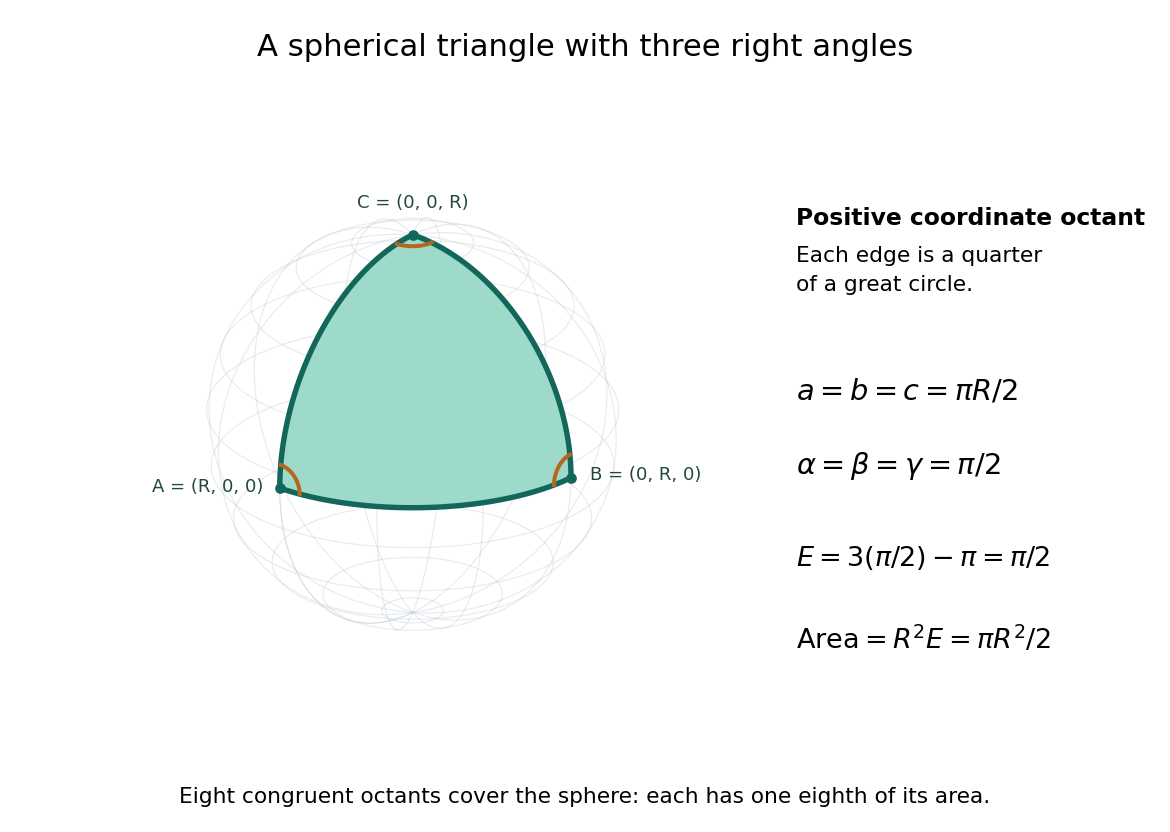
Consider the spherical triangle with vertices , and , joined by the shorter great circle arcs. Each side has length . At each vertex the two outgoing tangent vectors point along the other coordinate axes and are orthogonal, so all three interior angles are . This is the positive coordinate octant of the sphere, not a flat triangle drawn inside it.
For a convex minor spherical triangle with interior angles in radians, the spherical excess formula statesOur octant therefore has area . Independently, eight congruent octants partition the sphere, giving again. Thus angles alone determine area when is fixed, unlike Euclidean geometry, where similar triangles can have arbitrarily different areas. The Gauss-Bonnet theorem explains the connection: the sphere's constant Gaussian curvature times the area equals this excess. For spherical triangles whose area is small compared with , the excess is small, recovering the familiar flat picture.