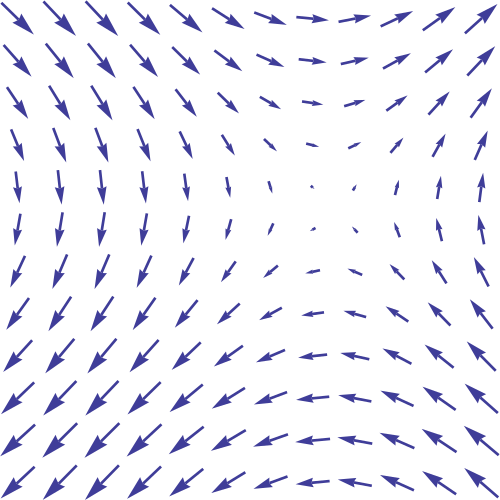
A vector field is a mathematical construct that assigns a vector to every point in a space. It can be thought of as a way to represent spatial variations in a quantity that has both magnitude and direction. Vector fields are widely used in physics and engineering to model phenomena such as fluid flow, electromagnetic fields, and gravitational fields, among others.
Articles by others on the same topic

On an open set , a vector field assigns a vector to each point . Its components are scalar functions. For a smooth manifold , the corresponding definition requires : the vector belongs to the tangent space at its base point. A smooth vector field is a smooth section of the tangent bundle.[ref]
Calculus Volume 3 by Gilbert Strang and others. section6.1, Vector Fields, planar and spatial definitions
For example, is tangent to circles centred at the origin. Its integral curves solve , , so is constant. This distinguishes the field, which assigns a direction and magnitude at every point, from any one trajectory following it. A fluid velocity is a physical vector field; its divergence measures local expansion, while its curl measures local rotation in three dimensions.