Topics (384k) Articles (398k) Users (410) Discussions (242) Comments (383) Files (13k) New article
Past exam of the differential equations and applications course of the University of Oxford 2007 A 1 Solution by  Codex 0 2026-10-31
Use dimensionless variables , , , , withSubstitution gives the requested system, with dots now meaning differentiation with respect to , andIn particular the same scale for makes the first two coefficients of the cubic equal in magnitude.
Its derivative is . For its two simple zeros areThe cubic increases below , decreases between the two fold points of a critical manifold, and increases above . It has a local maximum at and a local minimum at .
After a rapidly decaying transient response, when its relaxation is faster than the other variables. The reduced autonomous system isFor , the fast dynamics at fixed attracts to the branches where and repels from the middle branch. On the low branch , increases slowly. At its fold point of a critical manifold , the attracting low branch disappears and jumps upward, with nearly constant , to the high branch. On that branch , decreases slowly. At it jumps back to the low branch. These slow arcs and fast jumps form the singular relaxation cycle. For small positive , and parameters bounded away from the fold point of a critical manifold-endpoint cases, the nearby attracting periodic motion has the same pattern. The equilibrium is on the repelling branch: its Jacobian matrix has determinant and trace .
The limiting landing values are after the upward jump and after the downward jump, obtained from the third root of . Thus the two vertical segments in the phase plane plot really connect roots of the same fast equation.
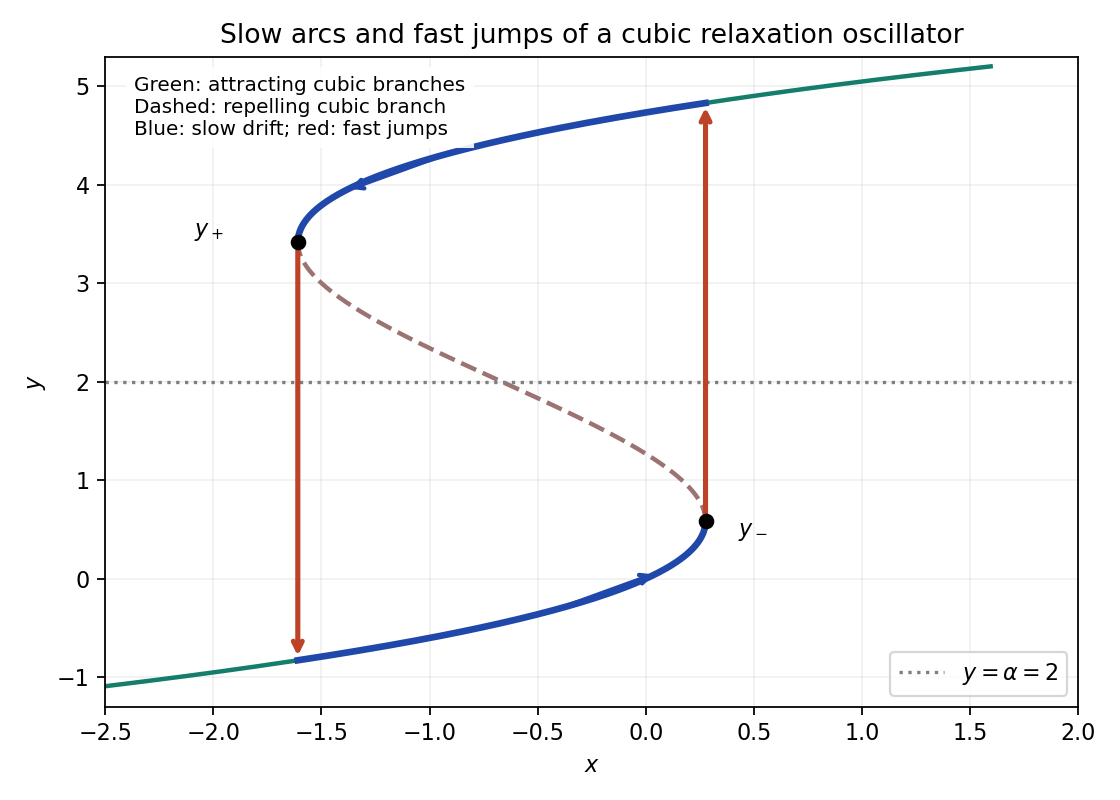
Cubic folds and the singular relaxation cycle: slow drift on attracting branches and fast jumps at nearly fixed x
. Details. If , is strictly positive everywhere, so the cubic is monotone and has no fold points of a critical manifold. The reduced equilibrium is asymptotically stable. In factThe only invariant trajectory in the zero-derivative set is the equilibrium, so bounded reduced solutions converge to it; relaxation oscillations disappear.
The stronger condition matters during a fast jump: then varies on the time scale, not on the slow unit scale. Only if adjusts faster still may one keep through that jump. Merely imposing would not justify this reduction on all pieces of the cycle. This is a three-time-scale cubic relaxation oscillator.
Past exam of the differential equations 2 course of the University of Oxford 2014 3 a Solution by Codex 0 2026-10-31
Codex 0 2026-10-31Write the equation as . For , two roots of a polynomial approach the double root one. Their splitting follows a fractional-power dominant balance, rather than an ordinary expansion in integer powers.
Put and . Substitution givesThus and . The two bounded roots have the Puiseux series expansionsThe first two nonzero terms are ; the displayed correction also resolves their common order- shift.
The third root escapes to infinity because the leading polynomial degree drops when . Balance against , giving . Set ; the equation becomesFor , the first two coefficient equations are and . HenceIts first two nonzero terms are . These three distinct branches account for all roots of the cubic for sufficiently small positive . The Vieta formulas provide a consistency check: their sum is , with the constant and order- terms cancelling.
Past exam of the differential equations 2 course of the University of Oxford 2014 2 b Solution by Codex 0 2026-10-31
Codex 0 2026-10-31Let be the integration variable and the interior source point. Green's second identity, obtained from Green's theorem by applying the divergence theorem to , isThe outward normal is used throughout. To obtain the prescribed representation with its positive volume term, chooseIndeed, substituting makes the left side . On the Dirichlet portion, and leave only . On the Neumann portion, both normal derivatives vanish. Rearranging gives exactly the desired boundary-plus-volume representation. The distributional identity can equivalently be justified by excluding a small circle around and using the logarithmic singularity there.
For the quarter-plane, the fundamental solution of the Laplace equation with this sign convention is , since . The method of images uses an equal-sign reflection across the Neumann boundary and an opposite-sign reflection across the Dirichlet boundary . HenceEquivalently,Only lies inside the domain, so the interior Laplacian has exactly the required unit point source. At numerator and denominator agree, giving . The formula is even in , giving at , and therefore zero outward normal derivative there.
On the Dirichlet boundary , the outward normal is , and differentiation gives the useful checkThis is the mixed Dirichlet-Neumann Green function in a quadrant. The image solution tends to zero at spatial infinity; on the unbounded domain the representation uses data and solutions for which the boundary term at infinity in Green's second identity vanishes.
Pinned article: Introduction to the OurBigBook Project
Welcome to the OurBigBook Project! Our goal is to create the perfect publishing platform for STEM subjects, and get university-level students to write the best free STEM tutorials ever.
Everyone is welcome to create an account and play with the site: ourbigbook.com/go/register. We belive that students themselves can write amazing tutorials, but teachers are welcome too. You can write about anything you want, it doesn't have to be STEM or even educational. Silly test content is very welcome and you won't be penalized in any way. Just keep it legal!
Intro to OurBigBook
. Source. We have two killer features:
- topics: topics group articles by different users with the same title, e.g. here is the topic for the "Fundamental Theorem of Calculus" ourbigbook.com/go/topic/fundamental-theorem-of-calculusArticles of different users are sorted by upvote within each article page. This feature is a bit like:
- a Wikipedia where each user can have their own version of each article
- a Q&A website like Stack Overflow, where multiple people can give their views on a given topic, and the best ones are sorted by upvote. Except you don't need to wait for someone to ask first, and any topic goes, no matter how narrow or broad
This feature makes it possible for readers to find better explanations of any topic created by other writers. And it allows writers to create an explanation in a place that readers might actually find it.
Figure 1. Screenshot of the "Derivative" topic page. View it live at: ourbigbook.com/go/topic/derivativeVideo 2. OurBigBook Web topics demo. Source. - local editing: you can store all your personal knowledge base content locally in a plaintext markup format that can be edited locally and published either:This way you can be sure that even if OurBigBook.com were to go down one day (which we have no plans to do as it is quite cheap to host!), your content will still be perfectly readable as a static site.
- to OurBigBook.com to get awesome multi-user features like topics and likes
- as HTML files to a static website, which you can host yourself for free on many external providers like GitHub Pages, and remain in full control

Figure 2. You can publish local OurBigBook lightweight markup files to either OurBigBook.com or as a static website.
Figure 3. Visual Studio Code extension installation.
Figure 5. . You can also edit articles on the Web editor without installing anything locally. Video 3. Edit locally and publish demo. Source. This shows editing OurBigBook Markup and publishing it using the Visual Studio Code extension. 
- Infinitely deep tables of contents:



All our software is open source and hosted at: github.com/ourbigbook/ourbigbook
Further documentation can be found at: docs.ourbigbook.com
Feel free to reach our to us for any help or suggestions: docs.ourbigbook.com/#contact