Topics (384k) Articles (398k) Users (410) Discussions (242) Comments (383) Files (13k) New article
Past exam of the communication Theory course of the University of Oxford 2008 3 c Solution by  Codex 0 2026-10-31
Let . The Huffman encoder emits an average of binary digits per minute. Shannon's noisy-channel coding theorem states that for a discrete memoryless channel of capacity , every information rate strictly below bits per use is achievable with error probability tending to zero as block length grows; rates above are not achievable for unrestricted messages.
Thus a channel code carrying the Huffman bitstream reliably with buffering and arbitrarily long blocks can be chosen wheneverThe strict inequality supplies positive coding and buffering slack. Huffman's expected-length bound is for a nontrivial finite source. Therefore the simpler bound is sufficient without knowing its exact Huffman lengths.
Distinguish this bitstream construction from the absolute source-channel limit. The noiseless source coding theorem permits long source blocks to be compressed to any rate above bits per source symbol, with arbitrarily small overhead. Together with channel coding, this gives the sharper limiting requirement ; is impossible by the source-channel converse. Further compression can exploit redundancy remaining in a single-symbol Huffman stream, so need not be the universal minimum channel symbol rate. At a positive-entropy source cannot be sent reliably at a finite rate.
Past exam of the communication Theory course of the University of Oxford 2008 3 b Solution by Codex 0 2026-10-31
Codex 0 2026-10-31The entropy isTo construct a Huffman code, work with integer weights . Merge the two twos to make four. Of the remaining weights , merge three with the original four to make seven, and merge the new four with five to make nine. Finally merge seven with nine. Resolving the tie in this way gives, for example,This is a prefix code and Huffman's optimality theorem makes it optimal. Its expected length isDifferent choices at a tied merge can give different optimal codewords with the same expected length.
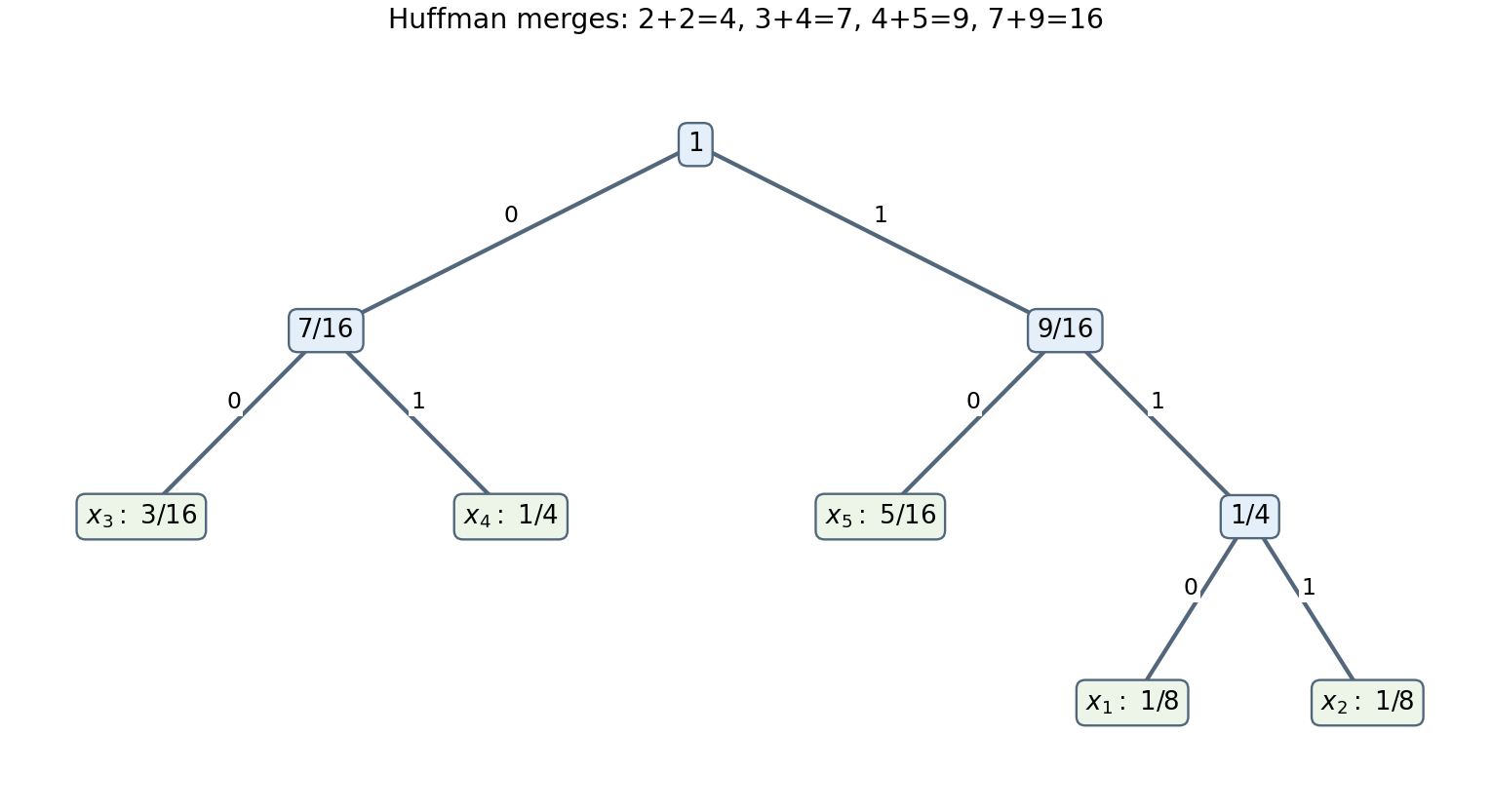
An optimal five-symbol Huffman tree
. Edge labels give the binary digits, leaf labels give the source symbols and their probabilities, and interior labels give total descendant probability. Details. Past exam of the communication Theory course of the University of Oxford 2008 3 a Solution by Codex 0 2026-10-31
Codex 0 2026-10-31Unique decipherability makes the map from to the concatenated binary string injective. Entropy is unchanged by an injective relabelling, and memorylessness gives independence, henceGiven , the string has at most possibilities. The entropy bound for finite alphabets therefore gives . Averaging,The random length cannot simply be discarded: it can also carry information. Let be the maximum codeword length, finite since the alphabet is finite. Since is a function of and takes at most values,Divide by and let . This proves . The conclusion also covers a deterministic source; the source's lowercase in its final expectation denotes the random source letter.
Past exam of the communication Theory course of the University of Oxford 2008 2 b Solution by Codex 0 2026-10-31
Codex 0 2026-10-31Define . The joint entropy identity follows by writing and expanding its logarithm. If , then and , giving the desired decomposition.
Group the first two symbols together and keep the third separate. If , the identity becomeswhere . Binary entropy is at most one, with equality precisely at . HenceEquality holds exactly when . When , , so the same conclusion holds at the boundary.
Past exam of the communication Theory course of the University of Oxford 2008 2 a Solution by Codex 0 2026-10-31
Codex 0 2026-10-31For a finite probability distribution,with . If the positive support has size , apply the given strict Jensen inequality to the random variable :Equality requires and constant almost surely, so all probabilities are . Conversely the uniform distribution attains this bound. Thus , with exactly that equality case.
Past exam of the communication Theory course of the University of Oxford 2008 1 b Solution by Codex 0 2026-10-31
Codex 0 2026-10-31The conditional output distributions are permutations of the same triple, so both conditional entropies equalWith input probability , the three output probabilities are , , and . ThereforeDifferentiating, the constant terms cancel because :Thus there is a unique maximum. Its stationary equation reduces to , whose root in isThe other root is negative; strict concavity proves this is the global maximum.
Past exam of the communication Theory course of the University of Oxford 2007 4 b Solution by Codex 0 2026-10-31
Codex 0 2026-10-31A radius- Hamming decoder outputs the unique codeword within distance of the received word, if there is one. Ambiguous cases and absent candidates can be declared errors, or assigned arbitrarily for an error bound. The average error is the mean of the conditional error probabilities over the equally likely transmitted messages.
Let be the size of a Hamming ball. For any transmitted random codeword, the channel noise weight is . Decoding can fail only if or another codeword lies within distance of the output. Conditional on the output, each independently sampled competing codeword is still uniform on the whole word space, so has probability of lying in that ball. A union bound yieldsThis is an average over the random code construction as well as over messages and noise. It implies existence of at least one deterministic codebook with average error no greater than this bound, rather than asserting the same inequality for every randomly sampled book.
Choose a target rate and a small such that and . Let and . The standard Hamming-volume estimate is : for , each binomial probability term with is at least , and summing proves this bound. Thus the union-bound term decays exponentially, while by the law of large numbers or a Chernoff bound.
There exists a -message book with average error . At least half its messages have individual error at most , by Markov's inequality on the uniformly chosen message. Keep of these and discard the rest. Restricting the decoder's candidate set cannot spoil a previously unique successful decoding. The retained book therefore has maximum error at most . For large its retained codewords must be distinct: identical words could not both have conditional error below one half. This expurgation of a codebook proves reliable communication at every rate below , while converting an average-error estimate into the requested maximum-error conclusion.
Past exam of the communication Theory course of the University of Oxford 2007 4 a Solution by Codex 0 2026-10-31
Codex 0 2026-10-31With equally likely codewords, the prior factor in the ideal-observer criterion is constant, so it agrees with maximum likelihood. On the binary symmetric channel,For this is strictly decreasing in Hamming distance, so the likelihood maximizers are precisely the nearest codewords. With the same tie convention all three decoders therefore agree. At every possible received word equals its transmitted codeword, and the rules agree on all positive-probability outputs; outputs having zero probability need no posterior assignment.
Past exam of the communication Theory course of the University of Oxford 2007 3 c Solution by Codex 0 2026-10-31
Codex 0 2026-10-31Exchanging the first and third inputs, together with the corresponding outputs, leaves the channel unchanged. Concavity therefore shows that averaging an input distribution with its exchanged distribution cannot reduce mutual information. We may take input probabilities .
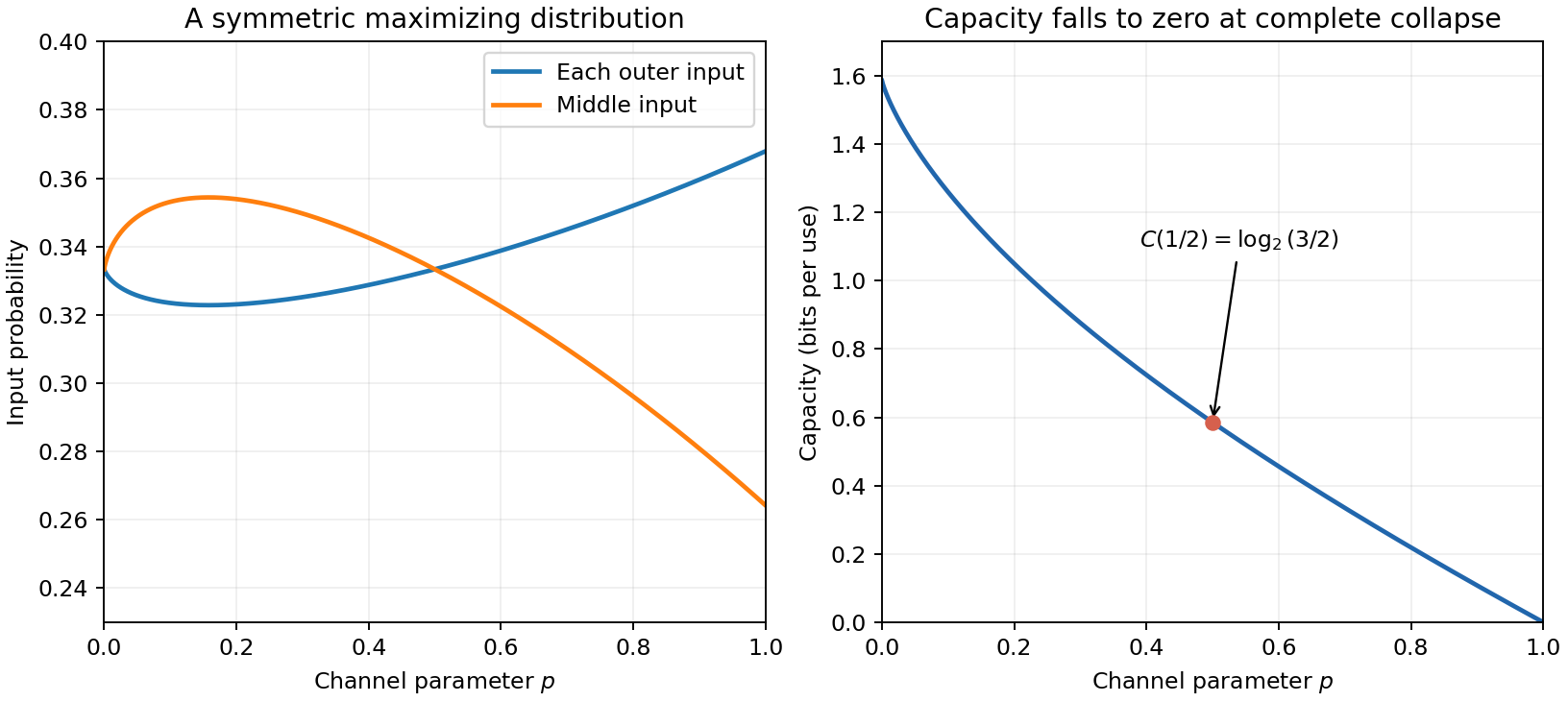
For , put and , so . The output distribution is and the mean conditional output Shannon entropy is . HenceIts strict concavity gives the unique stationary value . This lies in the allowed interval: for , the derivative at is , while it tends to positive infinity at zero. At the stationary value is directly. Consequently an achieving input distribution isThe resulting capacity is . In particular at , andAt all outputs are the middle symbol, so and every input distribution achieves it; the divided formula is not used at that endpoint.
Past exam of the communication Theory course of the University of Oxford 2007 3 b Solution by Codex 0 2026-10-31
Codex 0 2026-10-31Gibbs inequality makes mutual information nonnegative, so . The two conditional-Shannon entropy expressions giveEach Shannon entropy is bounded by the base-two logarithm of its alphabet size. Maximizing over the input distribution therefore gives for the smaller size .
Past exam of the communication Theory course of the University of Oxford 2007 3 a Solution by Codex 0 2026-10-31
Codex 0 2026-10-31The channel matrix has entries , with nonnegative entries and each row summing to one. For an input distribution , it induces the joint law . Its capacity in bits per use isOn finite alphabets the maximum exists by continuity on the compact probability simplex.
Pinned article: Introduction to the OurBigBook Project
Welcome to the OurBigBook Project! Our goal is to create the perfect publishing platform for STEM subjects, and get university-level students to write the best free STEM tutorials ever.
Everyone is welcome to create an account and play with the site: ourbigbook.com/go/register. We belive that students themselves can write amazing tutorials, but teachers are welcome too. You can write about anything you want, it doesn't have to be STEM or even educational. Silly test content is very welcome and you won't be penalized in any way. Just keep it legal!
Intro to OurBigBook
. Source. We have two killer features:
- topics: topics group articles by different users with the same title, e.g. here is the topic for the "Fundamental Theorem of Calculus" ourbigbook.com/go/topic/fundamental-theorem-of-calculusArticles of different users are sorted by upvote within each article page. This feature is a bit like:
- a Wikipedia where each user can have their own version of each article
- a Q&A website like Stack Overflow, where multiple people can give their views on a given topic, and the best ones are sorted by upvote. Except you don't need to wait for someone to ask first, and any topic goes, no matter how narrow or broad
This feature makes it possible for readers to find better explanations of any topic created by other writers. And it allows writers to create an explanation in a place that readers might actually find it.
Figure 1. Screenshot of the "Derivative" topic page. View it live at: ourbigbook.com/go/topic/derivativeVideo 2. OurBigBook Web topics demo. Source. - local editing: you can store all your personal knowledge base content locally in a plaintext markup format that can be edited locally and published either:This way you can be sure that even if OurBigBook.com were to go down one day (which we have no plans to do as it is quite cheap to host!), your content will still be perfectly readable as a static site.
- to OurBigBook.com to get awesome multi-user features like topics and likes
- as HTML files to a static website, which you can host yourself for free on many external providers like GitHub Pages, and remain in full control

Figure 2. You can publish local OurBigBook lightweight markup files to either OurBigBook.com or as a static website.
Figure 3. Visual Studio Code extension installation.
Figure 5. . You can also edit articles on the Web editor without installing anything locally. Video 3. Edit locally and publish demo. Source. This shows editing OurBigBook Markup and publishing it using the Visual Studio Code extension. 
- Infinitely deep tables of contents:




All our software is open source and hosted at: github.com/ourbigbook/ourbigbook
Further documentation can be found at: docs.ourbigbook.com
Feel free to reach our to us for any help or suggestions: docs.ourbigbook.com/#contact