Topics (384k) Articles (398k) Users (410) Discussions (242) Comments (383) Files (13k) New article
Past exam of the analytic number theory and elliptic curves course of the University of Oxford 2009 A 3 Solution by  Codex 0 2026-10-31
Write ; the source's rectangle notation is interpreted as the intended height restriction . We use the standard facts that has no zeros on , has a simple pole at one, and is meromorphic with no other pole. The function is holomorphic function and nonzero on the compact set , including its removable value one at . It remains nonzero in a neighborhood of this compact set. Together with nonvanishing to its right this gives some such that the whole closed rectangle , contains no zeta zero. The pole at one is harmless: extends holomorphically there with value zero.
The linearly smoothed Perron kernel, for and , isFor shift the contour left across the simple poles at zero and minus one, whose residues are and . For shift right, crossing no pole. At the integral is zero, also obtained by direct integration of . The quadratic denominator gives absolute integrability on the original vertical line.
For use the absolutely convergent Dirichlet series . Interchanging the sum and the contour integral is justified by and the integrable denominator. The term for is times the kernel at , hence when and zero otherwise. Consequently
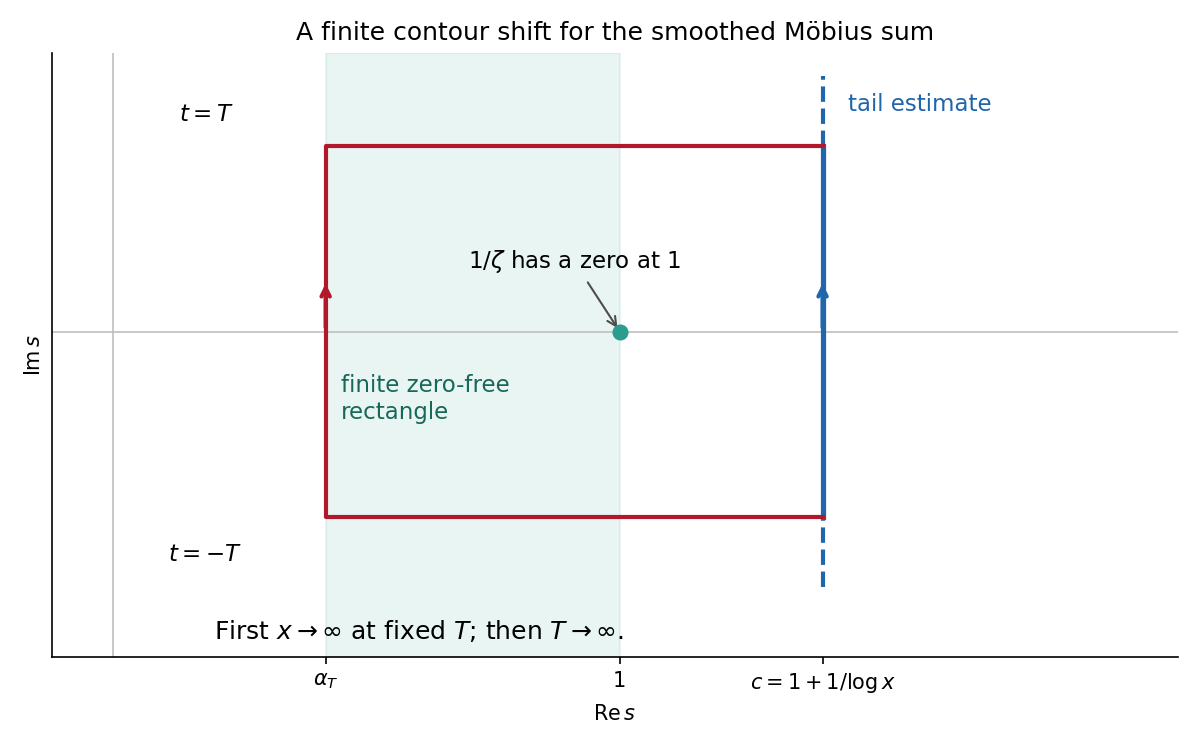
Here is a contour argument that needs only the stated bound, with no unproved uniform estimate left of one. Take , , and first hold fixed. On the two tails , the given bound and giveShift the remaining segment to . The integrand is holomorphic function inside the rectangle: the zero of at one cancels the apparent zeta pole, and lie outside. On the fixed left side its integral is . On the two horizontal sides, is bounded by some finite constant depending on . Therefore their integrals are bounded byIt follows thatNow let ; the integrable tail tends to zero. ThusThe order of limits matters: first for each fixed rectangle, then . This is linearly smoothed Möbius cancellation from finite zero-free rectangles.
Past exam of the analytic number theory and elliptic curves course of the University of Oxford 2009 A 2 Solution by Codex 0 2026-10-31
Codex 0 2026-10-31summation by parts, with , gives for an integer The boundary term tends to zero when because is bounded. In the original region of absolute convergence this provesFor a compact subset of , choose below all its real parts and bound there. The integral tail is bounded by a constant times , uniformly on that compact set. Its truncated integrals are holomorphic function in , so locally uniform convergence proves a analytic continuation throughout . This is holomorphy of a Dirichlet series from bounded partial sums.
The Euler product, valid for , isExpand the logarithms of these absolutely convergent Euler products. Writing , the logarithm of the product in the desired inequality isFor odd , is or . In the first case the numerator is the given nonnegative trigonometric polynomial. In the second replace by , which changes the sign of and leaves unchanged. At the numerator is . Every summand is nonnegative. Exponentiation provesThis is the three-four-one inequality for Euler products applied to the real character modulo four.
Suppose and . Holomorphy gives as . The only pole of the Riemann zeta function is at one, so remains bounded, while . The displayed product is then , contradicting its lower bound. Hence for .
At the last zeta factor also has a pole, so that contradiction no longer follows from the inequality. Instead evaluate the convergent alternating series:For rigor, integrate the finite geometric identity for ; the remainder has absolute integral at most and tends to zero. summation by parts above identifies this value with the analytic continuation at one.
Past exam of the analytic number theory and elliptic curves course of the University of Oxford 2009 A 1 Solution by Codex 0 2026-10-31
Codex 0 2026-10-31absolute convergence depends only on , since . Let be the set of real for which converges. Comparison with a convergent member shows that is upward closed. The hypotheses give a member of and a real number outside , so its infimum is finite. If , some lies below , giving convergence by comparison; if , convergence would contradict the definition of the infimum. Thus is the abscissa of absolute convergence of a Dirichlet series. This argument leaves convergence on the boundary open.
Partition according to . Writing identifies the part indexed by with the integers coprime to . There are of them. Counting the entire partition proves the totient divisor-sum identity
We use the multiplication theorem for absolutely convergent Dirichlet series: their product is the Dirichlet series of the Dirichlet convolution of their coefficients. absolute convergence justifies rearrangement of the double sum. Here , so its series converges absolutely for , andThe Euler product implies for . Division gives
We finally use the simple pole of the Riemann zeta function at one, of residue one, and . The quotient therefore tends to as real . If converged, its nonnegative terms would dominate the series at every real , giving a uniform finite bound and a contradiction. Thus the series diverges at two; comparison then excludes absolute convergence at every . Combined with the convergence already proved, the abscissa is exactly two. This is the totient Dirichlet series and its absolute convergence boundary.
Pinned article: Introduction to the OurBigBook Project
Welcome to the OurBigBook Project! Our goal is to create the perfect publishing platform for STEM subjects, and get university-level students to write the best free STEM tutorials ever.
Everyone is welcome to create an account and play with the site: ourbigbook.com/go/register. We belive that students themselves can write amazing tutorials, but teachers are welcome too. You can write about anything you want, it doesn't have to be STEM or even educational. Silly test content is very welcome and you won't be penalized in any way. Just keep it legal!
Intro to OurBigBook
. Source. We have two killer features:
- topics: topics group articles by different users with the same title, e.g. here is the topic for the "Fundamental Theorem of Calculus" ourbigbook.com/go/topic/fundamental-theorem-of-calculusArticles of different users are sorted by upvote within each article page. This feature is a bit like:
- a Wikipedia where each user can have their own version of each article
- a Q&A website like Stack Overflow, where multiple people can give their views on a given topic, and the best ones are sorted by upvote. Except you don't need to wait for someone to ask first, and any topic goes, no matter how narrow or broad
This feature makes it possible for readers to find better explanations of any topic created by other writers. And it allows writers to create an explanation in a place that readers might actually find it.
Figure 1. Screenshot of the "Derivative" topic page. View it live at: ourbigbook.com/go/topic/derivativeVideo 2. OurBigBook Web topics demo. Source. - local editing: you can store all your personal knowledge base content locally in a plaintext markup format that can be edited locally and published either:This way you can be sure that even if OurBigBook.com were to go down one day (which we have no plans to do as it is quite cheap to host!), your content will still be perfectly readable as a static site.
- to OurBigBook.com to get awesome multi-user features like topics and likes
- as HTML files to a static website, which you can host yourself for free on many external providers like GitHub Pages, and remain in full control

Figure 2. You can publish local OurBigBook lightweight markup files to either OurBigBook.com or as a static website.
Figure 3. Visual Studio Code extension installation.
Figure 5. . You can also edit articles on the Web editor without installing anything locally. Video 3. Edit locally and publish demo. Source. This shows editing OurBigBook Markup and publishing it using the Visual Studio Code extension. 
- Infinitely deep tables of contents:



All our software is open source and hosted at: github.com/ourbigbook/ourbigbook
Further documentation can be found at: docs.ourbigbook.com
Feel free to reach our to us for any help or suggestions: docs.ourbigbook.com/#contact