Topics (384k) Articles (398k) Users (410) Discussions (242) Comments (383) Files (13k) New article

A set of database attributes that determines every database attribute of a database relation under its database integrity constraints.
A foreign key is a database integrity constraint requiring designated database attributes to match a referenced identifier in a database relation. The referenced database relation may be the same one: a self-reference can represent each employee's manager. The identifier being referenced must have the required uniqueness, but the referencing database attributes need not be unique; several employees can have the same manager.[ref]
Constraints in the PostgreSQL documentation. version 18, section 5.5.5, foreign keys and self-referential tree example
For a simple example, let
Instrument(id) contain identifiers . A measurement carrying instrument_id=4 has a matching scientific instrument; one carrying instrument_id=7 violates the foreign key. Deleting scientific instrument four while measurements still refer to it requires a stated policy: reject the deletion, cascade a suitable deletion, or apply another permitted referential action.[ref]SQL NULL and compound foreign keys require an explicit matching policy. A nullable simple reference can represent no parent, whereas
NOT NULL can require a reference. A foreign key enforces reference existence; it does not by itself prove that a self-referencing structure has no directed cycles.A database integrity constraint saying that any two database tuples agreeing on database attributes also agree on database attributes .
For database tuples agreeing on , requires the combinations obtained by swapping their values on and on the remaining database attributes to occur too. A functional dependency implies the corresponding multivalued dependency; complementation exchanges with the remaining database attributes. A multivalued dependency is trivial if or is the full relational schema.
Database normalization organizes relational schemas using their dependencies to reduce redundant facts and update anomalies. If a table stores
(student,course,instructor,office) and each instructor has one office, repeating the office in every enrolment creates multiple places to update. Splitting instructor-office facts into a separate relation can remove that redundancy. A decomposition must be checked for lossless join and, when needed, dependency preservation; merely creating more tables is not a correctness argument. Different normal forms impose different conditions on functional dependencies and other dependency types.Retains the database tuples satisfying a condition.
Combines database tuples satisfying a matching condition. A natural join uses equality of all shared database attribute names.
For two database relations with compatible database attributes, retains the database tuples in the first and absent from the second.
Relational division expresses an all-required-matches query. Let be a database relation, the required values and an explicit candidate database relation. The desired result isIt can be constructed using Cartesian product, relational projection and relational difference:The inner relational difference contains missing required pairs. Its relational projection identifies failing candidates; removing them from proves the formula.
For example, can record scientific instrument/test pairs and the required tests. An scientific instrument with both pairs passes; one with only the heat pair does not. This is a universal quantifier requirement, unlike an ordinary relational join asking for some match.
When is empty, vacuous truth gives . Choosing is conventional but cannot recover candidates absent from ; use an independently stored scientific instrument database relation if those candidates must be included. Stating the candidate universe makes this edge case unambiguous.
Consider independent rejection sampling trials with proposal density , accepted-value density , acceptance probability and rejection probability . Splitting the proposal law by its accept/reject outcome gives , where is the rejected-proposal distribution.
If an algorithm permits trials, returns the first accepted value when one occurs, and otherwise returns the final rejected proposal, its output density is the displayed mixture. The event of failures has probability and gives the conditional law ; every successful stopping trial gives law . Hence the forced return introduces bias unless , and its contribution decays geometrically with the cap. Conditional on success before any specified trial, the output still has law , since accepted value and successful-trial index are independent.
Stopping after a fixed number of rejection sampling proposals preserves the target law of accepted labels, conditional on the number accepted. Stopping instead after a fixed amount of elapsed computing time can change the finite-sample law if processing costs depend on the proposed state. The deadline may censor precisely the expensive states.
For an exact counterexample, let both target and proposal be uniform on two states, so every proposal is accepted. Let processing cost be one time unit for the first state and two for the second. Stop between one and two units and retain only finished proposals. Conditional on obtaining an output, the first state is the only possible value, despite its target probability being one half. This proves that a runtime cutoff need not be an unbiased stopping rule for the realized finite output. It does not imply asymptotic bias of the indefinitely growing completed sequence; it identifies a finite-horizon censoring effect.
For cyclically ordered planar vertices, let , with indices modulo . They describe a convex regular polygon exactly when and there is a single choice of sign for which every successive edge vector is obtained by a rotation through in that orientation. Necessity follows from equal sides and equal exterior angles. Conversely, the edge vectors have the form . Their sum is zero because the corresponding geometric series runs through the distinct roots of unity. Summing its partial series shows that the vertices are a translated and scaled copy of those roots, so they form a convex regular polygon. A larger turn such as can instead trace a star, which is why merely checking a constant turning angle is insufficient.
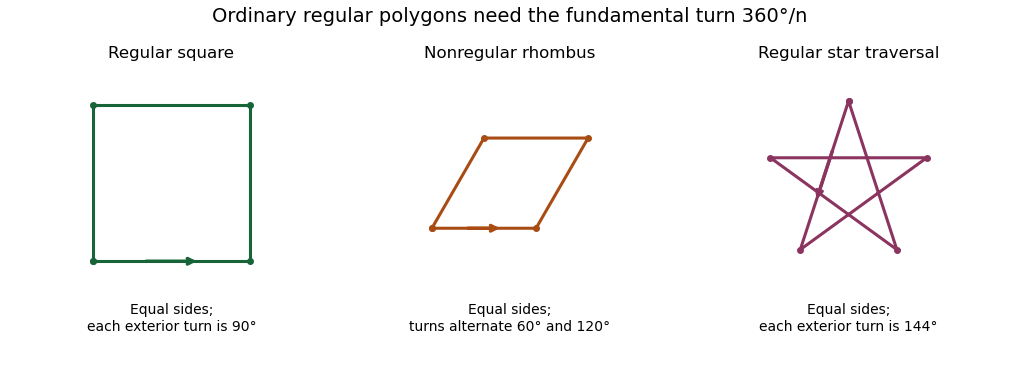
Equal sides, equal turns and the fundamental turn distinguish an ordinary regular polygon
. Original constructions: a square satisfies the edge-rotation criterion; a nonsquare rhombus has unequal turns; a five-point star uses the wrong turn, instead of . Arrows indicate traversal direction. Details.A regular heptagon is a regular polygon with seven sides. Its unit-circle vertices have complex coordinates for . It cannot be constructed from a unit segment by a straightedge and compass construction: the first coordinate has degree three over , since the seventh cyclotomic field has degree six and degree two over its real subfield. Every finite constructible coordinate extension has power-of-two degree, which cannot contain a degree-three subextension by the tower law.
For and , expand all three quantities in powers of . The order- problem has and , with . In particular, Taylor series boundary coefficients are generally nonzero even when the differential operator depends linearly on the parameter. If the homogeneous realization of is invertible and boundary data admit smooth lifts, the same inverse solves each successive inhomogeneous boundary value problem. Induction establishes unique coefficients at every order. This formal conclusion does not alone assert convergence of the full power series; convergence needs additional bounds on the inverse and the perturbation.
For a fixed symbol and a regular language , inserting exactly one at an arbitrary position preserves regularity. Make two copies of a recognizing finite-state automaton, one before and one after the insertion. Preserve its ordinary automaton transitions in each copy, and add a transition consuming from each before-state to its matching after-state. Accept only in the after-copy. Every accepting run makes exactly one of the additional moves.
Regular languages are closed under finite intersection, but not countably infinite intersection. Indeed, for any formal language over a finite alphabet, let contain every word of length at least , together with the members of of length less than . Each is a regular language, since its exceptional short part is a finite language, and . Thus every formal language, including one that is not a regular language, can arise in this way.
For a nonzero real normal vector , orthogonal reflection in has the displayed affine map. It is with and . In homogeneous coordinates its matrix isEvery point on the hyperplane is fixed, and the signed normal displacement changes sign. Choosing any point on the hyperplane gives , so translating by , applying the reflection matrix and translating back gives the same transformation.
Pinned article: Introduction to the OurBigBook Project
Welcome to the OurBigBook Project! Our goal is to create the perfect publishing platform for STEM subjects, and get university-level students to write the best free STEM tutorials ever.
Everyone is welcome to create an account and play with the site: ourbigbook.com/go/register. We belive that students themselves can write amazing tutorials, but teachers are welcome too. You can write about anything you want, it doesn't have to be STEM or even educational. Silly test content is very welcome and you won't be penalized in any way. Just keep it legal!
Intro to OurBigBook
. Source. We have two killer features:
- topics: topics group articles by different users with the same title, e.g. here is the topic for the "Fundamental Theorem of Calculus" ourbigbook.com/go/topic/fundamental-theorem-of-calculusArticles of different users are sorted by upvote within each article page. This feature is a bit like:
- a Wikipedia where each user can have their own version of each article
- a Q&A website like Stack Overflow, where multiple people can give their views on a given topic, and the best ones are sorted by upvote. Except you don't need to wait for someone to ask first, and any topic goes, no matter how narrow or broad
This feature makes it possible for readers to find better explanations of any topic created by other writers. And it allows writers to create an explanation in a place that readers might actually find it.
Figure 1. Screenshot of the "Derivative" topic page. View it live at: ourbigbook.com/go/topic/derivativeVideo 2. OurBigBook Web topics demo. Source. - local editing: you can store all your personal knowledge base content locally in a plaintext markup format that can be edited locally and published either:This way you can be sure that even if OurBigBook.com were to go down one day (which we have no plans to do as it is quite cheap to host!), your content will still be perfectly readable as a static site.
- to OurBigBook.com to get awesome multi-user features like topics and likes
- as HTML files to a static website, which you can host yourself for free on many external providers like GitHub Pages, and remain in full control

Figure 2. You can publish local OurBigBook lightweight markup files to either OurBigBook.com or as a static website.
Figure 3. Visual Studio Code extension installation.
Figure 5. . You can also edit articles on the Web editor without installing anything locally. Video 3. Edit locally and publish demo. Source. This shows editing OurBigBook Markup and publishing it using the Visual Studio Code extension. 
- Infinitely deep tables of contents:



All our software is open source and hosted at: github.com/ourbigbook/ourbigbook
Further documentation can be found at: docs.ourbigbook.com
Feel free to reach our to us for any help or suggestions: docs.ourbigbook.com/#contact