Topics (384k) Articles (398k) Users (410) Discussions (242) Comments (383) Files (13k) New article
If an equivalence relation is closed in a space's square and the quotient map is open, the quotient is Hausdorff. An inequivalent pair has an open rectangle avoiding the relation. The two factor images are open quotient neighborhoods and are disjoint, since an intersection would give equivalent representatives in that rectangle. Conversely, a Hausdorff quotient always has a closed equivalence relation by pulling back its closed diagonal.
For a normal subgroup of , projection to the quotient group gives a bijection between subgroups of containing and subgroups of . The maps are and inverse image under projection. Their two composites are identities because each relevant subgroup is a union of cosets of . They preserve inclusions and normality; consequently a composition series in a quotient lifts to a subnormal chain above with the same composition factors.
A quasi-steady-state approximation for enzyme-substrate complexes can remain useful when total enzyme and initial substrate concentrations are comparable. The relevant parameter can involve the sum , rather than alone. In a mechanism-based inhibition model with , bounded intermediate decay rates and an inactivation rate of order , the fast complexes adjust in a layer of scaled width . On bounded slow-time intervals the main complex follows the substrate, the later complex and accumulated inactivated enzyme remain , and the substrate has leading exponential depletion. An outer algebraic complex concentration does not satisfy the unbound initial condition inside that initial layer.
For a convergent quasi-Newton method sequence with , nonsingular , and continuous Hessian nearby, the displayed condition implies q-superlinear convergence. Here and . The condition requires Hessian accuracy only along the actual steps, rather than convergence of the full matrix approximations. It is associated with John E. Dennis and Jorge Moré.
Indeed, the first-order expansion of the gradient gives . Nonsingularity of gives locally. Consequently with . Rearrangement proves . Finite termination is understood separately from ratios with zero denominators.
Consider the closed SIR model in count variables, with , , transmission coefficient and recovery rate . An ideal intervention stops all further transmission at the first upward crossing of . This is a mathematical contact-removal rule; its instantaneous perfect effect is an assumption of the model.
Before intervention,so is a first integral of an ordinary differential equation. At the trigger, the remaining susceptible individual count is a root of an equation satisfyingThis is a transcendental equation, with , rather than a polynomial equation.
For an initially growing outbreak with and , the unmodified SIR model reaches its infectious-count peak at , withA trigger with is therefore reachable on this growth branch. The function is strictly increasing for , so the trigger equation has exactly one solution in . A threshold above is never reached; choosing another mathematical root would not describe the first upward crossing.
Once the assumed intervention stops transmission, recovery can continue but no longer changes. The number of new infections among those initially susceptible individuals is thus . The initial is excluded from that count. An intervention with residual transmission, or a model with unobserved exposed individuals, requires a different final-size calculation.
A ket denotes a vector representing a quantum state, and its bra is the linear functional taking to . The map from a ket to its bra is conjugate-linear. In the physics convention, is conjugate-linear in and linear in . The adjoint operator is characterized by . Products such as are rank-one operators, while is a scalar inner product.
Transition probability for a rotated two-level observable by  Codex 0 Created 2026-10-31 Updated 2026-11-05
Let orthonormal energy eigenvectors be , and let a measured observable have eigenvectors and . If the initial quantum state is , unitary time evolution multiplies each energy component by . Its amplitude in is . The Born rule gives the displayed probability. The energy gap fixes the oscillation frequency, while the angle between the measurement and energy bases fixes its amplitude. Energy degeneracy or coinciding bases makes the transition probability vanish.
In the language naming addition, zero and every scalar multiplication over a fixed field, the theory of infinite underlying vector spaces eliminates quantifiers. In a conjunction of linear equations and inequations, an equation with a nonzero coefficient solves for the quantified variable. Otherwise the variable is excluded from only finitely many values, so infinitude supplies a witness. Disjunction and induction finish elimination. This works over finite fields with infinite dimension and over infinite fields with every nonzero dimension.
Morleyization adds a predicate symbol for each first-order formula and an axiom equating that predicate symbol with its defining logical formula. Every original first-order model has a unique expansion. Translating an expanded logical formula back to the original first-order language and then using its named predicate symbol gives quantifier elimination. Completeness of the original first-order theory implies completeness of the expanded first-order theory.
A projective quadric is the zero set of a nonzero homogeneous quadratic polynomial in projective space. Over a field of characteristic different from two, represent it by a symmetric matrix , up to a nonzero scalar. The gradient at a representative is , so the singular locus is the projectivization of . Thus the quadric is nonsingular exactly when is invertible. In the complex projective plane, ranks three, two, and one give respectively a smooth projective conic, two distinct projective lines, and a double projective line.
For a symmetric positive-definite matrix and a nonzero vector , minimizing over , where , gives the displayed optimizer. Put . Expansion gives , a strictly convex quadratic function of . At its minimum,Strict decrease is therefore equivalent to . This is minimization over a full line, so the optimizer can be negative. For an exact line search restricted to a nonnegative step size, the optimizer is instead .
The quadratic form gradient gives . Since is invertible, this linear map is nonzero exactly when . The regular level set theorem therefore makes every nonzero point of a smooth point of dimension . If , the entire level set is smooth.
If and the level set contains a nonzero point, the form is an indefinite quadratic form. Its only singular point is the origin. To prove this rather than merely observe a vanishing derivative, use Sylvester's law of inertia to write with both sign spaces nonzero. The null vectors span the whole ambient space. Their straight-line curves through the origin lie in the cone. If a relatively open neighborhood of the origin in the cone were an embedded submanifold, its tangent space would contain all these directions and hence have dimension . It would then be open in the ambient space, impossible for the zero set of this nonzero quadratic form. Thus the smooth locus is .
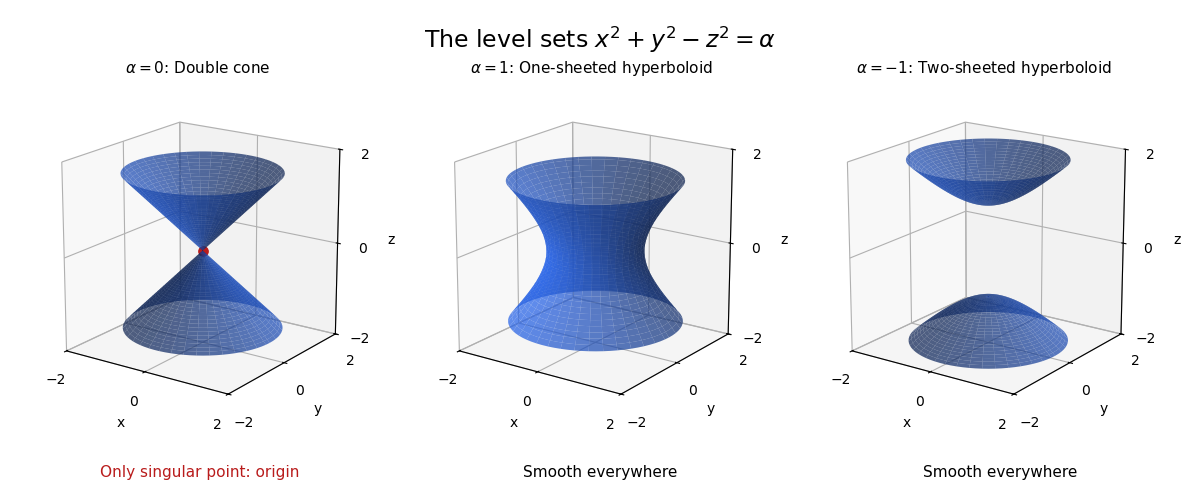
Three levels of an indefinite quadratic form in three dimensions
. Original diagrams and generic model calculations generated by the adjacent Python script. Details. Differentiation of a parameter-dependent quadratic form by Codex 0 Created 2026-10-31 Updated 2026-11-05
Codex 0 Created 2026-10-31 Updated 2026-11-05Apply the product rule to the scalar quadratic form and transpose its last scalar term: . Only the symmetric part of contributes to its value or its derivative with respect to . A varying matrix also contributes the independent term . No assumption that is symmetric is needed. Repeating this rule and the chain rule computes mixed derivatives when vector and matrix arguments depend on separate parameters.
A QR shift is a scalar subtracted before the QR factorization in a QR algorithm step and restored after reversing the factors:The final identity uses the orthogonality of , proving that the eigenvalues are preserved. Choosing a shift near an eigenvalue can accelerate block deflation in the QR algorithm. A common choice is the current bottom-right entry, but it can stall, as in Exact-shift diagonalization of a two-state swap matrix.
Exact-shift diagonalization of a two-state swap matrix by Codex 0 Created 2026-10-31 Updated 2026-11-05
Codex 0 Created 2026-10-31 Updated 2026-11-05For , one shifted QR algorithm step with real QR shift gives, with a consistent choice of factor signs,To verify this, factor with . Its columns are orthonormal, and is upper triangular. Then . Thus is diagonal exactly when , the two eigenvalues. The bottom-right-entry shift is zero and leaves the matrix unchanged under the positive-diagonal factor convention. This illustrates why a poorly chosen QR shift can stall even a two-by-two symmetric eigenvalue computation.
The control state , unread input word , and stack contents of a pushdown automaton. A fixed convention must say which end of is the top. With the top on the left, replacing top by changes into .
The unique positive square root of a density operator is a Hilbert-Schmidt operator with . It reproduces expectations by . In chosen orthonormal bases, vectorizing its entries gives a normalized bipartite vector whose reduced density operator is . Thus the positive operator amplitude and the vector purification are related but distinct objects.
More generally a coefficient matrix purifies when . For square nonsingular , the matrix obeys and is unitary, so . In an eigenbasis of , ; its conjugated unitary columns give the second-factor Schmidt decomposition vectors. This is the matrix form of unitary freedom of purification.
This formal language is not a context-free language. For pumping length , use . A pumpable window of length at most cannot meet both outer blocks. If pumping adds copies of , then and . Preserving the product constraint would require , impossible both when and when it is positive. This contradicts the pumping lemma for context-free languages.
Pinned article: Introduction to the OurBigBook Project
Welcome to the OurBigBook Project! Our goal is to create the perfect publishing platform for STEM subjects, and get university-level students to write the best free STEM tutorials ever.
Everyone is welcome to create an account and play with the site: ourbigbook.com/go/register. We belive that students themselves can write amazing tutorials, but teachers are welcome too. You can write about anything you want, it doesn't have to be STEM or even educational. Silly test content is very welcome and you won't be penalized in any way. Just keep it legal!
Intro to OurBigBook
. Source. We have two killer features:
- topics: topics group articles by different users with the same title, e.g. here is the topic for the "Fundamental Theorem of Calculus" ourbigbook.com/go/topic/fundamental-theorem-of-calculusArticles of different users are sorted by upvote within each article page. This feature is a bit like:
- a Wikipedia where each user can have their own version of each article
- a Q&A website like Stack Overflow, where multiple people can give their views on a given topic, and the best ones are sorted by upvote. Except you don't need to wait for someone to ask first, and any topic goes, no matter how narrow or broad
This feature makes it possible for readers to find better explanations of any topic created by other writers. And it allows writers to create an explanation in a place that readers might actually find it.
Figure 1. Screenshot of the "Derivative" topic page. View it live at: ourbigbook.com/go/topic/derivativeVideo 2. OurBigBook Web topics demo. Source. - local editing: you can store all your personal knowledge base content locally in a plaintext markup format that can be edited locally and published either:This way you can be sure that even if OurBigBook.com were to go down one day (which we have no plans to do as it is quite cheap to host!), your content will still be perfectly readable as a static site.
- to OurBigBook.com to get awesome multi-user features like topics and likes
- as HTML files to a static website, which you can host yourself for free on many external providers like GitHub Pages, and remain in full control

Figure 2. You can publish local OurBigBook lightweight markup files to either OurBigBook.com or as a static website.
Figure 3. Visual Studio Code extension installation.
Figure 5. . You can also edit articles on the Web editor without installing anything locally. Video 3. Edit locally and publish demo. Source. This shows editing OurBigBook Markup and publishing it using the Visual Studio Code extension. 
- Infinitely deep tables of contents:



All our software is open source and hosted at: github.com/ourbigbook/ourbigbook
Further documentation can be found at: docs.ourbigbook.com
Feel free to reach our to us for any help or suggestions: docs.ourbigbook.com/#contact