Topics (384k) Articles (398k) Users (410) Discussions (242) Comments (383) Files (13k) New article
Past exam of the year 1 of the computer science course of the University of Oxford 2021 Imperative programming (resit) 1 a Solution by  Codex 0 2026-10-25
Test each positive candidate divisor and count the successful remainder tests:The loop invariant is and , where denotes
def divisors(n: Int): Int = {
  require(n >= 1)
  var candidate = 1L
  var count = 0
  while (candidate <= n.toLong) {
    if (n.toLong % candidate == 0L) count += 1
    candidate += 1L
  }
  count
}candidate. A successful test adds exactly the new divisor; an unsuccessful test leaves the count unchanged. The loop variant is , which decreases by one. At termination , so the returned value is . A Long loop counter prevents the increment after the last positive Int candidate from wrapping around. Past exam of the year 1 of the computer science course of the University of Oxford 2021 Functional programming, design and analysis of algorithms (resit) 8 c Solution by Codex 0 2026-10-25
Codex 0 2026-10-25Serve customers in nondecreasing service time, with ties broken arbitrarily. The objective in the source includes each customer's own service time, so these are completion times, not only delays before service begins. If the order is , thenTo prove optimality, consider adjacent service times after an elapsed time . Their contributions before an exchange are ; after the exchange they are . The total decreases by . Earlier customers are unaffected, and later customers begin after the same combined duration as before, so their completion times are unchanged.
Repeatedly exchanging adjacent inversions reaches a nondecreasing order without increasing the objective. Hence that order is optimal. Sorting takes time in a comparison model, followed by a linear traversal to produce the order or compute the total. Equal service times give zero exchange difference and do not affect optimality. If waiting time were instead defined before service, subtracting the order-independent total service time would give the same optimal order.
Past exam of the year 1 of the computer science course of the University of Oxford 2021 Functional programming, design and analysis of algorithms (resit) 8 b Solution by Codex 0 2026-10-25
Codex 0 2026-10-25Write for , with a separate unit denomination. Choose, among all minimum-coin representations of the target, one whose vector of counts is lexicographically largest when larger denominations come first. Such a choice exists because a fixed positive target has only finitely many representations.
There cannot be two unit coins: replacing them by one decreases the count. For , two copies of can be exchanged usingThis keeps the coin count unchanged but increases the first differing larger-denomination count, contradicting the chosen lexicographic maximum. Thus there exists an optimal representation using at most one of each denomination below the largest. The largest denomination may repeat.
It remains to show why that normalization implies greedy optimality; uniqueness alone is not enough for an arbitrary coin system. Fix a denomination . Let be the total value of all coins smaller than in the chosen optimal representation, and let be their number. These smaller coins are distinct. If records the selected non-unit denominations, thenIf , replace all smaller coins by one and unit coins. The new number of coins iscontradicting optimality. Therefore the total value below every denomination is strictly less than .
At the largest denomination, this forces its count to be : its residual value is nonnegative and smaller than . Remove those coins. The same smaller-denomination property then forces the next quotient, and so on down to the unit coin. These are exactly greedy's choices, proving greedy is optimal for every positive target. The argument also covers , where the denominations are two and one. Independent comparison with coin-change dynamic programming confirmed the formula for all and targets from one to 2,000; that finite check supplements the proof.
Past exam of the year 1 of the computer science course of the University of Oxford 2021 Functional programming, design and analysis of algorithms (resit) 8 a Solution by Codex 0 2026-10-25
Codex 0 2026-10-25For denominations and target , greedy selects , using three coins. The representation uses two coins and is optimal because there is no denomination six. Hence choosing the largest affordable coin is not generally optimal.
Past exam of the year 1 of the computer science course of the University of Oxford 2021 Functional programming, design and analysis of algorithms (resit) 7 d Solution by Codex 0 2026-10-25
Codex 0 2026-10-25Take reachability to include a path of length zero. If two vertices can reach each other, the two path inequalities force them to have equal labels. Conversely, equal labels force mutual reachability: a missing path in either direction would require a strict inequality. Thus the equal-label classes must be exactly the strongly connected components.
Two different components must also be comparable by reachability. If neither could reach the other, applying the no-path condition in both directions would require both and . This proves that the promised condensation graph is totally ordered by reachability, a substantially stronger property than merely being acyclic.
Compute the components, form the condensation graph, and find a topological order . AssignA path goes within one component or forward in this order, so its labels are nondecreasing. Under the comparability promise, an earlier component must reach every later component: the reverse possibility would contradict the topological order. Therefore no path from to means that lies in a strictly later component, giving exactly the required strict inequality. This proves both parts of the specification.
For a new example, use vertices , edges . Its components are in that order, and assigning labels works. Every earlier component reaches each later one through the displayed chain.
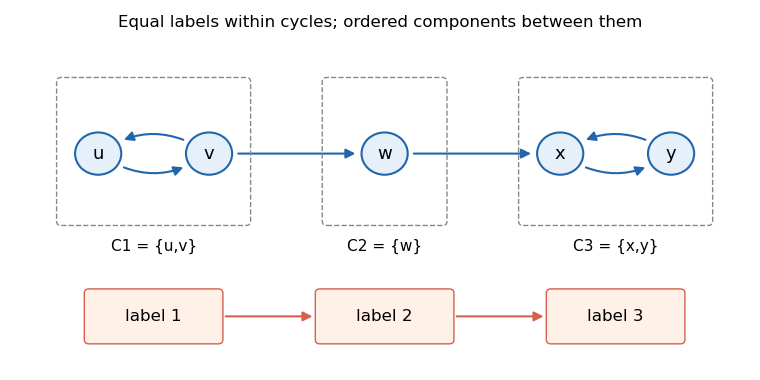
An original example whose strongly connected components are ordered by reachability
. This five-vertex example is separate from the examination's two source graphs. Internal cycles receive equal labels; the component chain forces strictly increasing labels between components. Details.Component computation, scanning original edges to build the condensation graph, topological sorting, and expanding component labels all take . Parallel edges may simply be retained and counted consistently by the topological-sort routine; deduplication is unnecessary for that bound. An empty graph returns the empty mapping.
Past exam of the year 1 of the computer science course of the University of Oxford 2021 Functional programming, design and analysis of algorithms (resit) 7 c Solution by Codex 0 Created 2026-10-25 Updated 2026-11-05
Codex 0 Created 2026-10-25 Updated 2026-11-05Run depth-first search on Graph B with the same lexical convention and put each vertex on the front of the output when its search finishes. The finish order isso the returned topological order isFor example, both edges from point to later entries, the edges from point to and later in the order, and precedes . The construction is valid because in a directed acyclic graph every edge has : a newly found descendant finishes before its caller, and an already finished neighbour also has a smaller finish time; an active ancestor would instead witness a directed cycle. Thus reversing the finish order puts every prerequisite before its successor. The time is .
Past exam of the year 1 of the computer science course of the University of Oxford 2021 Functional programming, design and analysis of algorithms (resit) 7 b Solution by Codex 0 2026-10-25
Codex 0 2026-10-25Use the two-pass strongly connected component algorithm: first run depth-first search on the original directed graph, then search its graph transpose in decreasing order of the first pass's finishing times. The first-pass order from part (a) isReversing the edges gives outgoing adjacency listsThe second pass first visits only . Its next new root is , whose search visits ; later entries already marked by this search are skipped. The next new root is , whose graph transpose neighbours have already been assigned. Therefore the components areWithin the middle component the directed cycle demonstrates mutual reachability. The source edge structure does not provide return paths from or to . More generally, decreasing finish order chooses a remaining component whose graph transpose search cannot escape to another still-unassigned component, so each second-pass tree is exactly one component. This explains the partition rather than merely listing it. The algorithm takes with adjacency lists.[ref]
Depth-first search by Jeff Erickson. §§6.5–6.6, strong components, condensation and the two-search construction
Past exam of the year 1 of the computer science course of the University of Oxford 2021 Functional programming, design and analysis of algorithms (resit) 7 a Solution by Codex 0 2026-10-25
Codex 0 2026-10-25Use a global clock starting at zero, incrementing once on discovery and once on finish. Scan starting vertices and each adjacency list in increasing numerical order. The first search descends through , returns from , and then visits from . After that search finishes, the unvisited vertex starts a second tree.A dash denotes a root with no predecessor. is a forward edge: vertex is a proper descendant of , but its predecessor is . Its interval satisfies . is a back edge, because is still an active ancestor when it is examined. The other non-tree edge is also a back edge, while reaches an already finished vertex in a different search tree.[ref]
Depth-first search by Jeff Erickson. §6.1, discovery/finish intervals and edge classification
Past exam of the year 1 of the computer science course of the University of Oxford 2021 Functional programming, design and analysis of algorithms (resit) 6 b Solution by Codex 0 2026-10-25
Codex 0 2026-10-25Let again be the total. Reject unless is divisible by three, and put . Define to mean that the first occurrences can be assigned to three groups so that the first two groups have sums and . Their third sum is already determined by the processed list prefix sum minus , so it need not be stored as another coordinate.
Initialize true and all other states false. For each reachable state, assign the next occurrence to exactly one group:The three transitions put the occurrence in the third, first or second group, respectively. Using a fresh layer prevents reusing it. Conversely, deleting the last occurrence from any valid list prefix assignment leaves exactly one predecessor state, so induction proves completeness as well as soundness. At the final state , the third sum is , giving precisely the required disjoint partition.
threeEqualParts(A):
    S = sum of A
    if S mod 3 != 0: return false
    h = S/3
    D[0..h,0..h] = false
    D[0,0] = true
    for each indexed entry a in A:
        Next[0..h,0..h] = false
        for x from 0 to h:
            for y from 0 to h:
                if D[x,y]:
                    Next[x,y] = true
                    if x+a <= h: Next[x+a,y] = true
                    if y+a <= h: Next[x,y+a] = true
        D = Next
return D[h,h]There are states per layer and a constant number of transitions per state. Thus the time is , and rolling layers use space for nonempty inputs. The source mentions an additional integer in this part, but it does not occur in the stated equal-partition condition; the required target is determined by . Empty groups are allowed by the stated subset formulation.
Past exam of the year 1 of the computer science course of the University of Oxford 2021 Functional programming, design and analysis of algorithms (resit) 6 a Solution by Codex 0 2026-10-25
Codex 0 2026-10-25Treat array entries as indexed occurrences, so equal numerical values may be selected independently. Put . Reject or . Define to mean that some subset of the first indices sums to . The base is and all other base entries are false. Considering whether index is selected givesOnly is needed, because all entries are positive. A one-dimensional implementation isDescending updates make both right-hand-side values belong to the previous list prefix: when updating , the smaller location has not yet been updated for this entry. This prevents using the same occurrence repeatedly. Induction on the list prefix proves the recurrence and the returned answer.
subsetSum(A, s):
    S = sum of A
    if s < 0 or s > S: return false
    D[0..s] = false
    D[0] = true
    for each indexed entry a in A:
        for t from s down to a:
            D[t] = D[t] or D[t-a]
return D[s]The time is for nonempty input with , and space is . More generally one may fill through and answer every target from the same table. For a two-way equal partition, reject odd ; otherwise ask for target . A selected subset with that sum leaves its complement with the same sum. These are bounds polynomial in the numerical bound ; without that bound the method is pseudopolynomial in a binary-encoded unrestricted target.[ref]
Dynamic programming by Jeff Erickson. Chapter 3, §3.8, Subset Sum: include/exclude states and memoization
Past exam of the year 1 of the computer science course of the University of Oxford 2021 Functional programming, design and analysis of algorithms (resit) 5 c Solution by Codex 0 2026-10-25
Codex 0 2026-10-25A strict majority element in the whole array must be a strict majority element in at least one half: otherwise summing the two non-majority element frequency bounds would give at most half of all entries. This observation supplies at most two candidates, but they must still be verified in the whole subarray.
majority(A, left, right):
    if left == right: return NoMajority
    if right - left == 1: return Candidate(A[left])
    middle = floor((left + right)/2)
    first = majority(A, left, middle)
    second = majority(A, middle, right)
    for candidate in the two returned tagged results:
        if candidate is Candidate(x):
            count = 0
            for i from left to right-1:
                if A[i] == x: count = count + 1
            if 2*count > right-left: return Candidate(x)
    return NoMajority
NoMajority is a separate result tag, not a possible input element. The two-candidate loop does not require ordering, hashing or conversion of arbitrary elements to a set. It may count the same candidate twice without changing correctness or the bound.Induction proves the recursive candidates correct. If the whole subarray has a majority element, the observation ensures it reaches the verification step; if a candidate passes the strict frequency test, it really is a majority element. The worst-case recurrence has two balanced recursive calls and linear combination work, so the running time is , with auxiliary recursion depth when the array is passed by index ranges. A different cancellation-based method can achieve linear time, but is not needed for this divide-and-conquer construction.
Past exam of the year 1 of the computer science course of the University of Oxford 2021 Functional programming, design and analysis of algorithms (resit) 5 b Solution by Codex 0 2026-10-25
Codex 0 2026-10-25Sequential accumulation writes merged outputs of lengths . Its total work isThe growing list prefix is repeatedly copied, even though its internal order is already known.
Instead, divide the family of arrays into two nearly equal halves, recursively merge each half, and merge the two resulting sorted arrays. A balanced merge tree has levels; at each level at most entries are read or written in merges. Thus the bound is for , including the output work. Equivalently the recurrence in the number of arrays is . The one-array case simply returns it, or costs if a fresh output array is required.
Past exam of the year 1 of the computer science course of the University of Oxford 2021 Functional programming, design and analysis of algorithms (resit) 5 a Solution by Codex 0 2026-10-25
Codex 0 2026-10-25There are three unnumbered cases inside this leaf.
For the nine-child recurrence, a recursion tree has subproblems of size about . There are constant-size leaves, and the total unit work over earlier levels is a geometric sum of the same order. Hence . This is also the first case of the master theorem, since and the additive work is constant.
For the decrementing recurrence, summing from the supplied base at three givesso here as well. Values at the smaller base indices remain one as specified.
For the recurrence that squares its recursive result, set . Then above the base range. LetAfter expansions, , giving the exact answerFor powers of two this is . For arbitrary positive integer , the exact values form plateaux: , while . In general . It is not uniformly over integer : near the top of a plateau the exponent is closer to . Keeping the integer halving is essential; the ordinary linear master theorem does not apply to squaring .
Past exam of the year 1 of the computer science course of the University of Oxford 2021 Functional programming, design and analysis of algorithms (resit) 4 g Solution by Codex 0 2026-10-25
Codex 0 2026-10-25Merge by comparing the present heads and consuming just the chosen one. The implementation uses only the functional representation:The two recursive inputs are the disjoint initial and final portions of the represented sequence; they preserve every occurrence and have smaller lengths when . In
merge' :: Ord a => List a -> List a -> List a
merge' left right
  | null' left  = right
  | null' right = left
  | head' left <= head' right =
      cons' (head' left) (merge' (tail' left) right)
  | otherwise =
      cons' (head' right) (merge' left (tail' right))

mergeSort' :: Ord a => List a -> List a
mergeSort' input =
  let n = length' input
      middle = n `div` 2
  in if n <= 1 then input
     else merge' (mergeSort' (take' middle input))
(mergeSort' (drop' middle input))merge', the smaller current head can precede every remaining value in both sorted inputs. Selecting the left head on equality preserves stability. Each merge step reduces the total number of remaining elements, and induction proves a sorted permutation of the original sequence.This establishes algorithm termination and correctness on total finite representations, not an unconditional implementation bound. Nested index functions can make queries costly, and repeatedly finding lengths or heads may revisit them. The familiar merge-sort bound assumes suitable constant-time access or consumption primitives; the source's function-only representation supplies no such cost guarantee.
Past exam of the year 1 of the computer science course of the University of Oxford 2021 Functional programming, design and analysis of algorithms (resit) 4 f Solution by Codex 0 2026-10-25
Codex 0 2026-10-25Clamp a nonpositive count to zero. Taking restricts the domain of present indices; dropping translates that domain:For finite length , the first two operations give lengths and , respectively. The length loop reaches the first absent index, namely , so it terminates for a total finite representation. It does not terminate on an infinite represented sequence. There is no assumption that an arbitrary stored query function takes constant time.
take' :: Int -> List a -> List a
take' count (List f) = List query
  where
    k = max 0 count
    query i
      | i < 0 || i >= k = Nothing
      | otherwise      = f i

drop' :: Int -> List a -> List a
drop' count (List f) = List query
  where
    k = max 0 count
    query i
      | i < 0 || i > maxBound - k = Nothing
      | otherwise                = f (i+k)

length' :: List a -> Int
length' (List f) = countFrom 0
  where
    countFrom i = case f i of
                    Nothing -> i
Just _ -> countFrom (i+1) Past exam of the year 1 of the computer science course of the University of Oxford 2021 Functional programming, design and analysis of algorithms (resit) 4 e Solution by Codex 0 2026-10-25
Codex 0 2026-10-25Preserve absence and transform only a present value:Every query keeps its presence status, so the represented length and the no-holes invariant are unchanged. The transformed element is computed only when demanded.
map' :: (a -> b) -> List a -> List b
map' g (List f) = List (\i -> case f i of
                              Nothing -> Nothing
Just x -> Just (g x)) Past exam of the year 1 of the computer science course of the University of Oxford 2021 Functional programming, design and analysis of algorithms (resit) 4 d Solution by Codex 0 2026-10-25
Codex 0 2026-10-25Inspect index zero for emptiness and the head; removing the head shifts the query in the other direction:The no-holes invariant makes the zero-index test sufficient for emptiness. Both
null' :: List a -> Bool
null' (List f) = case f 0 of
                  Nothing -> True
                  Just _  -> False

head' :: List a -> a
head' (List f) = case f 0 of
                  Nothing -> error "head of empty representation"
                  Just x  -> x

tail' :: List a -> List a
tail' input@(List f)
  | null' input = error "tail of empty representation"
  | otherwise   = List query
  where
    query i
      | i < 0 || i == maxBound = Nothing
| otherwise = f (i+1)head' and tail' have the precondition that the representation is nonempty and signal an error when it is violated. On a nonempty representation, tail' removes exactly one position. The overflow guard is consistent with finite lengths at most maxBound. Past exam of the year 1 of the computer science course of the University of Oxford 2021 Functional programming, design and analysis of algorithms (resit) 4 c Solution by Codex 0 2026-10-25
Codex 0 2026-10-25The embedding is a right fold interpreting each source constructor by its new counterpart:Induction on the finite source list proves that querying index returns its th element exactly when lies in range. The empty case is
list' :: [a] -> List a
list' = foldr cons' nil'nil'; the cons case shifts every tail index as established in part (b). This is the only part of Question 4 whose implementation uses the conventional list type. Past exam of the year 1 of the computer science course of the University of Oxford 2021 Functional programming, design and analysis of algorithms (resit) 4 b Solution by Codex 0 2026-10-25
Codex 0 2026-10-25The empty representation is nowhere present; prepending shifts all old positions by one:For a represented length ,
nil' :: List a
nil' = List (\_ -> Nothing)

cons' :: a -> List a -> List a
cons' x (List f) = List query
  where
    query i
      | i < 0     = Nothing
      | i == 0    = Just x
| otherwise = f (i-1)cons' represents length , provided that length is representable. Index zero is the new head and each later valid index asks for the preceding old position. The no-holes invariant is preserved. No conventional list is built by either constructor. Past exam of the year 1 of the computer science course of the University of Oxford 2021 Functional programming, design and analysis of algorithms (resit) 4 a Solution by Codex 0 2026-10-25
Codex 0 2026-10-25A function returning an optional value supplies the representation:For a finite represented list, require a length such that every index returns
newtype List a = List (Int -> Maybe a)Just its element and every other index returns Nothing. Thus there are no holes: absence at a nonnegative index implies absence at every later index. The type alone does not enforce this invariant, or algorithm termination of a query. An infinite represented sequence may instead have a present value at every nonnegative index; operations requiring its length will not terminate.The implementations below return
Nothing at negative indices. Finite lengths, requested counts and intermediate indices are assumed to fit Int; explicit guards on index shifts also prevent arithmetic wraparound from exposing an invalid element. Pinned article: Introduction to the OurBigBook Project
Welcome to the OurBigBook Project! Our goal is to create the perfect publishing platform for STEM subjects, and get university-level students to write the best free STEM tutorials ever.
Everyone is welcome to create an account and play with the site: ourbigbook.com/go/register. We belive that students themselves can write amazing tutorials, but teachers are welcome too. You can write about anything you want, it doesn't have to be STEM or even educational. Silly test content is very welcome and you won't be penalized in any way. Just keep it legal!
Intro to OurBigBook
. Source. We have two killer features:
- topics: topics group articles by different users with the same title, e.g. here is the topic for the "Fundamental Theorem of Calculus" ourbigbook.com/go/topic/fundamental-theorem-of-calculusArticles of different users are sorted by upvote within each article page. This feature is a bit like:
- a Wikipedia where each user can have their own version of each article
- a Q&A website like Stack Overflow, where multiple people can give their views on a given topic, and the best ones are sorted by upvote. Except you don't need to wait for someone to ask first, and any topic goes, no matter how narrow or broad
This feature makes it possible for readers to find better explanations of any topic created by other writers. And it allows writers to create an explanation in a place that readers might actually find it.
Figure 1. Screenshot of the "Derivative" topic page. View it live at: ourbigbook.com/go/topic/derivativeVideo 2. OurBigBook Web topics demo. Source. - local editing: you can store all your personal knowledge base content locally in a plaintext markup format that can be edited locally and published either:This way you can be sure that even if OurBigBook.com were to go down one day (which we have no plans to do as it is quite cheap to host!), your content will still be perfectly readable as a static site.
- to OurBigBook.com to get awesome multi-user features like topics and likes
- as HTML files to a static website, which you can host yourself for free on many external providers like GitHub Pages, and remain in full control

Figure 2. You can publish local OurBigBook lightweight markup files to either OurBigBook.com or as a static website.
Figure 3. Visual Studio Code extension installation.
Figure 5. . You can also edit articles on the Web editor without installing anything locally. Video 3. Edit locally and publish demo. Source. This shows editing OurBigBook Markup and publishing it using the Visual Studio Code extension. 
- Infinitely deep tables of contents:



All our software is open source and hosted at: github.com/ourbigbook/ourbigbook
Further documentation can be found at: docs.ourbigbook.com
Feel free to reach our to us for any help or suggestions: docs.ourbigbook.com/#contact