Topics (384k) Articles (398k) Users (410) Discussions (242) Comments (383) Files (13k) New article

2D IR population normalization relates selected amplitudes in two-dimensional infrared spectroscopy to a population fraction while accounting for factors shared between the signals. It is a measurement-model operation: a normalized ratio is not automatically a molecular probability.
Suppose a positive signal component obeys for a transferred population and for the remaining population. Here is a common survival factor, the fraction of interest, and the respective response factors. The raw ratio isIt equals only when the response factors match. Solving instead gives the 2D IR response-factor correctionFor an original example, , and yield . Substituting those response factors into the inverse relation recovers 0.5. Reading the uncorrected ratio as a population would overestimate it.
Common multiplicative gain cancels from the ratio, but common additive background generally does not. Stipulated signals give ; doubling both preserves 0.6, while adding 1 to each gives .
Uncertainty also depends on shared inputs. For ,This follows from correlated-input uncertainty propagation.[ref]
Evaluation of measurement data — Guide to the expression of uncertainty in measurement by JCGM. §5.2, covariance terms and sensitivity coefficients.
Small denominators and uncertain backgrounds can make the ratio unstable.Real 2D IR cross peaks can have signed or complex response contributions. Normalizing such values requires defining the fitted signal component and demonstrating its connection to populations. A waiting-time-dependent cross peak is an observation to model, rather than a population count supplied directly by the spectrometer.
2D IR diagonal-peak overlap is the contribution of extended diagonal spectral features to regions where an off-diagonal signal might be assigned in two-dimensional infrared spectroscopy. A nonzero value at an off-diagonal coordinate is not sufficient evidence for a separate 2D IR cross peak.
Peak orientation matters as well as width. An original positive-envelope model for a diagonal feature centered at isHere specifies 2D IR line-shape correlation. It is a shape parameter in this illustrative model, not automatically a measured population correlation. Let for two diagonal features, with . At the off-diagonal coordinate ,For original values , and , all in , the off-diagonal amplitude is approximately 0.0879 at , but only 0.000340 at . Both models have the same individual marginal width. An overlap estimate based only on that width can therefore miss a substantial shape dependence.
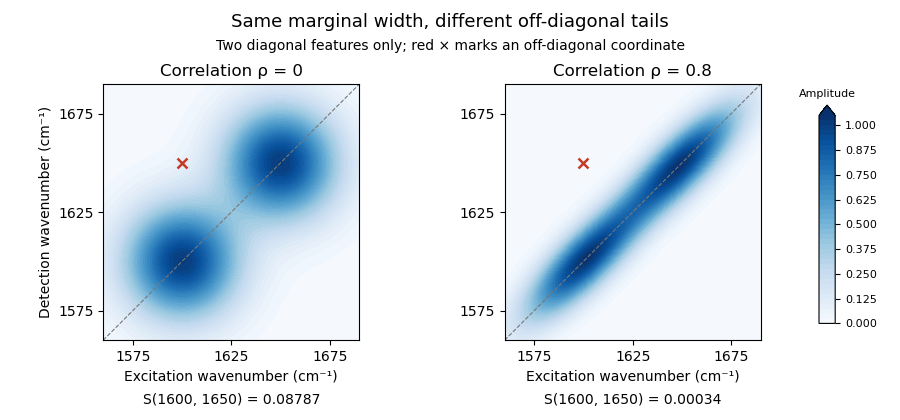
Original two-diagonal-feature model: changing 2D IR line-shape correlation changes off-diagonal tails without adding a 2D IR cross peak
. Details. The toy envelope is positive. Actual coherent spectra can contain signed features, so fitting and subtraction must respect the measured response and phase convention. The primary phase-controlled peptide experiment used phase and amplitude information to interpret mode-coupling cross peaks.[ref]
Useful tests vary the fit region, include plausible neighboring features and compare the proposed cross signal across 2D IR waiting times and other controlled conditions. A residual can indicate a missing feature, an unsuitable diagonal line shape or an unmodeled background. Its persistence alone does not uniquely select one molecular explanation.
A Zeeman sublevel is a magnetic-field-resolved component of an angular-momentum level, labeled by its projection quantum number . In the weak-field regime, for the relevant electronic angular momentum, with appropriate modifications for hyperfine levels.
For angular momentum one, the values give three shifts. The states can be degenerate at zero field yet acquire different energies in a field. Light polarization and selection rules control which sublevels a laser addresses. Strong fields can change the angular-momentum coupling, so one cannot extrapolate every weak-field formula indefinitely.
A non-breaking space is a separating character intended to keep adjacent text together during ordinary line breaking. The common Unicode character is U+00A0 NO-BREAK SPACE. It has line-break class GL; the surrounding rules determine which boundaries are prohibited.[ref]
Unicode Line Breaking Algorithm by the Unicode Consortium. §5.1, GL class; rules LB12 and LB12a
For an example,
25\u00a0µm is a visible spelling of an escape notation for a number, U+00A0, and a micrometre symbol. The actual text 25 µm keeps the number and unit together at that separator. Ordinary 25 µm instead uses U+0020 SPACE and can provide a wrap opportunity there. Neither choice fixes the physical width of the gap in every computer font.The rule is local. In the sequence
A\u0020\u00a0B, a break after the ordinary space can still be allowed, leaving the non-breaking space on the following line. Thus inserting U+00A0 does not make an entire text paragraph unbreakable.[ref]Unicode Line Breaking Algorithm by the Unicode Consortium. GL description: SPACE before NO-BREAK SPACE; LB12a exception
Pinned article: Introduction to the OurBigBook Project
Welcome to the OurBigBook Project! Our goal is to create the perfect publishing platform for STEM subjects, and get university-level students to write the best free STEM tutorials ever.
Everyone is welcome to create an account and play with the site: ourbigbook.com/go/register. We belive that students themselves can write amazing tutorials, but teachers are welcome too. You can write about anything you want, it doesn't have to be STEM or even educational. Silly test content is very welcome and you won't be penalized in any way. Just keep it legal!
Intro to OurBigBook
. Source. We have two killer features:
- topics: topics group articles by different users with the same title, e.g. here is the topic for the "Fundamental Theorem of Calculus" ourbigbook.com/go/topic/fundamental-theorem-of-calculusArticles of different users are sorted by upvote within each article page. This feature is a bit like:
- a Wikipedia where each user can have their own version of each article
- a Q&A website like Stack Overflow, where multiple people can give their views on a given topic, and the best ones are sorted by upvote. Except you don't need to wait for someone to ask first, and any topic goes, no matter how narrow or broad
This feature makes it possible for readers to find better explanations of any topic created by other writers. And it allows writers to create an explanation in a place that readers might actually find it.
Figure 1. Screenshot of the "Derivative" topic page. View it live at: ourbigbook.com/go/topic/derivativeVideo 2. OurBigBook Web topics demo. Source. - local editing: you can store all your personal knowledge base content locally in a plaintext markup format that can be edited locally and published either:This way you can be sure that even if OurBigBook.com were to go down one day (which we have no plans to do as it is quite cheap to host!), your content will still be perfectly readable as a static site.
- to OurBigBook.com to get awesome multi-user features like topics and likes
- as HTML files to a static website, which you can host yourself for free on many external providers like GitHub Pages, and remain in full control

Figure 2. You can publish local OurBigBook lightweight markup files to either OurBigBook.com or as a static website.
Figure 3. Visual Studio Code extension installation.
Figure 5. . You can also edit articles on the Web editor without installing anything locally. Video 3. Edit locally and publish demo. Source. This shows editing OurBigBook Markup and publishing it using the Visual Studio Code extension. 
- Infinitely deep tables of contents:



All our software is open source and hosted at: github.com/ourbigbook/ourbigbook
Further documentation can be found at: docs.ourbigbook.com
Feel free to reach our to us for any help or suggestions: docs.ourbigbook.com/#contact