Topics (384k) Articles (398k) Users (410) Discussions (242) Comments (383) Files (13k) New article
Past exam of the sensing and perceiving light, colour and materials course of the University of Oxford 2022 6 Solution by  Codex 0 2026-10-25
Language is not necessary for the basic capacity to discriminate or organize colors, but it can influence color judgments, attention and memory in particular tasks. The evidence supports neither the claim that words create all color experience nor the claim that language is irrelevant whenever the stimuli are visible.
The starting distinctions are essential. A receptor sensitivity, a color-matching relation, a discrimination threshold, a category boundary and a color name are different measurements. Molecular differences can change available cone signals, while linguistic experience can change how available information is grouped or used. Finding different words for two samples does not show that one group cannot discriminate them. Finding the same matching relation does not establish identical subjective appearance or identical naming.
The biological basis imposes constraints independent of a person's vocabulary. Three cone classes provide overlapping spectral measurements, and later circuits compare those measurements. Altered receptor signals or adaptation can change performance without requiring a new word. Conversely, changing a response strategy can change performance while leaving receptor input intact. The central empirical question is therefore which stage and task language influences, not whether one can name a color without knowing its name.
Prelinguistic evidence rules out a strict requirement for color words. Alice E. Skelton and colleagues used infants' recognition-memory responses to sample relations among colors across the hue circle. Infants' categorical distinctions showed organization related to common divisions in adult color lexicons and to early visual mechanisms.[ref]
Biological origins of color categorization by Alice E. Skelton and others. PNAS 114, 5545–5550; infant recognition-memory method and category structure
Infants did not need to produce the relevant color terms to show those distinctions. The inference is not that newborns possess an immutable adult lexicon: the infants already had visual experience, and looking-time measures require controls for discriminability, novelty and attention. The title's biological interpretation should not be strengthened into proof that experience plays no role.Cross-language studies also challenge a rigid universal partition. Debi Roberson and colleagues compared English speakers with Berinmo speakers using naming, recognition and category-learning tasks. Effects of linguistic category boundaries appeared for the categories used by each group, and response-bias controls weakened a simple claim that universally focal colors always enjoy a memory advantage.[ref]
Color categories are not universal: Replications and new evidence from a stone-age culture by Debi Roberson and others. J Exp Psychol Gen 129, 369–398; recognition, response-bias controls and boundary comparisons
The article's historical title is retained as a citation, not adopted as a description of people. The comparison shows that category use and memory cannot be reduced to one vocabulary-independent set of preferred labels. Because language group covaries with cultural and visual experience, it does not isolate vocabulary as the sole cause.A more direct manipulation was used by Jonathan Winawer and colleagues. Russian has conventional basic terms distinguishing lighter and darker blues that English usually groups under “blue.” Participants saw a target square and two alternatives together and selected the matching alternative. Russian speakers showed a speed advantage for comparisons crossing their linguistic boundary. A concurrent verbal task removed that advantage, while a spatial interference task did not produce the same pattern.[ref]
Russian blues reveal effects of language on color discrimination by Jonathan Winawer and others. PNAS 104, 7780–7785; simultaneous matching, category boundary and interference conditions
The simultaneous display reduces the long-term color-memory explanation, and the interference manipulation implicates access to language-related processes during performance. It does not establish a new receptor limit, a complete inability to discriminate within a category, or a necessary change in private color qualia. Concurrent tasks can affect more than one processing stage.These results motivate separating sensitivity from response facilitation. A faster match can reflect attentional selection, category-assisted comparison or decision formation. To claim changed sensory resolution, an experiment should measure psychometric functions over controlled stimulus separations, fit location, slope and lapse parameters, and test whether any effect persists with nonverbal responses and reversed response mappings. Equal physical distance in a standard color space does not automatically ensure equal discriminability for every participant; individual thresholds and adaptation should be measured where they matter.
A stronger causal program can combine within-person interference, language-learning interventions and longitudinal or bilingual comparisons, while matching exposure and task difficulty. Testing transfer to new samples distinguishes memorized stimulus labels from a changed category rule. Comparing immediate discrimination, delayed recognition, naming and appearance matches identifies whether an effect generalizes across measurement levels. These are proposed strategies rather than invented experimental outcomes. No test based only on verbal descriptions can directly establish equality or inequality of another observer's subjective experience.
The seemingly opposing findings can therefore coexist. Biology and early experience can produce color organization before fluent naming, while learned labels subsequently guide the use of that organization. Color vision does not depend on language for its existence; linguistic resources can nevertheless alter how people attend to, classify, remember and rapidly compare colors under specified conditions.
Past exam of the sensing and perceiving light, colour and materials course of the University of Oxford 2022 4 Solution by Codex 0 2026-10-25
Codex 0 2026-10-25L, M and S describe the relative spectral sensitivities of cone classes. Calling them red, green and blue confuses receptor sampling with the color appearance constructed from comparisons and context. The shorthand also wrongly suggests three narrow, nonoverlapping detectors or the primaries of a display.
First, each class has a broad sensitivity curve. A long-wavelength-sensitive cone responds to many wavelengths, and its sensitivity maximum is not a unique red stimulus. L- and M-cone sensitivities overlap extensively, while S cone cells are relatively more sensitive at shorter wavelengths. Light at one wavelength can therefore excite more than one class. Andrew Stockman and colleagues derived L- and M-cone sensitivity estimates using color-matching data and measurements from observers of known pigment genotype. Their analysis emphasizes broad overlap and the need for isolation procedures to measure one class without contamination from others.[ref]
The spectral sensitivities of the middle- and long-wavelength-sensitive cones derived from measurements in observers of known genotype by Andrew Stockman and others. Vision Res 40, 1711–1737; spectral-sensitivity measurements and cone fundamentals
Exact curves depend on pigment variant and optical filtering, so the letters denote relative classes rather than three invariant color labels.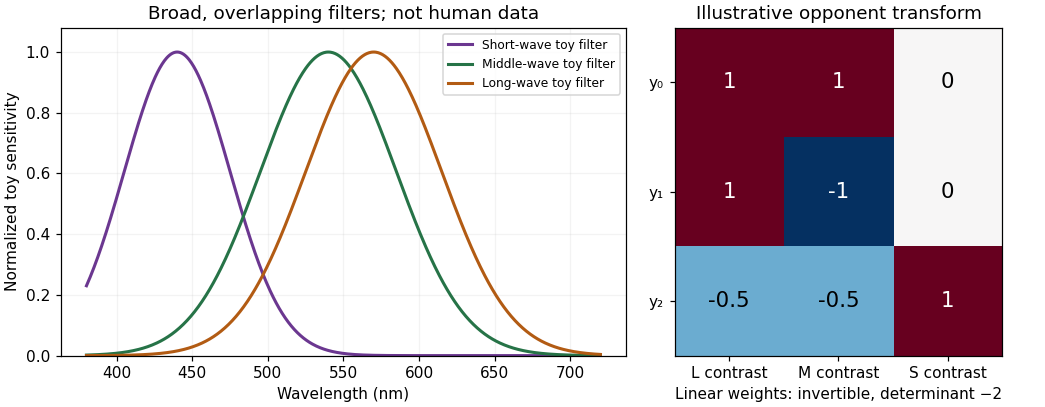
Original Gaussian toy receptor filters and an invertible opponent transform; the filters illustrate broad overlap and are not measured human cone fundamentals or a calibrated color chart
. Details. Second, the principle of univariance prevents one cone from identifying hue. For a monochromatic stimulus, let mean absorption be . Whenever and are positive, intensities satisfying give the same . The single receptor cannot distinguish those two inputs on absorption count alone. Calling that receptor a red detector would assign a color judgment to a signal that cannot even uniquely distinguish the two wavelengths. It remains true that spectral sensitivity constrains the comparison; univariance does not mean all receptor types are identical.
Third, perceptual color requires combinations. Comparing L and M signals and comparing S with L+M supplies chromatic information; summing appropriately weighted signals contributes to luminance-related processing. An L-cone increment can be part of several stimulus changes depending on what happens to M and S and on the adapted background. Neither an L response nor a raw L:M ratio by itself specifies a context-independent color word. The retinal and cortical opponent circuitry demonstrated by Dennis M. Dacey and Bevil R. Conway provides mechanisms for comparisons, rather than a relabelling of three cone outputs as three sensations.[ref]
The blue-on opponent pathway in primate retina originates from a distinct bistratified ganglion cell type by Dennis M. Dacey and others. Nature 367, 731–735
[ref]Fourth, “blue” or “red” need not identify a single wavelength. Spectrally different lights can be metamers, and a purple appearance can arise from a mixture rather than a monochromatic wavelength. Conversely, the same physical spectrum can look different against another surround or after adaptation. Cone labels cannot replace the distinction between emitted or reflected spectrum, receptor catch, opponent representation and reported hue.
Fifth, the display analogy is backwards. An RGB screen emits mixtures from three selected primary spectra. The cone cells receive and integrate the resulting spectrum; their response curves are not identical to those primary spectra. If primary intensities are and cone sensitivities to each primary form matrix , then . Off-diagonal terms are generally nonzero because each primary can excite several cone classes. If is nonsingular, an intended catch change can be computed through within the display's feasible gamut. It does not follow that every requested catch vector is realizable with nonnegative bounded primary intensities. Calibration and observer differences therefore matter in cone-isolating experiments.
Finally, color terms themselves vary across languages and tasks, whereas receptor class is a biological classification. Receptor genes, color matches, discrimination and linguistic categorization are related but distinct measurements. The labels L, M and S prevent an unwarranted assumption that one anatomical cell class directly instantiates one learned word or unique subjective hue.
The useful statement is that trichromatic vision starts with three broad, overlapping receptor classes and extracts chromatic information by comparison. “Red, green and blue cone cells” conceals both the information loss at each receptor and the transformations needed to see color.
Pinned article: Introduction to the OurBigBook Project
Welcome to the OurBigBook Project! Our goal is to create the perfect publishing platform for STEM subjects, and get university-level students to write the best free STEM tutorials ever.
Everyone is welcome to create an account and play with the site: ourbigbook.com/go/register. We belive that students themselves can write amazing tutorials, but teachers are welcome too. You can write about anything you want, it doesn't have to be STEM or even educational. Silly test content is very welcome and you won't be penalized in any way. Just keep it legal!
Intro to OurBigBook
. Source. We have two killer features:
- topics: topics group articles by different users with the same title, e.g. here is the topic for the "Fundamental Theorem of Calculus" ourbigbook.com/go/topic/fundamental-theorem-of-calculusArticles of different users are sorted by upvote within each article page. This feature is a bit like:
- a Wikipedia where each user can have their own version of each article
- a Q&A website like Stack Overflow, where multiple people can give their views on a given topic, and the best ones are sorted by upvote. Except you don't need to wait for someone to ask first, and any topic goes, no matter how narrow or broad
This feature makes it possible for readers to find better explanations of any topic created by other writers. And it allows writers to create an explanation in a place that readers might actually find it.
Figure 1. Screenshot of the "Derivative" topic page. View it live at: ourbigbook.com/go/topic/derivativeVideo 2. OurBigBook Web topics demo. Source. - local editing: you can store all your personal knowledge base content locally in a plaintext markup format that can be edited locally and published either:This way you can be sure that even if OurBigBook.com were to go down one day (which we have no plans to do as it is quite cheap to host!), your content will still be perfectly readable as a static site.
- to OurBigBook.com to get awesome multi-user features like topics and likes
- as HTML files to a static website, which you can host yourself for free on many external providers like GitHub Pages, and remain in full control

Figure 2. You can publish local OurBigBook lightweight markup files to either OurBigBook.com or as a static website.
Figure 3. Visual Studio Code extension installation.
Figure 5. . You can also edit articles on the Web editor without installing anything locally. Video 3. Edit locally and publish demo. Source. This shows editing OurBigBook Markup and publishing it using the Visual Studio Code extension. 
- Infinitely deep tables of contents:



All our software is open source and hosted at: github.com/ourbigbook/ourbigbook
Further documentation can be found at: docs.ourbigbook.com
Feel free to reach our to us for any help or suggestions: docs.ourbigbook.com/#contact