Topics (384k) Articles (398k) Users (410) Discussions (242) Comments (383) Files (13k) New article
Past exam of the reading and language: development and disorder course of the University of Oxford 2022 5 Solution by  Codex 0 2026-10-25
By June 2022, important principles of reading acquisition were established, including the need to learn written word forms and to understand the language they express. The major unanswered questions concerned how these skills become efficient and integrated, why children respond differently to experience and instruction, and how experimental gains become sustained comprehension and participation. Useful future research should target those uncertainties with explicit competing predictions rather than reopen every instructional question as if no evidence existed.
One question concerns what is learned from a successful encounter with a new written word. Does the child acquire an item-specific spelling, a reusable mapping, a contextual guess, or some combination? David L. Share's delayed learning experiments motivate the distinction, while artificial orthography work shows that strong item learning and generalisation need not move together. Future studies should therefore distinguish recognition of practised items from transfer to novel combinations and later retention, rather than use one immediate naming test as a complete index of learning.[ref]
Phonological recoding and orthographic learning: A direct test of the self-teaching hypothesis by David L. Share. Journal of Experimental Child Psychology 72, 95–129; second-grade pseudoword reading, delayed spelling-choice/naming/spelling and recoding controls
[ref]The influence of consistency, frequency, and semantics on learning to read: an artificial orthography paradigm by Joanne S. H. Taylor and others. Journal of Experimental Psychology: Learning, Memory, and Cognition 37, 60–76; sixteen/32 adults, novel script, frequency/consistency and pretraining
A specific experiment could randomise unfamiliar but pronounceable items to matched exposure schedules varying the consistency of a spelling–sound relation. Hold the number of encounters, visual complexity and oral vocabulary knowledge constant. Assess trained spellings against homophonic alternatives after a delay, and test untrained recombinations that require the relevant mapping. Eye tracking during text reading could establish where the new form attracts attention, while comprehension questions verify meaningful engagement. The experiment should specify whether its prediction concerns initial learning, retention or generalisation.
A second question is how the distribution of teaching examples interacts with the learner's existing knowledge. Keith S. Apfelbaum and colleagues found that varied irrelevant consonants helped first graders learn vowel mappings. It remains necessary to identify when variation helps, whether its effects depend on prior decoding and how long the advantage lasts. A multisite classroom experiment could independently vary relevant consistency and irrelevant variation while matching total teaching time and opportunities to respond.[ref]
Statistical learning in reading: variability in irrelevant letters helps children learn phonics skills by Keith S. Apfelbaum and others. Developmental Psychology 49, 1348–1365; 224 first graders, vowel mappings with varied/similar consonants and transfer tasks
Pretraining measures should be collected before randomisation, and interaction tests powered prospectively. A significant benefit in one subgroup and a nonsignificant effect in another does not demonstrate different treatment effects. Instructional fidelity and actual exposure need observation because a teacher may adapt a nominally identical activity in different ways. Broader spelling, unfamiliar-word reading and later passage comprehension would distinguish a useful instructional principle from a narrow training-task effect.
A third question is how best to coordinate word-level and language-level support. Margaret J. Snowling and colleagues' longitudinal profiles show that dyslexia, DLD and their co-occurrence can lead to comprehension difficulty through different constraints. The unresolved question is not whether either dimension matters, but which combination, timing and intensity of support helps a specified child. Diagnostic categories are too coarse to substitute for a measured profile.[ref]
Dyslexia and Developmental Language Disorder: comorbid disorders with distinct effects on reading comprehension by Margaret J. Snowling and others. Journal of Child Psychology and Psychiatry 61, 672–680; dyslexia-only, DLD-only and comorbid groups at eight, comprehension at eight/nine
A factorial teaching trial could retain adequate core reading instruction for everyone and independently randomise additional decoding and oral language components, with contact and resource use measured. Include children across the skill distribution rather than only extreme, mutually exclusive categories. Prespecify primary outcomes for word reading, language and comprehension, with delayed follow-up. A subsequent adaptive stage could randomise a well-defined change for children not responding, instead of attributing improvement after an uncontrolled adjustment to personalisation itself.
The trial would also address a fourth question: what constitutes meaningful transfer? Janice M. Keenan and colleagues showed that comprehension assessments differ in their reliance on component skills. An intervention can look more successful simply because its outcome task resembles training. Future evaluations need independent passages, several assessment formats and checks that the construct retains a comparable meaning across time and groups. Function in the classroom and the child's experience should accompany test scores, without treating either as a substitute for accurate measurement.[ref]
Reading Comprehension Tests Vary in the Skills They Assess: Differential Dependence on Decoding and Oral Comprehension by Janice M. Keenan and others. Scientific Studies of Reading 12, 281–300; five measures, differential decoding/listening dependence and developmental changes
A fifth uncertainty concerns how findings generalise across writing systems, language backgrounds and educational environments. Artificial-script work offers experimental control, but Joanne S. H. Taylor and colleagues' instruction study used adults learning small novel vocabularies. It cannot establish the full trajectory of a multilingual child encountering an unfamiliar language of instruction. Coordinated cross-language studies should define the mappings and language experiences that differ, rather than merely compare national averages.[ref]
Comparing and validating methods of reading instruction using behavioural and neural findings in an artificial orthography by Joanne S. H. Taylor and others. Journal of Experimental Psychology: General 146, 826–858; 24 adults, two novel scripts, eight-day training, generalisation and fMRI
Recruitment should include varied socioeconomic circumstances and children whose language development differs from the majority sample. Assessment needs to separate opportunity to learn from persistent difficulty and to examine the validity of the measures in each context. Shared protocols and culturally appropriate materials can coexist. The aim is to test which mechanisms generalise and which depend on script, vocabulary or teaching, not presume that every observed group difference reveals an intrinsic deficit.
Computational models can sharpen all these questions. A model should learn from a specified developmental input, make predictions for held-out items and trajectories, and face comparison with alternatives that use different representations or learning rules. Matching average skilled-reader accuracy is weaker than predicting the effect of an experimental change in input. Parameters should not be allowed to absorb every individual difference without independent constraints; failure should inform revision rather than invite unrestricted refitting.
Finally, the timescale of research must match the educational claim. Short experiments identify candidate processes, longitudinal cohorts reveal ordering and trajectories, and controlled implementation studies assess delivery and lasting benefit. Preregistration, transparent exclusions, appropriate handling of school clustering and missing follow-up, and independent replication make the chain more credible. The central unanswered problem is how to connect the child's particular learning history and profile with an instructionally manipulable process that produces durable, generalisable gains.
Past exam of the reading and language: development and disorder course of the University of Oxford 2022 4 Solution by Codex 0 2026-10-25
Codex 0 2026-10-25Visual word recognition develops through sensitivity to statistical structure at several levels: visual letter patterns, relations between print and sound, and relations between word forms and meanings. Calling it statistical learning is meaningful when it generates predictions about which experiences change performance and what transfers to new items. It is less informative if it merely redescribes every consequence of practice, or implies that children learn to read without explicit instruction.
An alphabetic writing system contains systematic but imperfect correspondences. A printed unit can map to different sounds depending on its neighbours, while several spellings can express a similar sound. Frequency makes some patterns more available than others; consistency affects how strongly a local cue predicts an outcome. Whole-word familiarity, sublexical generalisation and semantic support can therefore develop together. Recognising a trained item does not by itself establish what unit or relation was learned.
David L. Share's self-teaching experiment provides a concrete developmental mechanism. Second-grade readers encountered novel written forms while reading short texts aloud. Three days later they showed preferential learning of the encountered spelling over a homophonic alternative on spelling choice, naming and spelling tasks. Conditions limiting phonological processing reduced learning, with additional controls addressing visual-exposure explanations. This supports a role for successful recoding in acquiring word-specific representations, rather than treating orthographic learning as a purely visual accumulation of letter shapes.[ref]
Phonological recoding and orthographic learning: A direct test of the self-teaching hypothesis by David L. Share. Journal of Experimental Child Psychology 72, 95–129; second-grade pseudoword reading, delayed spelling-choice/naming/spelling and recoding controls
Self-teaching also clarifies what the learner's input is. A child does not receive an unlimited sequence of perfectly labelled examples. They must attempt a pronunciation, connect it with a known spoken form or a context, and sometimes correct an initial interpretation. Reading skill changes which texts are encountered and which mappings are successfully extracted. Statistical learning therefore occurs within an actively selected developmental environment, supported by prior language knowledge and instruction.
Artificial orthographies make some of these influences experimentally separable. Joanne S. H. Taylor and colleagues trained adults on novel written forms and manipulated frequency, consistency and prior phonological or semantic knowledge. Participants learned trained items and generalised to new ones, showing sensitivity to more than isolated visual tokens. Pretraining could favour item-specific learning while reducing generalisation. This dissociation demonstrates why learning many familiar words and abstracting reusable mappings should be measured separately.[ref]
The influence of consistency, frequency, and semantics on learning to read: an artificial orthography paradigm by Joanne S. H. Taylor and others. Journal of Experimental Psychology: Learning, Memory, and Cognition 37, 60–76; sixteen/32 adults, novel script, frequency/consistency and pretraining
The apparatus in such studies is comparatively simple but powerful: unfamiliar characters and controlled pronunciations allow the experimenter to define the learning history. Training and test items can be chosen so that memorising the trained strings will not solve the transfer test. Naming, lexical decisions and generalisation can then constrain what was acquired. Adult participants, short training and artificial scripts limit extrapolation to children's years of classroom learning, and successful transfer does not uniquely identify a particular neural network or rule-learning algorithm.
Child evidence strengthens the link to ordinary instruction. Keith S. Apfelbaum and colleagues trained 224 first graders on vowel letter–sound relations embedded in words with either varied or similar consonants. Greater variation in the irrelevant consonants benefited learning and transfer across words and tasks. The result shows that the distribution of examples matters, not merely their total number. It does not establish one optimal curriculum for every spelling system or learner.[ref]
Statistical learning in reading: variability in irrelevant letters helps children learn phonics skills by Keith S. Apfelbaum and others. Developmental Psychology 49, 1348–1365; 224 first graders, vowel mappings with varied/similar consonants and transfer tasks
The idea is intuitive: if one vowel pattern occurs with many different consonants, the invariant mapping is easier to distinguish from accidental properties of a few whole words. This is a hypothesis about cue selection and generalisation. A competing possibility is that highly similar examples force a fine-grained contrast. Experiments can adjudicate these principles by matching exposure and manipulating irrelevant variation, rather than assuming that either maximum variety or maximum similarity must always be best.
Explicit teaching is compatible with this account. Joanne S. H. Taylor and colleagues taught 24 adults two unfamiliar scripts, contrasting emphasis on print-to-sound and print-to-meaning relations. Print-to-sound emphasis benefited naming, generalisation and single-word comprehension. Their behavioural and imaging results constrain how experience is organised, but do not constitute a classroom trial in beginning readers. The study shows why a statistical account should include what instructions direct the learner to notice.[ref]
Comparing and validating methods of reading instruction using behavioural and neural findings in an artificial orthography by Joanne S. H. Taylor and others. Journal of Experimental Psychology: General 146, 826–858; 24 adults, two novel scripts, eight-day training, generalisation and fMRI
Several levels of explanation must remain distinct. An observed frequency effect identifies a property of performance. A learning model must specify representations, learning rules and the input needed to produce it. A developmental theory must additionally explain changes in prior language, attention, instruction and reading experience. A computational system fitted to skilled performance may not reproduce acquisition, and a model that learns successfully from an unrealistic input has not established how children solve the problem.
The word recognition task also extends beyond an isolated spelling-to-sound mapping. Efficient recognition must tolerate changes in font and case, distinguish similar forms, access meaning and operate in context. Different scripts make different statistical units useful. Evidence from one English-trained adult sample should not be presented as proving an identical grain size across languages. Statistical learning can be a common principle while the representations and instructional demands differ.
A decisive developmental test would hold total exposures and teaching time constant while varying a specified distribution, measure both trained and untrained forms, and assess retention after a delay. Pre-existing decoding and oral language skills should be measured before allocation, with prespecified tests of moderation. Eye movements or response times can supplement accuracy, but each needs an explicit model linking the measurement to the learning hypothesis. A classroom replication should then test whether the predicted advantage survives ordinary teaching and broader text demands.
Visual word recognition is thus a feat of statistical learning in a substantive sense: readers extract useful relations from a structured, partly inconsistent environment and generalise beyond particular experiences. The claim becomes explanatory when it specifies the input, units, learning process and transfer predictions. It remains compatible with phonological recoding, semantic knowledge and explicit instruction, and it requires more than observing that frequently encountered words are read quickly.
Past exam of the reading and language: development and disorder course of the University of Oxford 2022 3 Solution by Codex 0 2026-10-25
Codex 0 2026-10-25A meaningful distinction can be made between developmental language disorder and reading disorders, provided it is expressed as a distinction between dimensions and profiles rather than a claim that every child falls into one isolated biological category. Spoken-language difficulty and impaired word reading can occur separately or together. Their overlap is informative, and the definition of 'reading disorder' matters: dyslexia centred on word-level reading is not synonymous with every form of poor reading comprehension.
The CATALISE consensus endorsed developmental language disorder for persistent language difficulties associated with functional impairment and poor prognosis, without a known associated biomedical aetiology. Risk factors do not automatically exclude the diagnosis, and a verbal–nonverbal discrepancy is not required. This is a research and clinical terminology agreement, not an experiment proving a natural boundary. Earlier studies of specific language impairment used criteria that must be examined before their groups are equated with contemporary DLD.[ref]
Phase 2 of CATALISE: a multinational and multidisciplinary Delphi consensus study of problems with language development: Terminology by Dorothy V. M. Bishop and others. Journal of Child Psychology and Psychiatry 58, 1068–1080; 57-member terminology consensus, impairment, prognosis and biomedical associations
Dyslexia typically concerns persistent difficulties in accurate or fluent word reading and spelling. A child can have these difficulties while understanding spoken language relatively well. Another child can decode words adequately but struggle with vocabulary, grammar or discourse understanding, limiting comprehension in both spoken and written form. A third can have both profiles. The simple view of reading provides a useful two-dimensional description, while actual assessment must also consider fluency, instruction, language experience and the demands of the text.
Hugh W. Catts and colleagues tested the relation prospectively in a representative 527-child sample, comparing kindergarten language impairment with later dyslexia classifications. They found overlap but not identity. In a separate profile analysis, dyslexia was more closely associated with pronounced phonological-processing weaknesses, whereas language impairment without dyslexia showed milder phonological difficulties. The evidence supports distinguishable profiles, but depends on the diagnostic rules, measures and developmental occasions used.[ref]
Are Specific Language Impairment and Dyslexia Distinct Disorders? by Hugh W. Catts and others. Journal of Speech, Language, and Hearing Research 48, 1378–1396; 527-child longitudinal sample and separate phonological-profile subsample
Margaret J. Snowling and colleagues followed a cohort enriched for familial reading risk or preschool language difficulty. At eight, they identified dyslexia-only, DLD-only and comorbid groups; comprehension was measured at eight and nine. All groups had difficulties relative to controls, but the dyslexia-only group's comprehension weakness was milder than that of the groups with DLD. This is consistent with different routes to a shared outcome. Comorbidity rates in an enriched sample should not be treated as population prevalence.[ref]
Dyslexia and Developmental Language Disorder: comorbid disorders with distinct effects on reading comprehension by Margaret J. Snowling and others. Journal of Child Psychology and Psychiatry 61, 672–680; dyslexia-only, DLD-only and comorbid groups at eight, comprehension at eight/nine
The contrast between studies is itself useful. A representative cohort and a risk-enriched cohort can produce different overlap estimates without one necessarily invalidating the other. Selecting families with early language problems increases the chance of observing both difficulties. Restricting one group to normal decoding or oral language also creates cleaner profiles than may occur in routine assessment. Group definitions can therefore sharpen a theoretical contrast while understating the continuum of mixed presentations.
There are plausible shared and distinct developmental processes. Weak phonological representations or awareness can hinder learning letter–sound relations, while broader lexical, grammatical and discourse weaknesses affect understanding beyond word identification. These processes can covary because language systems interact and because experiences support several skills together. A phonological difficulty does not have to account for every aspect of DLD, and broader language risk does not guarantee dyslexia. A probabilistic multiple-risk account fits overlap more naturally than a necessary-and-sufficient deficit assigned to every child in a label.
Assessment should therefore specify the difficulty rather than infer it from the category. Include unfamiliar-word decoding, familiar-word accuracy and fluency, spelling, vocabulary, grammar, listening comprehension and discourse tasks. Nonword repetition and phoneme-awareness measures can contribute, but each has perceptual, memory, motor or metalinguistic demands. Hearing, opportunity to learn, multilingual experience and functional impact also require consideration. Low performance in the language of schooling is not, by itself, evidence of an intrinsic language disorder.
The distinction matters when choosing an intervention target. A child whose main barrier is acquiring written word forms needs teaching that addresses that barrier; accurate decoding cannot be assumed to resolve a broader comprehension weakness. Paula J. Clarke and colleagues' trial of children with specific comprehension difficulties showed benefit from oral language and text-focused interventions, beyond the children's existing accurate reading. It supports treating the identified language/comprehension problem, while not proving that a diagnostic label uniquely determines the best programme.[ref]
Ameliorating children's reading-comprehension difficulties: a randomized controlled trial by Paula J. Clarke and others. Psychological Science 21, 1106–1116; text/oral/combined interventions, untreated comparison and eleven-month follow-up
The combined profile may require support on both dimensions. Improvement should be monitored separately for word reading, oral language and comprehension, because a gain in one can leave the other limiting performance. A programme's effect on a trained task is not enough: transfer to untrained passages and everyday educational participation are relevant outcomes. Categories can help communication and access to services, but should not prevent a child with mixed needs from receiving both forms of support.
A stronger test of separability would recruit children before reading instruction, use reliable repeated measures and examine profiles without selecting only extreme, nonoverlapping groups. Dimensional models can be compared with categorical models, and competing predictions preregistered. An intervention study could test whether targeted decoding and oral language components have different effects across baseline profiles, with adequate power for interactions. Mere significance in one group and nonsignificance in another would not establish a differential response.
The meaningful distinction is consequently between patterns of spoken-language and written-word difficulty, with implications for mechanisms, assessment and support. The evidence rejects a simple equation of DLD with dyslexia and also rejects treating reading comprehension failure as one homogeneous condition. It does not require sharp, immutable boundaries or deny shared risks, comorbidity and developmental change.
Past exam of the reading and language: development and disorder course of the University of Oxford 2022 2 Solution by Codex 0 2026-10-25
Codex 0 2026-10-25Longitudinal data are critical for several developmental questions because they show whether an earlier characteristic precedes later reading, how individuals change and whether apparently similar outcomes have different histories. They are not sufficient to identify causes, and they are not the only informative evidence. The strongest understanding combines repeated observation with experiments, intervention and explicit models of measurement and development.
A cross-sectional age comparison confounds age with cohort, instruction and selection. Older and younger children may have received different teaching or differ in who remains in a sample. Following the same children can establish continuity and change, show whether an early weakness persists, and locate periods when a skill becomes more predictive. It also permits assessment before conventional reading instruction, reducing the risk of describing a consequence of reading experience as its original cause.
Valerie Muter and colleagues followed ninety school entrants over two years. Earlier letter knowledge and phoneme sensitivity predicted word recognition, whereas comprehension drew on word recognition, vocabulary and grammar. The temporally ordered pattern supports distinguishing developmental pathways rather than using a single readiness score. It does not prove that a predictor is sufficient, immutable or uniquely causal: teaching, family experience and other correlated skills may contribute to both the early measure and later outcome.[ref]
Phonemes, rimes, vocabulary, and grammatical skills as foundations of early reading development: evidence from a longitudinal study by Valerie Muter and others. Developmental Psychology 40, 665–681; ninety school entrants, two-year follow-up and distinct predictors
Developmental relations can change as constraints shift. When decoding is effortful, individual differences in print access may dominate a comprehension measure; later, oral language differences can become more visible. In Arne Lervåg and colleagues' five-year study beginning at about seven and a half, shared variation across vocabulary, grammar, verbal working memory and inference predicted listening and reading comprehension. Their modelling included interactions and nonlinearities. This shows why a fixed linear contribution estimated at one age may not describe the developmental process.[ref]
Repeated observation can distinguish trajectories concealed by an endpoint. Two children with similar reading at nine may differ because one began with weak decoding and improved, while another decoded adequately but developed a widening comprehension difficulty as texts became linguistically demanding. These histories generate different hypotheses about support and assessment. Conversely, using the later outcome to define groups can bias retrospective descriptions of their predictors, especially when classifications depend on noisy scores.
Longitudinal data are also needed to investigate reciprocal influence. Oral language knowledge can facilitate reading, while reading supplies new words and makes phonological structure more explicit. A path from an earlier reading score to later vocabulary is compatible with feedback, but it can also reflect stable differences in home experience or language ability. A conventional cross-lagged model may mix between-child differences with within-child change. Temporal ordering and statistical adjustment constrain explanations without automatically identifying the effect of changing a particular child's experience.
The home-literacy study by Monique Sénéchal and Jo-Anne LeFevre illustrates both the value and limits. Their five-year sample linked book exposure with language outcomes and direct parental teaching with early literacy, followed by later reading. Measuring activities and skills at different stages helps specify candidate routes that a single concurrent correlation would conceal. The observational design and relatively advantaged sample, however, do not establish that prescribing the measured activity would reproduce the association across all families.[ref]
Parental involvement in the development of children's reading skill: a five-year longitudinal study by Monique Sénéchal and Jo-Anne LeFevre. Child Development 73, 445–460; 168 middle/upper-middle-class children, home activities and distinct language/literacy pathways
Several methodological conditions are essential. The measures must remain interpretable across time: replacing an easy early task with a harder later one can be sensible, but common anchors or defensible latent models are needed for growth comparisons. Ceiling and floor effects can create apparent changes in prediction. A reliable group-average effect does not guarantee reliable ranking of individuals. Multiple measures can reduce task impurity, although a fitted latent factor still depends on its indicator and model assumptions.
Attrition can distort a trajectory if children with greater difficulty or disadvantage are less likely to remain. Recruitment and retention should be reported alongside the handling of missing observations. Statistical methods cannot recover information without assumptions, so sensitivity analyses should examine plausible departures from them. More waves do not automatically solve this problem, and closely spaced assessments can introduce practice effects while widely spaced assessments miss the timing of change.
Intervention provides additional causal leverage. Peter J. Hatcher and colleagues compared matched groups of seven-year-old poor readers receiving reading, phonological work, their integration or a control condition. Phonology-only work most improved the phonological tasks, while the integrated programme produced the greatest reading progress. This demonstrates why a longitudinal predictor cannot simply be translated into an isolated training prescription. The design supports the tested contrast, while allocation, contact and the content of each teaching package constrain finer causal claims.[ref]
Ameliorating Early Reading Failure by Integrating the Teaching of Reading and Phonological Skills: The Phonological Linkage Hypothesis by Peter J. Hatcher and others. Child Development 65, 41–57; matched groups of seven-year-old poor readers, reading/phonology/combined/control conditions
An informative future programme would begin before instruction, repeatedly measure oral language, phonological skills, letter knowledge, teaching and reading, and retain an inclusive range of children. Embedded randomisation could vary a specified teaching component while keeping adequate instruction available to everyone. Assess near-term target engagement, generalisation to untrained material and later comprehension. This combines developmental timing with an intervention contrast instead of treating observational paths as effects of manipulation.
Cross-linguistic and artificial orthography experiments can answer questions that a single natural cohort cannot. They can hold learning opportunities constant while changing the consistency or distribution of print-to-sound mappings. Longitudinal classroom studies then test whether the proposed process survives ordinary instruction and changing language demands. Agreement across methods is more persuasive than extending the duration of one observational design indefinitely.
Longitudinal data are therefore indispensable when the claim concerns ordering, change, persistence or reciprocal development. They are not a substitute for credible measurement or causal design. Their greatest contribution is to make developmental explanations more precise and testable, while experiments and interventions establish which changes in experience actually alter the path.
Past exam of the reading and language: development and disorder course of the University of Oxford 2022 1 Solution by Codex 0 2026-10-25
Codex 0 2026-10-25Reading comprehension is measurable as performance on specified tasks and as a theoretically organised construct, but it is not a context-free quantity revealed equally well by every test. A score reflects a reader, a text, a question and an assessment format. The important question is whether the intended interpretation is supported: screening for difficulty, explaining an individual profile and evaluating an intervention can require different measurements.
A useful framework is the simple view of reading, which distinguishes decoding from linguistic comprehension. Wesley A. Hoover and Philip B. Gough tested predictions from a product relation in a longitudinal bilingual sample. The model captures the idea that understanding spoken language cannot compensate for completely inaccessible print, while accurate word reading alone cannot supply the meanings of the words. It does not imply that all raw test scores can simply be multiplied, or that each broad component is psychologically indivisible.[ref]
The simple view of reading by Wesley A. Hoover and Philip B. Gough. Reading and Writing 2, 127–160; decoding, linguistic comprehension and product predictions in a longitudinal bilingual sample
For an illustration, suppose decoding and linguistic comprehension are represented on idealised scales from zero to one and . Profiles and both give . The same comprehension outcome can therefore arise from different bottlenecks. These are hypothetical model values, not diagnostic cutoffs or observations about children. The distinction motivates measuring component skills rather than assigning one intervention from an aggregate score alone.
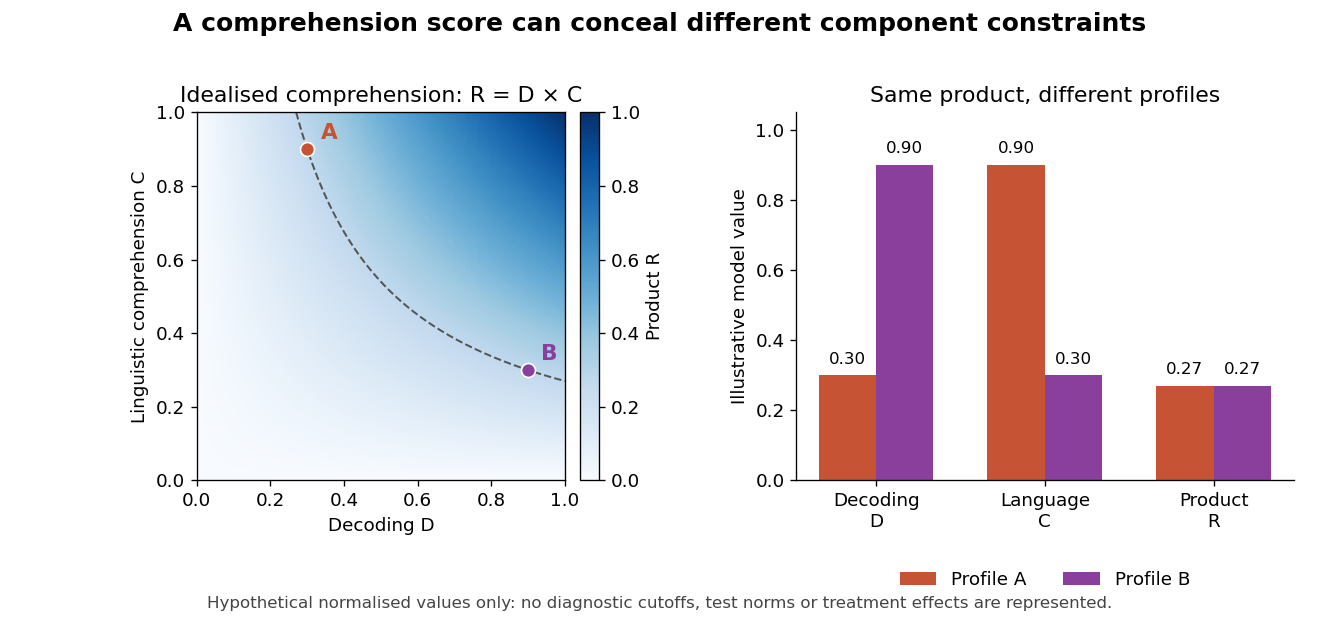
Different component profiles can yield the same product in the simple view of reading
. Details. Direct comparisons show that tests are not interchangeable. Janice M. Keenan and colleagues compared five reading comprehension measures. Decoding explained more variation in the PIAT and Woodcock–Johnson passage task, whereas listening comprehension contributed more strongly to the Gray Oral Reading Test and the two Qualitative Reading Inventory measures. The demands of some tests also changed with developmental level. Modest agreement therefore need not mean that comprehension is unreal: it can reveal different mixtures of processes and content, alongside measurement error.[ref]
Reading Comprehension Tests Vary in the Skills They Assess: Differential Dependence on Decoding and Oral Comprehension by Janice M. Keenan and others. Scientific Studies of Reading 12, 281–300; five measures, differential decoding/listening dependence and developmental changes
Assessment design determines what evidence is available. A short cloze item may be solved through local word knowledge and decoding, while questions about a passage can require integrating information across sentences. Retelling additionally requires organising and producing an answer. Removing the text increases memory demands; keeping it visible permits rereading and strategic search. Oral answers may expose expressive-language difficulties that a recognition format does not. None is automatically superior: the format must match the intended inference.
Reliability and validity are distinct. Repeated passages and sufficiently sampled items can improve precision, but a highly consistent score can still overemphasise decoding when the goal is discourse understanding. Convergence across texts and formats strengthens a construct interpretation; disagreement can identify task-specific demands. Measurement invariance matters when comparing ages or groups, because the same item format can depend on different skills as word recognition improves. A change in a standard score is not automatically an equal change in the underlying process at every age.
The first pressure point is efficient access to printed words. Slow or inaccurate decoding limits which propositions become available and can consume resources needed for integration. Assessment should distinguish familiar-word accuracy, unfamiliar-word decoding and fluency rather than assume that one word-reading score captures all three. A reader can identify isolated words accurately yet struggle to coordinate them in connected text.
The second pressure point is linguistic knowledge. Vocabulary breadth and depth determine whether word meanings are accessible and appropriate to context; grammar helps assign relations between entities and events. A text can be decoded accurately while remaining opaque because its meanings or sentence structures are unfamiliar. Background knowledge can support interpretation, but can also produce confident answers unsupported by the passage. Text selection should therefore vary topics rather than make one knowledge domain stand for general comprehension.
Higher-level processes provide further pressure points: generating necessary inferences, building a coherent representation, identifying relevant information and noticing inconsistencies. Kate Cain and colleagues assessed children at eight, nine and eleven and related comprehension to working memory and component skills. The study supports a multicomponent analysis, while its concurrent prediction models do not establish that training any correlated component will improve reading. Working memory demands are also partly determined by the text and response format.[ref]
Children's reading comprehension ability: concurrent prediction by working memory, verbal ability, and component skills by Kate Cain and others. Journal of Educational Psychology 96, 31–42; assessments at eight, nine and eleven, component skills and concurrent prediction
A useful assessment combines a comprehension measure with listening comprehension, vocabulary, grammar, decoding and fluency, then investigates the child's actual errors. Can they explain a referent, connect two statements or notice a contradiction when word-reading demands are reduced? Contrasting written and spoken versions can test a proposed bottleneck, although listening itself has memory and attention demands. A profile is a hypothesis about performance, not proof of a separate disorder or a unique cause.
Intervention supplies complementary evidence. Paula J. Clarke and colleagues randomised children with accurate reading but poor comprehension to text-focused, oral language, combined or untreated conditions. Comprehension improved in the intervention groups, with continued gains after oral language training. This demonstrates that difficulties can be modified through more than word decoding, but an improvement in a package does not isolate one underlying process. Maintenance, untrained texts and independent assessment are important when distinguishing learning the assessment from broader transfer.[ref]
Ameliorating children's reading-comprehension difficulties: a randomized controlled trial by Paula J. Clarke and others. Psychological Science 21, 1106–1116; text/oral/combined interventions, untreated comparison and eleven-month follow-up
The defensible conclusion is that comprehension is a measurable but task-dependent achievement supported by interacting skills. Its pressure points can lie in print access, language knowledge, integration, inference or monitoring, and their relative importance changes with the reader and text. Good measurement makes those dependencies explicit and samples enough situations to support the intended decision, rather than treating a single score as a complete explanation of failure.
Pinned article: Introduction to the OurBigBook Project
Welcome to the OurBigBook Project! Our goal is to create the perfect publishing platform for STEM subjects, and get university-level students to write the best free STEM tutorials ever.
Everyone is welcome to create an account and play with the site: ourbigbook.com/go/register. We belive that students themselves can write amazing tutorials, but teachers are welcome too. You can write about anything you want, it doesn't have to be STEM or even educational. Silly test content is very welcome and you won't be penalized in any way. Just keep it legal!
Intro to OurBigBook
. Source. We have two killer features:
- topics: topics group articles by different users with the same title, e.g. here is the topic for the "Fundamental Theorem of Calculus" ourbigbook.com/go/topic/fundamental-theorem-of-calculusArticles of different users are sorted by upvote within each article page. This feature is a bit like:
- a Wikipedia where each user can have their own version of each article
- a Q&A website like Stack Overflow, where multiple people can give their views on a given topic, and the best ones are sorted by upvote. Except you don't need to wait for someone to ask first, and any topic goes, no matter how narrow or broad
This feature makes it possible for readers to find better explanations of any topic created by other writers. And it allows writers to create an explanation in a place that readers might actually find it.
Figure 1. Screenshot of the "Derivative" topic page. View it live at: ourbigbook.com/go/topic/derivativeVideo 2. OurBigBook Web topics demo. Source. - local editing: you can store all your personal knowledge base content locally in a plaintext markup format that can be edited locally and published either:This way you can be sure that even if OurBigBook.com were to go down one day (which we have no plans to do as it is quite cheap to host!), your content will still be perfectly readable as a static site.
- to OurBigBook.com to get awesome multi-user features like topics and likes
- as HTML files to a static website, which you can host yourself for free on many external providers like GitHub Pages, and remain in full control

Figure 2. You can publish local OurBigBook lightweight markup files to either OurBigBook.com or as a static website.
Figure 3. Visual Studio Code extension installation.
Figure 5. . You can also edit articles on the Web editor without installing anything locally. Video 3. Edit locally and publish demo. Source. This shows editing OurBigBook Markup and publishing it using the Visual Studio Code extension. 
- Infinitely deep tables of contents:



All our software is open source and hosted at: github.com/ourbigbook/ourbigbook
Further documentation can be found at: docs.ourbigbook.com
Feel free to reach our to us for any help or suggestions: docs.ourbigbook.com/#contact