Topics (384k) Articles (398k) Users (410) Discussions (242) Comments (383) Files (13k) New article

For a finite group , write for its number of conjugacy classes. Exactly the elements of the center of a group have singleton conjugacy classes; every other conjugacy class has at least two elements. Since the conjugacy classes form a partition of a set , . If is a nonabelian group, the cyclic quotient by the center criterion and the fact that every group of group order at most three is a cyclic group give , hence . The quaternion group attains this bound, with five conjugacy classes among eight elements.
If , a null geodesic with affine parameter for has affine parameter for when along the curve. Indeed the conformal change of the Levi-Civita connection gives ; rescaling by cancels this tangential acceleration. Constant preserves the direction of parametrization. Agreement of unparametrized null geodesics does not imply agreement of their affine parameters or completeness.
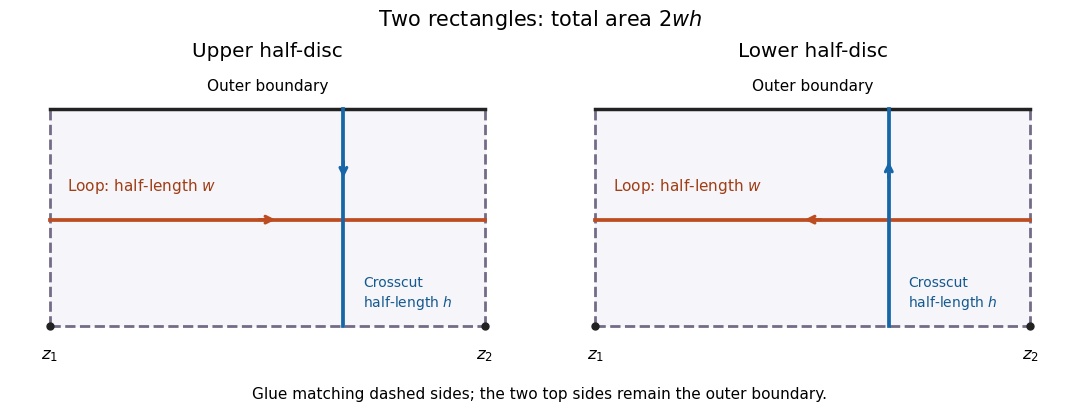
Glue two copies of along their left, bottom and right sides. Their unglued top sides form the outer boundary of a disk; the two bottom corners are marked interior points. Let be the loops surrounding both points, and the boundary-to-boundary crosscuts separating them. Then .
Each vertical seam joins a marked point to the outer boundary, so the Jordan curve theorem forces a loop surrounding both points to meet both seams. In the flat conformal metric, its total horizontal travel is therefore at least . Doubled horizontal segments attain this length. Each separating crosscut meets the bottom seam and starts and ends at height , so its total vertical travel is at least ; doubled vertical segments attain it. The total area is .
For an arbitrary density, integrate the lengths of the doubled horizontal segments over their height. The Cauchy-Schwarz inequality yields . Doubled vertical segments similarly give . These upper bounds equal the flat-metric ratios, proving both displayed formulas. Mapping the upper and lower halves of a disc to these rectangles gives the corresponding duality for a simply connected domain with two marked interior points.
A positive-integer labeling with and exists exactly when the condensation graph is totally ordered by reachability. Mutual paths force equal labels, and equal labels force mutual paths. Two incomparable components would require strict inequalities in both directions. Conversely number the components in topological order; total comparability forces every earlier component to reach every later one, proving both conditions. Compute the labeling in linear time. Reachability here includes length-zero paths.
Every two-by-two complex orthogonal matrix has form , where and . This follows by equating to in the two-by-two inverse formula, and direct multiplication proves the converse. A complete parametrization is , with complex ; restricting to real values selects only a subfamily.
In distinct-flavour quark annihilation, the one-photon exchange color charge tensor is , whereas the one-gluon tensor is . Their inner product after the external color charge sum is , since the fundamental gauge generators of are traceless. Thus the averaged squared scattering amplitude has no leading electromagnetic–strong interference term for this process. Fixed external color charge components, or processes with different exchange pairings, need not share this cancellation.
If a spherical collector falls with through constant liquid-water content and efficiency , neglecting condensation and small-droplet fall speed, then with . A uniform updraft gives . The formula is valid only while the assumed cloud conditions hold.
The ratio of the third to the second radius moment determines projected extinction area per liquid mass. For size-independent extinction efficiency , the local particle extinction coefficient is . It is not generally the mean radius or the mean-volume radius. In adiabatic cloud droplet moments, the shape factor gives .
For fixed , a Clifford gate permutes the finite Pauli group by conjugation. Its action is determined by the images of , so there are finitely many possible such actions. If two unitary operators induce the same action, their quotient commutes with every and is diagonal in the computational basis. Commutation with every equates diagonal entries at bit strings differing in one position; those flips connect all strings, so the quotient is a scalar. A unitary scalar is a global phase. Thus the Clifford group modulo global phase is finite and cannot approximate every unitary arbitrarily well. This proves the obstruction for any fixed number of wires, rather than relying solely on a one-qubit picture.[ref]
The Heisenberg Representation of Quantum Computers by Daniel Gottesman. Section 3 and Table 1, Pauli normalizer and Clifford generators
Original solutions to past classical mechanics examinations at the University of Oxford.
Pinned article: Introduction to the OurBigBook Project
Welcome to the OurBigBook Project! Our goal is to create the perfect publishing platform for STEM subjects, and get university-level students to write the best free STEM tutorials ever.
Everyone is welcome to create an account and play with the site: ourbigbook.com/go/register. We belive that students themselves can write amazing tutorials, but teachers are welcome too. You can write about anything you want, it doesn't have to be STEM or even educational. Silly test content is very welcome and you won't be penalized in any way. Just keep it legal!
Intro to OurBigBook
. Source. We have two killer features:
- topics: topics group articles by different users with the same title, e.g. here is the topic for the "Fundamental Theorem of Calculus" ourbigbook.com/go/topic/fundamental-theorem-of-calculusArticles of different users are sorted by upvote within each article page. This feature is a bit like:
- a Wikipedia where each user can have their own version of each article
- a Q&A website like Stack Overflow, where multiple people can give their views on a given topic, and the best ones are sorted by upvote. Except you don't need to wait for someone to ask first, and any topic goes, no matter how narrow or broad
This feature makes it possible for readers to find better explanations of any topic created by other writers. And it allows writers to create an explanation in a place that readers might actually find it.
Figure 1. Screenshot of the "Derivative" topic page. View it live at: ourbigbook.com/go/topic/derivativeVideo 2. OurBigBook Web topics demo. Source. - local editing: you can store all your personal knowledge base content locally in a plaintext markup format that can be edited locally and published either:This way you can be sure that even if OurBigBook.com were to go down one day (which we have no plans to do as it is quite cheap to host!), your content will still be perfectly readable as a static site.
- to OurBigBook.com to get awesome multi-user features like topics and likes
- as HTML files to a static website, which you can host yourself for free on many external providers like GitHub Pages, and remain in full control

Figure 2. You can publish local OurBigBook lightweight markup files to either OurBigBook.com or as a static website.
Figure 3. Visual Studio Code extension installation.
Figure 5. . You can also edit articles on the Web editor without installing anything locally. Video 3. Edit locally and publish demo. Source. This shows editing OurBigBook Markup and publishing it using the Visual Studio Code extension. 
- Infinitely deep tables of contents:



All our software is open source and hosted at: github.com/ourbigbook/ourbigbook
Further documentation can be found at: docs.ourbigbook.com
Feel free to reach our to us for any help or suggestions: docs.ourbigbook.com/#contact