Topics (384k) Articles (398k) Users (410) Discussions (242) Comments (383) Files (13k) New article

A researcher who coauthored experiments combining odor, location and temporal information in a hippocampus-dependent memory task. Cue-combination probes tested memory for relationships rather than mere detection of one cue.[ref]
The hippocampus and memory for what, where, and when by Ceren Ergorul and others. study design and results; author roster
A researcher who coauthored recordings of hippocampal time cells during event sequences separated by a delay. Changing temporal structure tested how firing tracked position within an interval.[ref]
Hippocampal time cells bridge the gap in memory for discontiguous events by Christopher J. MacDonald and others. study design and results; author roster
A researcher who coauthored functional-imaging experiments separating later memory for an item from memory for its source. Contrasting encoding tasks helped identify different routes to successful remembering.[ref]
Multiple routes to memory by Lila Davachi and others. study design and results; author roster

Portrait of Lila Davachi
. External portrait hosted by Yale University, Faculty of Arts and Sciences. Source.A researcher who coauthored comparisons of visual discrimination after perirhinal cortex ablation. Simultaneous oddity tasks and feature controls helped distinguish perceptual demands from a delay-dependent memory explanation.[ref]
Selective perceptual impairments after perirhinal cortex ablation by Mark J. Buckley and others. study design and results; author roster
A researcher who coauthored experiments manipulating feature ambiguity in visual discrimination. Comparing overlapping features tested a role for the perirhinal cortex in representing combinations, beyond describing it solely as a memory store.[ref]
Perirhinal cortex resolves feature ambiguity in complex visual discriminations by Timothy J. Bussey and others. study design and results; author roster
A researcher who developed a relational account of declarative memory. The proposal connected the hippocampus with organization and flexible expression of relationships among remembered events, distinguishing a theoretical account from one isolated recognition task.[ref]
The hippocampus and mechanisms of declarative memory by Howard Eichenbaum. study design and results; author roster

Portrait of Howard Eichenbaum
. Dan Kirksey, KDKC Photos, Escondido, California (explicit image caption credit). External portrait hosted by Boston University, BU Today. Source.A researcher who coauthored single-neuron recordings during viewing and later free recall of cinematic episodes. Reactivation in the hippocampus connected remembered content with internally generated neural activity rather than ongoing visual stimulation.[ref]
Internally generated reactivation of single neurons in human hippocampus during free recall by Hagar Gelbard-Sagiv and others. study design and results; author roster
A researcher who tested the habituation-based account of exposure therapy for childhood and adolescent anxiety. Analyses related changes during exposure exercises to treatment outcomes in 72 youths. Process–outcome associations probe a proposed mechanism, but do not independently randomize within-session fear reduction or establish it as the necessary cause of improvement.[ref]
Testing the habituation-based model of exposures for child and adolescent anxiety by Jeremy S. Peterman and others. online 2016, 2019 issue, exposure-process predictors
A researcher who compared treatments for adolescent social anxiety disorder. A randomized trial evaluated individual cognitive therapy, group cognitive behavioral therapy and an attentional placebo, with follow-up beyond treatment. Comparing specified alternatives makes the content and format of therapy empirical questions rather than assuming that all contact has the same effect.[ref]
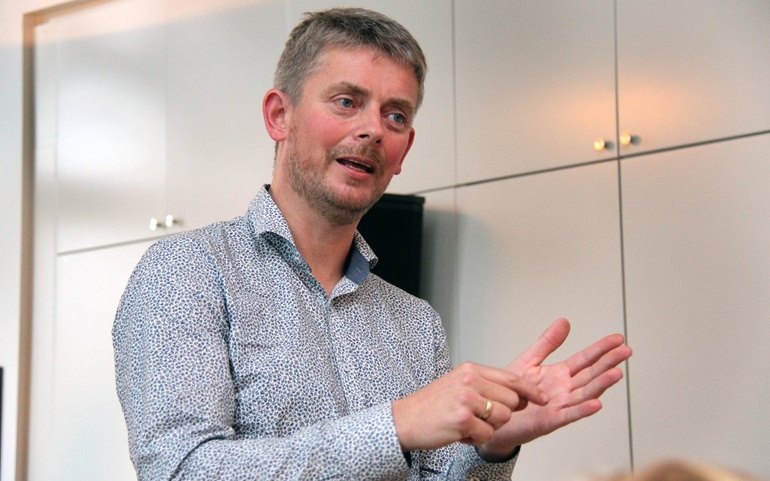
Portrait of Jo Magne Ingul
. Siri Bjaarstad, via NAPHA. Source.A researcher who tested guided parent-delivered cognitive behavioral therapy for childhood anxiety disorders. A randomized trial compared fuller guidance, briefer guidance and a waiting list. The contrast evaluates how therapist support contributes to a parent-delivered package, with eligibility rules limiting how broadly its results can be generalized.[ref]
Treatment of child anxiety disorders via guided parent-delivered cognitive-behavioural therapy by Kerstin Thirlwall and others. 2013, 194 children, guidance conditions and primary-carer eligibility
A researcher who evaluated guided internet-delivered cognitive behavioral therapy for childhood anxiety disorders. A randomized trial compared the intervention with child-directed play and included economic evaluation. The trial concerns a specified supported program, so its results do not automatically establish effectiveness of every unguided online resource.[ref]
Efficacy and cost-effectiveness of therapist-guided internet cognitive behavioural therapy for paediatric anxiety disorders: a single-centre, single-blind, randomised controlled trial by Maral Jolstedt and others. 2018, 131 children aged 8–12, active comparator and cost-effectiveness
A researcher who tested therapist-guided internet-delivered cognitive behavioral therapy for young people with social anxiety disorder. A randomized trial compared it with internet-delivered supportive therapy and used masked clinical severity ratings. An active comparison tests benefits beyond receiving online contact and support, rather than comparing only with no intervention.[ref]
A researcher who examined which components of cognitive behavioral therapy relate to childhood anxiety outcomes. A meta-analysis compared treatment conditions differing in exposure therapy and anxiety-management content. These between-study component associations motivate trials of treatment changes, but they do not randomize the components independently or establish a universal optimal package.[ref]
A meta-analysis to guide the enhancement of CBT for childhood anxiety: exposure over anxiety management by Stephen P. H. Whiteside and others. 2020, 75 studies, 111 CBT conditions and component meta-regressions

Portrait of Stephen P. H. Whiteside
. Mayo Clinic staff portrait. Source.A researcher who investigated barriers to access to mental health care for children with anxiety disorders. Interviews with parents of school-identified children examined how families recognized difficulties and sought help. The qualitative interview design reveals experiences and candidate mechanisms without estimating how prevalent each barrier is throughout the population.[ref]
A researcher who tested one-session treatment of specific phobia in youths. A randomized trial compared an intensive approach-based package with education-support and a waiting list. Including an active comparator helps distinguish benefits of the specified treatment from contact and support, while the trial does not establish that one session is optimal for every young person.[ref]
One-session treatment of specific phobias in youth: a randomized clinical trial in the United States and Sweden by Thomas H. Ollendick and others. 2009, 196 youths and three comparison conditions
A researcher who tested causal accounts of interpretation bias and anxiety with Bundy Mackintosh. Training altered how participants resolved ambiguous information; changes in anxiety depended on how the material was processed. The experiments distinguish manipulating an interpretive tendency from observing a correlation between anxious feelings and threatening interpretations.[ref]
A researcher who, with Andrew Mathews, experimentally changed interpretation bias. Repeated ambiguous material was resolved in threatening or benign ways, with later interpretations and anxiety measured separately. Active processing mattered for changes in anxiety, showing why shifting a task score is not equivalent to establishing a clinical benefit.[ref]
Induced emotional interpretation bias and anxiety by Andrew Mathews and Bundy Mackintosh. 2000, five experiments and active-meaning-generation comparison
A clinical psychologist who developed cognitive accounts and treatments of panic disorder.[ref]
A cognitive approach to panic by David M. Clark. 1986, author and study described in the original publication
A clinical psychologist who experimentally investigated the maintaining role of safety behaviors in anxiety.[ref]
An experimental investigation of the role of safety-seeking behaviours in the maintenance of panic disorder with agoraphobia by Paul Salkovskis and others. 1999, author and study described in the original publication
A clinical psychologist who tested self-focused attention, safety behaviors and video feedback in social anxiety.[ref]
Why social anxiety persists by Freda McManus and others. 2008, author and study described in the original publication
Pinned article: Introduction to the OurBigBook Project
Welcome to the OurBigBook Project! Our goal is to create the perfect publishing platform for STEM subjects, and get university-level students to write the best free STEM tutorials ever.
Everyone is welcome to create an account and play with the site: ourbigbook.com/go/register. We belive that students themselves can write amazing tutorials, but teachers are welcome too. You can write about anything you want, it doesn't have to be STEM or even educational. Silly test content is very welcome and you won't be penalized in any way. Just keep it legal!
Intro to OurBigBook
. Source. We have two killer features:
- topics: topics group articles by different users with the same title, e.g. here is the topic for the "Fundamental Theorem of Calculus" ourbigbook.com/go/topic/fundamental-theorem-of-calculusArticles of different users are sorted by upvote within each article page. This feature is a bit like:
- a Wikipedia where each user can have their own version of each article
- a Q&A website like Stack Overflow, where multiple people can give their views on a given topic, and the best ones are sorted by upvote. Except you don't need to wait for someone to ask first, and any topic goes, no matter how narrow or broad
This feature makes it possible for readers to find better explanations of any topic created by other writers. And it allows writers to create an explanation in a place that readers might actually find it.
Figure 1. Screenshot of the "Derivative" topic page. View it live at: ourbigbook.com/go/topic/derivativeVideo 2. OurBigBook Web topics demo. Source. - local editing: you can store all your personal knowledge base content locally in a plaintext markup format that can be edited locally and published either:This way you can be sure that even if OurBigBook.com were to go down one day (which we have no plans to do as it is quite cheap to host!), your content will still be perfectly readable as a static site.
- to OurBigBook.com to get awesome multi-user features like topics and likes
- as HTML files to a static website, which you can host yourself for free on many external providers like GitHub Pages, and remain in full control

Figure 2. You can publish local OurBigBook lightweight markup files to either OurBigBook.com or as a static website.
Figure 3. Visual Studio Code extension installation.
Figure 5. . You can also edit articles on the Web editor without installing anything locally. Video 3. Edit locally and publish demo. Source. This shows editing OurBigBook Markup and publishing it using the Visual Studio Code extension. 
- Infinitely deep tables of contents:


All our software is open source and hosted at: github.com/ourbigbook/ourbigbook
Further documentation can be found at: docs.ourbigbook.com
Feel free to reach our to us for any help or suggestions: docs.ourbigbook.com/#contact