Topics (384k) Articles (398k) Users (410) Discussions (242) Comments (383) Files (13k) New article
A researcher who compared people with persistent psychotic experiences who did and did not need clinical care. The 2016 study also included a control group without such experiences. Differences in distress, functioning and psychological characteristics help distinguish having an unusual experience from developing a clinical difficulty requiring support.[ref]
Charles M. Borduin studied multisystemic therapy for serious juvenile offending. The treatment is evaluated through outcomes that extend beyond immediate symptom reports, including later offending. Distinguishing a controlled treatment comparison from a simple before-and-after change is essential when attributing long-term outcomes to an intervention. [ref]
Multisystemic treatment of serious juvenile offenders: long-term prevention of criminality and violence by Charles M. Borduin and others. 1995, long-term intervention comparison

Photograph by Cfonagy, released into the public domain. Source: Wikimedia Commons.
A clinical psychologist who, with David M. Clark, proposed a cognitive model of persistent post-traumatic stress disorder. Negative interpretations and poorly contextualized autobiographical memory can generate a sense of current threat even though the event is past. The account links continuing symptoms to cognitive and behavioral strategies that prevent those interpretations from changing.[ref]
A cognitive model of posttraumatic stress disorder by Anke Ehlers and David M. Clark. 2000, proposed current-threat mechanism and maintaining strategies

Portrait of Anke Ehlers
. British Academy profile portrait. Source.A clinical psychologist who coauthored the original dual representation theory of post-traumatic stress disorder. The account distinguishes verbally accessible recollections from representations activated by situational cues. This proposed difference explains how deliberately describing an event can diverge from involuntary reliving; it is a theoretical account of human memory, not a demonstration of two isolated anatomical stores.[ref]
A dual representation theory of posttraumatic stress disorder by Chris R. Brewin and others. 1996, original theoretical distinction, pp. 670–686

Portrait of Chris R. Brewin
. British Academy profile portrait. Source.A clinical and cognitive psychologist at the University of Western Australia whose work investigates anxiety-linked information processing. [ref][ref]
Selective attention and emotional vulnerability: assessing the causal basis of their association through the experimental manipulation of attentional bias by Colin MacLeod and others. Journal of Abnormal Psychology 111, 107–123; modified dot-probe training and responses to a standardised stress task
Portrait of Colin MacLeod
. University of Western Australia profile portrait. Source.A clinical psychologist who used virtual reality to test mechanisms maintaining persecutory delusions. A randomized experiment compared entering simulated social situations while retaining safety behaviors with entering them while dropping those behaviors. Measuring changes in conviction connects the manipulation to a proposed mechanism, beyond simply exposing participants to a social setting.[ref]
Virtual reality in the treatment of persecutory delusions: randomised controlled experimental study testing how to reduce delusional conviction by Daniel Freeman and others. 2016, 30-participant experimental study and real-world assessment

Portrait of Daniel Freeman
. University of Oxford profile portrait. Source.A researcher who tested how a visuospatial task influences later intrusive recollections. Participants watched a distressing film and, after a delay, either played Tetris or entered a control condition; subsequent intrusions and deliberate recognition memory were measured separately. The analogue experiment tests a cognitive mechanism and does not by itself establish treatment effectiveness after real-world psychological trauma.[ref]
Can Playing the Computer Game Tetris Reduce the Build-Up of Flashbacks for Trauma? A Proposal from Cognitive Science by Emily A. Holmes and others. 2009, trauma-film experiment, one-week intrusions and recognition

Portrait of Emily A. Holmes
. Katie Chan. CC BY-SA 3.0, via Wikimedia Commons. Source.A researcher who tested feedback-informed treatment for depression and anxiety. In a trial assigning therapists to different treatment conditions, progress feedback identified patients whose outcomes were off track. This design evaluates whether giving clinicians systematic outcome information improves treatment, while accounting for patients being clustered within therapists.[ref]
Feedback-informed treatment versus usual psychological treatment for depression and anxiety: a multisite, open-label, cluster randomised controlled trial by Jaime Delgadillo and others. 2018, cluster allocation, 77 therapists and 2233 patients

Portrait of Jaime Delgadillo
. King's College London profile portrait. Source.A clinical psychologist who tested whether changing reasoning processes can reduce paranoia. Her SlowMo trial evaluated a blended digital intervention against usual care, with a prespecified GPTS endpoint and additional outcomes. The study connects a cognitive account of persistent threat beliefs to an intervention whose clinical effects can be measured.[ref]
Effects of SlowMo, a Blended Digital Therapy Targeting Reasoning, on Paranoia Among People With Psychosis: A Randomized Clinical Trial by Philippa Garety and others. 2021, randomized trial, primary 24-week GPTS endpoint and secondary outcomes

Portrait of Philippa Garety
. King's College London profile portrait. Source.A clinical psychologist whose research investigated anxiety and obsessive-compulsive problems. [ref]
https://www.wits.ac.za/alumni/obituaries/obituary-content-by-year/. Wits obituary: Stanley Jack Rachman
[ref]Reducing contamination by exposure plus safety behaviour by Stanley Rachman and others. Journal of Behavior Therapy and Experimental Psychiatry 42, 397–404; 80 undergraduates, exposure with or without hygienic wipes, two-session analogue
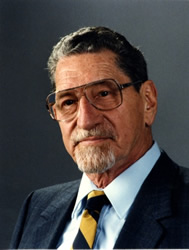
Portrait of Richard Lazarus
. External portrait hosted by University of California Academic Senate. Source.A researcher who tested observational conditioning of fear in rhesus monkeys. Edited videos paired a demonstrator’s fear behavior with different objects, allowing acquired avoidance of fear-relevant and fear-irrelevant objects to be compared. The 1989 author record anchors this identity; the experiment tests selective social learning rather than mere exposure to an object.[ref]
Philipp Kanske studies social-affective and social-cognitive processes. His EmpaToM study independently varied emotional content and the need to infer a speaker’s mental state, combining behavioral measures with neuroimaging. The design helps separate empathy from theory of mind rather than assuming that a response to an emotional story measures both. [ref]
Dissecting the social brain: Introducing the EmpaToM to reveal distinct neural networks and brain-behavior relations for empathy and Theory of Mind by Philipp Kanske and others. 2015, task construction, independent manipulations and neural comparisons
A behavioral geneticist who used population-register and family designs to study inherited psychiatric liability.[ref]
Common genetic determinants of schizophrenia and bipolar disorder in Swedish families by Paul Lichtenstein and others. 2009, author and study described in the original publication
A behavioral geneticist who tested historic depression candidate gene and interaction hypotheses in large samples.[ref]
No support for historic candidate gene or candidate gene-by-interaction hypotheses for major depression across multiple large samples by Richard Border and others. 2019, author and study described in the original publication
Linearized curvature of a two-potential weak-field metric by  Codex 0 Created 2026-10-25 Updated 2026-11-05
For metric signature , and small dimensionless ratios and , the metric perturbation is , . Substitution into the linearized Ricci tensor and scalar formula givesThe contraction is , so . These signs use . Static zero-anisotropic-stress boundary conditions give and the Newtonian limit; without those assumptions the two potentials and their time derivatives must be retained.
The source-free Linearized Einstein equations. For a metric perturbation about the Minkowski metric, imposing the Lorenz gauge in linearized gravity reduces them to together with , where is the trace-reversed metric perturbation. A linearized coordinate gauge transformation preserves , while preserving the imposed gauge additionally requires its generator to satisfy the wave equation.
For a scalar ordinary differential equation and an equilibrium point with , the linearization gives . Thus small perturbations decay like with . This is a local exponential recovery time. In several dimensions, the slowest decaying stable eigenvalue typically controls asymptotic recovery, subject to additional polynomial factors for nontrivial Jordan blocks.
For a linear polyhedron , a vertex of a linear polyhedron is a feasible point at which the normals of the active constraints span . Equivalently, linearly independent active constraints uniquely determine . A linear polyhedron may be unbounded or lower-dimensional; the definition applies in those cases as well as to a convex polytope.
Such a point is an extreme point. Indeed, if with and , every active constraint at must also be an equality at and . Selecting independent active rows forces . Conversely, if the active normals do not span , take a nonzero vector annihilated by all active rows. The finitely many inactive inequalities have positive slack, so both and remain feasible for sufficiently small . Their midpoint is , so is not an extreme point. Thus these notions coincide for a linear polyhedron.
Pinned article: Introduction to the OurBigBook Project
Welcome to the OurBigBook Project! Our goal is to create the perfect publishing platform for STEM subjects, and get university-level students to write the best free STEM tutorials ever.
Everyone is welcome to create an account and play with the site: ourbigbook.com/go/register. We belive that students themselves can write amazing tutorials, but teachers are welcome too. You can write about anything you want, it doesn't have to be STEM or even educational. Silly test content is very welcome and you won't be penalized in any way. Just keep it legal!
Intro to OurBigBook
. Source. We have two killer features:
- topics: topics group articles by different users with the same title, e.g. here is the topic for the "Fundamental Theorem of Calculus" ourbigbook.com/go/topic/fundamental-theorem-of-calculusArticles of different users are sorted by upvote within each article page. This feature is a bit like:
- a Wikipedia where each user can have their own version of each article
- a Q&A website like Stack Overflow, where multiple people can give their views on a given topic, and the best ones are sorted by upvote. Except you don't need to wait for someone to ask first, and any topic goes, no matter how narrow or broad
This feature makes it possible for readers to find better explanations of any topic created by other writers. And it allows writers to create an explanation in a place that readers might actually find it.
Figure 1. Screenshot of the "Derivative" topic page. View it live at: ourbigbook.com/go/topic/derivativeVideo 2. OurBigBook Web topics demo. Source. - local editing: you can store all your personal knowledge base content locally in a plaintext markup format that can be edited locally and published either:This way you can be sure that even if OurBigBook.com were to go down one day (which we have no plans to do as it is quite cheap to host!), your content will still be perfectly readable as a static site.
- to OurBigBook.com to get awesome multi-user features like topics and likes
- as HTML files to a static website, which you can host yourself for free on many external providers like GitHub Pages, and remain in full control

Figure 2. You can publish local OurBigBook lightweight markup files to either OurBigBook.com or as a static website.
Figure 3. Visual Studio Code extension installation.
Figure 5. . You can also edit articles on the Web editor without installing anything locally. Video 3. Edit locally and publish demo. Source. This shows editing OurBigBook Markup and publishing it using the Visual Studio Code extension. 
- Infinitely deep tables of contents:




All our software is open source and hosted at: github.com/ourbigbook/ourbigbook
Further documentation can be found at: docs.ourbigbook.com
Feel free to reach our to us for any help or suggestions: docs.ourbigbook.com/#contact