Topics (384k) Articles (398k) Users (410) Discussions (242) Comments (383) Files (13k) New article

Marc O. Ernst studied multisensory cue combination using visual and haptic height information. Changing cue uncertainty tests whether observers adjust their weighting in the direction predicted by a statistical integration model. The experiment connects a perceptual estimate to measurable noise rather than assuming that one sensory modality always dominates. [ref]
Humans integrate visual and haptic information in a statistically optimal fashion by Marc O. Ernst and Martin S. Banks. 2002, visual-haptic estimates and uncertainty-dependent weights
Alan D. Castel studies human memory and metacognition. With Matthew G. Rhodes, he tested whether perceptual characteristics influence judgments of learning differently from later recall. Manipulating print size helped reveal a mismatch between a cue’s influence on prediction and its influence on performance. Measuring both outcomes makes it possible to identify a metacognitive illusion rather than assuming that an easily processed item will necessarily be remembered better. [ref]
Memory Predictions Are Influenced by Perceptual Information by Matthew G. Rhodes and Alan D. Castel. 2008, perceptual-cue manipulation and calibration of predictions
Allison L. Foote coauthored an experimental study of metacognition in rats with Jonathon D. Crystal. Rats classified the duration of a stimulus and could instead select a decline option. Preferential use of that option on difficult trials, together with comparisons of forced and accepted tests, made uncertainty-sensitive behavior measurable without asking for a verbal explanation. The interpretation requires considering associative alternatives as well as the monitoring account. [ref]
Metacognition in the rat by Allison L. Foote and Jonathon D. Crystal. 2007, duration-discrimination experiment and opt-out comparisons
A researcher in metacognition who proposed that subjective confidence depends on the consistency of evidence supporting an answer. In his self-consistency model, people can confidently choose a wrong answer when the accessible evidence consistently favors it. This separates the mechanism producing confidence from the external criterion used to judge its accuracy.[ref]
The self-consistency model of subjective confidence by Asher Koriat. 2012, model assumptions and confidence–accuracy predictions

Portrait of Asher Koriat
. Photograph by צחי לרנר, 26 November 2008. Reuse permitted with attribution to the photographer; see the linked Commons file page for its attribution-only terms. Source.Benjamin Baird studies cognition, including the relation between mind-wandering and creativity. In the creative-incubation experiment, participants returned to an idea-generation task after different intervening activities. An undemanding intervening task was associated with improvement for previously encountered problems. The result concerns a particular incubation arrangement and outcome, rather than showing that distraction always improves reasoning or that every reported off-task thought is creative. [ref]
Inspired by Distraction: Mind Wandering Facilitates Creative Incubation by Benjamin Baird and others. 2012, repeated problems, incubation conditions and divergent-use performance
Brian Maniscalco is a researcher in metacognition and its measurement. With Hakwan Lau, he introduced a method that estimates meta-d-prime from confidence reports and task outcomes. Comparing the estimate with first-order sensitivity asks how much task-relevant information is reflected in self-evaluation. It avoids identifying confidence magnitude alone with accurate monitoring, although the interpretation still depends on the specified signal detection theory model. [ref]
A cognitive psychologist who applied information theory to limits on human information processing. His 1956 paper distinguished immediate human memory from judgments of isolated sensory magnitudes and emphasized that chunking changes how much information a remembered unit contains. Familiar groups of items can be retained as units, so a count of remembered units is not a universal limit on bits of information. [ref]
The Magical Number Seven, Plus or Minus Two by George Armitage Miller. Immediate memory, recoding and concluding discussion
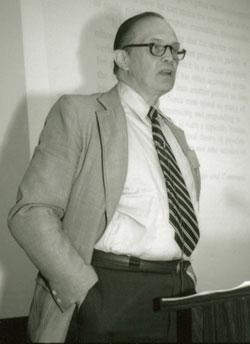
Hakwan Lau studies awareness and metacognition. With Brian Maniscalco, he developed a signal detection theory approach for estimating metacognitive sensitivity from confidence ratings. The resulting meta-d-prime expresses confidence-based discrimination using a scale comparable to task sensitivity. The method separates how strongly confidence tracks correctness from a general tendency to use high or low confidence, while retaining assumptions about the modeled decision process. [ref]
A signal detection theoretic approach for estimating metacognitive sensitivity from confidence ratings by Brian Maniscalco and Hakwan Lau. 2012, meta-d-prime construction and confidence criteria
John Dunlosky studies learning, human memory and metacognition, including how people assess what they will remember. His work with Thomas O. Nelson varied the timing and cue content of judgments of learning. A useful monitoring judgment predicts which items will later be recalled, which is different from merely reporting a high average expectation of success. This distinction helps connect laboratory judgments to decisions about further study. [ref]
Importance of the kind of cue for judgments of learning and the delayed-JOL effect by John Dunlosky and Thomas O. Nelson. 1992, cue conditions and delayed-JOL accuracy
Jonathan Smallwood studies mind-wandering and the allocation of attention. His work compares task performance with reports or other indicators of thought directed away from the ongoing task. In the creative-incubation study with Benjamin Baird and colleagues, activity during an intervening period was manipulated before later performance was measured. The contrast connects off-task thought to an experimentally specified context rather than treating every instance of distraction as equivalent. [ref]
Inspired by Distraction: Mind Wandering Facilitates Creative Incubation by Benjamin Baird and others. 2012, incubation-task conditions and subsequent idea generation
Jonathon D. Crystal studies animal cognition, including tests of metacognition that do not require verbal reports. With Allison L. Foote, he examined rats’ use of an option to decline difficult duration-discrimination trials. Performance on accepted trials and the pattern of declining provide complementary evidence about uncertainty-sensitive behavior. Distinguishing monitoring from learned stimulus or reward cues is part of interpreting this experimental design. [ref]
Metacognition in the rat by Allison L. Foote and Jonathon D. Crystal. 2007, duration classification, decline option and control comparisons
Matthew A. Killingsworth studies thought and experience in everyday settings. With Daniel T. Gilbert, he used smartphone-based experience sampling to obtain repeated reports of current activity, thought and feeling. The study associated mind-wandering with lower reported happiness. Repeated observations reduce dependence on one distant retrospective summary, but observational associations still require care when assigning a unique causal explanation. [ref]
Matthew G. Rhodes studies human memory and metacognition. With Alan D. Castel, he investigated how perceptual features such as print size influence judgments of learning. A feature could change predicted remembering without producing a matching change in later performance. The comparison separates a readily available cue from its actual predictive usefulness, illustrating how metacognitive judgments can depend on information that is salient but poorly calibrated to the final task. [ref]
Memory Predictions Are Influenced by Perceptual Information by Matthew G. Rhodes and Alan D. Castel. 2008, font-size manipulation and subsequent memory tests
Petter Johansson studies decision processes and the relation between choices and reported reasons. In a choice blindness experiment, a selected outcome was covertly exchanged before participants explained their choice. Some participants supplied reasons for an outcome they had not selected. Comparing detection with explanation shows why a fluent retrospective account is not by itself proof of accurate access to the process that generated the original decision. [ref]
Robert R. Hampton is a researcher in comparative cognition. In a rhesus-monkey memory in animals experiment, animals could choose whether to take a test; declining was related to conditions in which memory in animals was less reliable. This design tests monitoring of a currently available memory in animals rather than relying on verbal reports. Appropriate performance supports an account of memory in animals monitoring, while the relation to human subjective experience remains a separate explanatory question. [ref]
Rhesus monkeys know when they remember by Robert R. Hampton. 2001, memory-test acceptance and decline experiments

Portrait of Robert R. Hampton
. External portrait linked by Emory University’s researcher profile. Source.Stephen M. Fleming studies metacognition, including computational accounts of how people evaluate decisions. With Nathaniel D. Daw, he formulated self-evaluation as an inference about a decision system that is related to, but distinguishable from, the system generating the choice. This framework can represent differences between task performance and subjective confidence, turning a verbal claim about self-awareness into predictions about observable choices and confidence reports. [ref]
Self-Evaluation of Decision-Making: A General Bayesian Framework for Metacognitive Computation by Stephen M. Fleming and Nathaniel D. Daw. 2017, second-order Bayesian framework and modeled dissociations
Thomas O. Nelson contributed to cognitive psychology through work on metacognition and the accuracy of judgments of learning. With John Dunlosky, he studied how the delay before a judgment and the information available at judgment affect prediction of later remembering. Separating prediction from subsequent recall allows researchers to test which cues support useful monitoring, rather than equating high predicted success with good human memory. [ref]
Importance of the kind of cue for judgments of learning and the delayed-JOL effect by John Dunlosky and Thomas O. Nelson. 1992, delayed judgments and cue manipulation
A cognitive psychologist whose research includes concept learning and compositional generalization.[ref]
Human-level concept learning through probabilistic program induction by Brenden M. Lake and others. Author identification and the research contribution described in this paper
A cognitive psychologist whose research includes distributed representations, learning and human memory.[ref]
Why there are complementary learning systems in the hippocampus and neocortex: insights from the successes and failures of connectionist models of learning and memory by James L. McClelland and others. Author identification and the research contribution described in this paper

Portrait of James L. McClelland
. Jussi Puikkonen/KNAW. CC BY 2.0, via Wikimedia Commons. Source.A cognitive psychologist whose research includes task-state representations and decision making.[ref]
Human Orbitofrontal Cortex Represents a Cognitive Map of State Space by Nicolas W. Schuck and others. Author identification and the research contribution described in this paper
Pinned article: Introduction to the OurBigBook Project
Welcome to the OurBigBook Project! Our goal is to create the perfect publishing platform for STEM subjects, and get university-level students to write the best free STEM tutorials ever.
Everyone is welcome to create an account and play with the site: ourbigbook.com/go/register. We belive that students themselves can write amazing tutorials, but teachers are welcome too. You can write about anything you want, it doesn't have to be STEM or even educational. Silly test content is very welcome and you won't be penalized in any way. Just keep it legal!
Intro to OurBigBook
. Source. We have two killer features:
- topics: topics group articles by different users with the same title, e.g. here is the topic for the "Fundamental Theorem of Calculus" ourbigbook.com/go/topic/fundamental-theorem-of-calculusArticles of different users are sorted by upvote within each article page. This feature is a bit like:
- a Wikipedia where each user can have their own version of each article
- a Q&A website like Stack Overflow, where multiple people can give their views on a given topic, and the best ones are sorted by upvote. Except you don't need to wait for someone to ask first, and any topic goes, no matter how narrow or broad
This feature makes it possible for readers to find better explanations of any topic created by other writers. And it allows writers to create an explanation in a place that readers might actually find it.
Figure 1. Screenshot of the "Derivative" topic page. View it live at: ourbigbook.com/go/topic/derivativeVideo 2. OurBigBook Web topics demo. Source. - local editing: you can store all your personal knowledge base content locally in a plaintext markup format that can be edited locally and published either:This way you can be sure that even if OurBigBook.com were to go down one day (which we have no plans to do as it is quite cheap to host!), your content will still be perfectly readable as a static site.
- to OurBigBook.com to get awesome multi-user features like topics and likes
- as HTML files to a static website, which you can host yourself for free on many external providers like GitHub Pages, and remain in full control

Figure 2. You can publish local OurBigBook lightweight markup files to either OurBigBook.com or as a static website.
Figure 3. Visual Studio Code extension installation.
Figure 5. . You can also edit articles on the Web editor without installing anything locally. Video 3. Edit locally and publish demo. Source. This shows editing OurBigBook Markup and publishing it using the Visual Studio Code extension. 
- Infinitely deep tables of contents:




All our software is open source and hosted at: github.com/ourbigbook/ourbigbook
Further documentation can be found at: docs.ourbigbook.com
Feel free to reach our to us for any help or suggestions: docs.ourbigbook.com/#contact