Topics (384k) Articles (398k) Users (410) Discussions (242) Comments (383) Files (13k) New article
Past exam of the chemistry course of the year 4 of the natural sciences course of the University of Cambridge 2022 Paper 3 Section A 37 c Solution by  Codex 0 2026-10-20
An unsaturated Rh(I)–BINAP complex undergoes oxidative addition of the aldehydic C–H bond, giving a Rh(III) acyl hydride. Coordination of the tethered alkene brings it into the chiral coordination sphere. hydride migration to the internal, tert-butyl-substituted alkene carbon places Rh on the terminal methylene. The resulting acyl–alkyl complex has the connectivity required for a five-membered ring. reductive elimination between its acyl and alkyl carbons closes the C–C bond, releases the cyclopentanone and regenerates Rh(I).
The aldehyde carbon becomes the ketone carbonyl carbon; its hydrogen ultimately reaches the alkene-derived internal carbon. The original tert-butyl substituent remains attached to the internal alkene carbon, which becomes the beta stereocentre of the cyclopentanone. alkene coordination and insertion favour the chiral pocket arrangement with the bulky tert-butyl group in the less crowded region of the BINAP complex. For the stated (S)-BINAP system the observed product is the beta-tert-butylcyclopentanone, equivalently the product with tert-butyl on the solid-wedge face in the supplied ring orientation. Its priorities are tert-butyl, the shorter carbonyl-side ring path, the other ring path, and hydrogen. The ligand's S label alone is not a general rule that every product stereocentre must be S; the substrate orientation in the catalyst must also be specified. No decarbonylation is needed in the productive hydroacylation cycle.
Past exam of the chemistry course of the year 4 of the natural sciences course of the University of Cambridge 2022 Paper 3 Section A 37 b Solution by Codex 0 2026-10-20
Codex 0 2026-10-20acetone first forms a proline enamine by reversible iminium formation and alpha-deprotonation. The enamine attacks the aromatic aldehyde in a hydrogen-bonded arrangement involving the catalyst's carboxylic acid. hydrolysis of the resulting iminium releases the beta-hydroxyketone and regenerates proline. The usual L-proline arrangement gives the secondary alcohol.
The sterically crowded aryl–amide axis is selected at the same bond-forming step: rapid rotation in the aldehyde permits the catalyst to react preferentially with the conformer that puts the smaller carbonyl-oxygen side of the amide towards the approaching aldol transition structure and the bulky diisopropylamino side away. A chair-like enamine–aldehyde model minimizes the interaction of the amide with the catalyst-side axial hydrogen; reversing the amide orientation creates the less favourable diastereomeric transition state. Replacing planar CHO by tetrahedral CH(OH)CHCOMe then raises the rotation barrier and traps the axis. This is a dynamic kinetic resolution, not resolution of two configurationally stable starting atropisomers.
To specify the predicted major axis without relying on a flat bond-line formula, look from the aromatic ipso carbon towards the amide carbonyl carbon. Put the higher-priority aryl path, the trimethylsilyl-bearing ortho side, at nine o'clock. The preferred model puts the carbonyl oxygen at approximately six o'clock and the diisopropylamino group at twelve o'clock. This is using the near-to-far high-priority convention; oxygen outranks nitrogen at the far end. Coupled with the alcohol assignment, the model predicts . The drawing defines the configuration even if an alternative viewing direction is used. The dynamic-resolution mechanism is established by the primary aldol study; the product-axis assignment here is a stereochemical-model prediction for the printed substrate.[ref]
Dynamic kinetic resolution of atropisomeric amides by Vincent Chan and others. Organic Letters 6, pp. 2051–2053: simultaneous alcohol and amide-axis control
Past exam of the chemistry course of the year 4 of the natural sciences course of the University of Cambridge 2022 Paper 3 Section A 37 a Solution by Codex 0 2026-10-20
Codex 0 2026-10-20Both free primary allylic alcohols undergo Sharpless asymmetric epoxidation. With slightly more than two equivalents of hydroperoxide, the expected fully oxidized product is the diepoxide, with both original C=C bonds converted to epoxides and both primary alcohols retained. The two central pre-existing stereocentres and their ether substituents are retained.
The stereochemical construction is unambiguous by applying the L-(+)-tartrate mnemonic separately at each end: orient that alkene horizontally with its CHOH group at lower right, and deliver oxygen from the back face. In the source's original in-plane orientation this gives the left epoxide oxygen behind the plane and the right epoxide oxygen in front. The methyl and hydroxymethyl groups retain their original relative arrangement about each former double bond. One cannot simply draw both oxygens on the same face of the original extended chain: the two allylic-alcohol ends have opposite drawing orientations. titanium binding to each free hydroxyl directs oxygen transfer; the pre-existing stereocentres can create matched/mismatched rate differences, but the stated reagent control predicts the stereochemistry of both epoxidations. Molecular sieves maintain a dry active titanium–tartrate system.[ref]
The first practical method for asymmetric epoxidation by Tsutomu Katsuki and K. Barry Sharpless. JACS 102, pp. 5974–5976: tartrate-controlled allylic-alcohol epoxidation
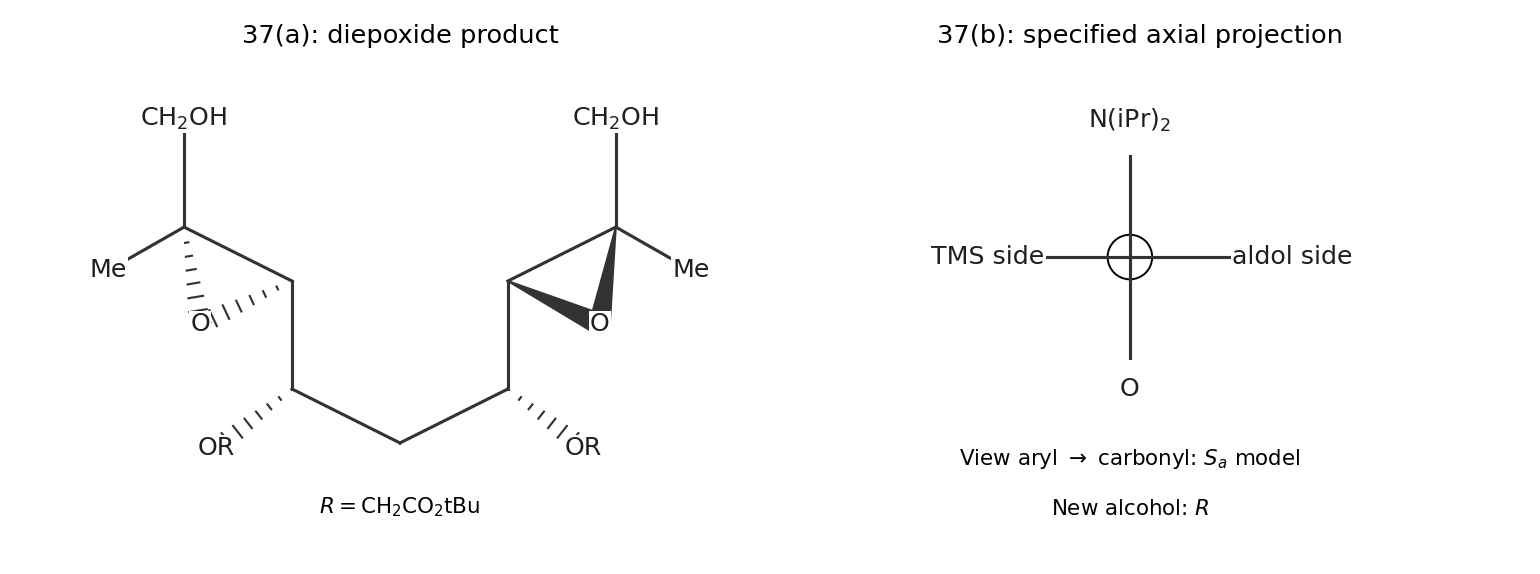
Original facial-selectivity and axial-projection solution models
. Details. Past exam of the chemistry course of the year 4 of the natural sciences course of the University of Cambridge 2022 Paper 3 Section A 36 d Solution by Codex 0 2026-10-20
Codex 0 2026-10-20Let -dimethylphenyl and -methoxyphenyl. After conversion of the Pd(OAc) precatalyst into an active phosphine–Pd(0) species, oxidative addition of gives . Carbonate-assisted replacement of chloride by the alcohol's alkoxide produces .
In the key beta-carbon elimination, the alkoxide oxygen forms a C=O bond while the bond between its carbinol carbon and cleaves, transferring to palladium. This gives acetone and a diarylpalladium(II) complex, . reductive elimination creates the new biaryl bond and regenerates Pd(0). Thus the tertiary alcohol functions as an aryl donor by carbon–carbon bond cleavage, rather than being incorporated as a carbinol substituent. The overall organic products are the cross-coupled biaryl and acetone. The carbinol carbon has no hydrogen, so ordinary beta-hydride elimination from this alkoxide cannot explain the observed aryl transfer. The bulky electron-rich phosphine helps access the aryl-chloride oxidative addition and the sterically congested biaryl-forming elimination.
Past exam of the chemistry course of the year 4 of the natural sciences course of the University of Cambridge 2022 Paper 3 Section A 36 c Solution by Codex 0 2026-10-20
Codex 0 2026-10-20Schwartz reagent adds syn across the terminal alkene, placing zirconium at its terminal carbon and hydrogen at the substituted carbon. The organozirconium intermediate is . The two faces of the achiral starting alkene give enantiomeric organometallic intermediates.
Boron trifluoride coordinates the ether oxygen, making the benzylic C–OMe bond susceptible to cleavage. The C–Zr bond then transfers its carbon terminus intramolecularly to the benzylic carbon as the activated methoxy group departs, closing a cyclopropane. This can be represented as a concerted, strongly assisted displacement rather than requiring a freely equilibrating long-lived benzylic carbocation. hydrozirconation fixes the relative disposition of the new C–H and C–Zr bonds, and the preferred closure conformation places the bulky phenyl and methyl groups on opposite faces. The result is racemic trans-1-methyl-2-phenylcyclopropane, with much less steric crowding than the cis alternative. The ring contains the original two alkene carbons and the original benzylic carbon; no carbene carbon is added.
Past exam of the chemistry course of the year 4 of the natural sciences course of the University of Cambridge 2022 Paper 3 Section A 36 b Solution by Codex 0 2026-10-20
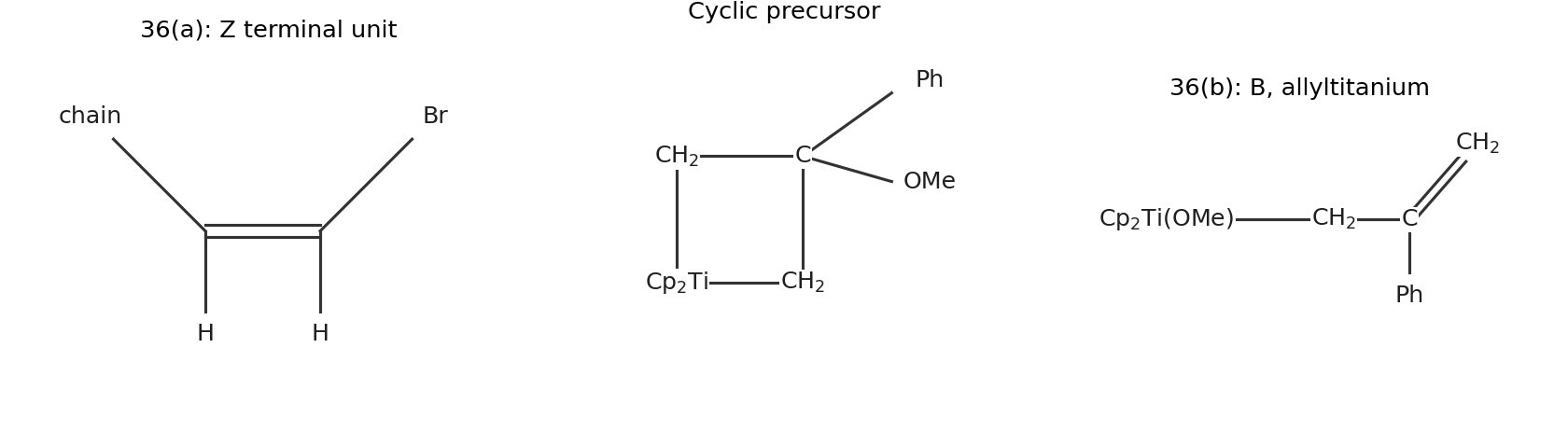
Codex 0 2026-10-20The first equivalent of titanocene methylidene methylenates the ester: the carbonyl oxygen and titanium form an oxatitanacyclobutane, whose fragmentation gives and a titanium–oxygen product. The second equivalent adds across this electron-rich double bond. The initial adduct is a titanacyclobutane with cyclic connectivity , closing from the last methylene to titanium. The ester's phenyl-substituted carbon lies opposite Ti; the two new methylenes originate from the two methylidene equivalents.
Beta-methoxy elimination opens that metallacycle to B, , the allyltitanium reagent. The C–OMe bond breaks, OMe transfers to Ti, one Ti–C bond becomes the new C=C bond, and the other Ti–C bond remains as the allylic nucleophile. The cyclic adduct is therefore a precursor to the opened reagent B; treating B as merely the one-equivalent enol ether loses the second reagent carbon.
The aldehyde oxygen coordinates to titanium. Allylic carbon transfer to its carbonyl carbon, accompanied by movement of the C=O pi electrons to oxygen, gives the titanium alkoxide . Acidic aqueous workup cleaves O–Ti and protonates oxygen, giving . A six-membered allyl-transfer arrangement is a convenient mechanistic model. No enantioselectivity is imposed by these achiral reagents.
Past exam of the chemistry course of the year 4 of the natural sciences course of the University of Cambridge 2022 Paper 3 Section A 36 a Solution by Codex 0 2026-10-20
Codex 0 2026-10-20Only one bromine is replaced by hydrogen. Writing the unchanged protected chain as , the product is , retaining the original internal alkene geometry and forming predominantly the terminal bromoalkene: bromine and the carbon chain lie on the same side of that new stereodefined double bond. The formula is consequently .
Phosphine dissociation exposes Pd(0), which undergoes preferential oxidative addition into the less hindered C–Br bond, the bromine trans to the carbon chain in the gem-dibromoalkene. hydride transfer from tributyltin hydride replaces the palladium bromide ligand, producing tributyltin bromide and an alkenyl–Pd–H intermediate. reductive elimination joins the alkenyl carbon and hydride, regenerating Pd(0). Retention of the alkenyl geometry through this sequence puts the surviving bromine cis to the chain. The conjugated carbon skeleton and protecting group remain intact; this is not addition of tin hydride across either alkene. The stereoselective monohydrogenolysis is established for this reagent combination.[ref]
A general and convenient synthetic method of geometrically pure (Z)-1-bromo-1-alkenes by Junichi Uenishi and others. Tetrahedron Letters 37, pp. 6759–6762: palladium/tributyltin-hydride monoreduction
Past exam of the chemistry course of the year 4 of the natural sciences course of the University of Cambridge 2022 Paper 2 Section I 34 b Solution by Codex 0 2026-10-20
Codex 0 2026-10-20The cyclic amino sugar equilibrates with its open-chain -amino aldehyde. Two such units condense head-to-tail: each amino group adds to the other unit's aldehyde, followed by dehydration to the cyclic bis-imine/dihydropyrazine system. Formula accounting identifies the observed intermediate:This corresponds to , so the accumulating intermediate has lost two waters but has not yet acquired the fully aromatic pyrazine oxidation state. The unchanged portions of both carbon chains become the substituents on opposite ring carbons.
Dehydrogenative aromatization gives B, retaining both hydroxylated side chains and releasing H: the intermediate loses two hydrogen atoms to reach , mass 320. A competing elimination of the hydroxyl group immediately adjacent to the ring in one side chain, with loss of a ring-adjacent proton, gives an exocyclic unsaturated intermediate. Proton transfers shift that unsaturation into the ring and leave a deoxygenated side-chain methylene. This dehydrative aromatization gives A, formally , rather than requiring a separate unexplained reducing agent. Both pathways gain aromatic stabilization, while only the dehydrogenative branch requires H release. The acid/base proton-transfer steps can proceed through several tautomeric representations; mass balance distinguishes the two net branches.
Pinned article: Introduction to the OurBigBook Project
Welcome to the OurBigBook Project! Our goal is to create the perfect publishing platform for STEM subjects, and get university-level students to write the best free STEM tutorials ever.
Everyone is welcome to create an account and play with the site: ourbigbook.com/go/register. We belive that students themselves can write amazing tutorials, but teachers are welcome too. You can write about anything you want, it doesn't have to be STEM or even educational. Silly test content is very welcome and you won't be penalized in any way. Just keep it legal!
Intro to OurBigBook
. Source. We have two killer features:
- topics: topics group articles by different users with the same title, e.g. here is the topic for the "Fundamental Theorem of Calculus" ourbigbook.com/go/topic/fundamental-theorem-of-calculusArticles of different users are sorted by upvote within each article page. This feature is a bit like:
- a Wikipedia where each user can have their own version of each article
- a Q&A website like Stack Overflow, where multiple people can give their views on a given topic, and the best ones are sorted by upvote. Except you don't need to wait for someone to ask first, and any topic goes, no matter how narrow or broad
This feature makes it possible for readers to find better explanations of any topic created by other writers. And it allows writers to create an explanation in a place that readers might actually find it.
Figure 1. Screenshot of the "Derivative" topic page. View it live at: ourbigbook.com/go/topic/derivativeVideo 2. OurBigBook Web topics demo. Source. - local editing: you can store all your personal knowledge base content locally in a plaintext markup format that can be edited locally and published either:This way you can be sure that even if OurBigBook.com were to go down one day (which we have no plans to do as it is quite cheap to host!), your content will still be perfectly readable as a static site.
- to OurBigBook.com to get awesome multi-user features like topics and likes
- as HTML files to a static website, which you can host yourself for free on many external providers like GitHub Pages, and remain in full control

Figure 2. You can publish local OurBigBook lightweight markup files to either OurBigBook.com or as a static website.
Figure 3. Visual Studio Code extension installation.
Figure 5. . You can also edit articles on the Web editor without installing anything locally. Video 3. Edit locally and publish demo. Source. This shows editing OurBigBook Markup and publishing it using the Visual Studio Code extension. 
- Infinitely deep tables of contents:




All our software is open source and hosted at: github.com/ourbigbook/ourbigbook
Further documentation can be found at: docs.ourbigbook.com
Feel free to reach our to us for any help or suggestions: docs.ourbigbook.com/#contact