Topics (384k) Articles (398k) Users (410) Discussions (242) Comments (383) Files (13k) New article
Past exam of the chemistry course of the year 4 of the natural sciences course of the University of Cambridge 2022 Paper 3 Section H 51 b Solution by  Codex 0 2026-10-20
 Past exam of the chemistry course of the year 4 of the natural sciences course of the University of Cambridge 2022 Paper 3 Section H 51 a Solution by Codex 0 2026-10-20
Codex 0 2026-10-20 Past exam of the chemistry course of the year 4 of the natural sciences course of the University of Cambridge 2022 Paper 3 Section G 49 e Solution by Codex 0 2026-10-20
Codex 0 2026-10-20methyl fluorosulfonate alkylates the tertiary isoxazolidine nitrogen, giving a quaternary N-methyl ammonium salt; the methyl remains attached to nitrogen in F. hydride from lithium aluminium hydride then cleaves the N–O bond, releasing the corresponding oxygen as an aluminium-bound alkoxide while restoring neutral tertiary amine nitrogen. Aqueous workup protonates the alkoxide to give the alcohol.
Thus the C–O bond made in the cycloaddition survives as the alcohol-bearing C–O bond, and the formaldehyde-derived methylene survives as the extra carbon between nitrogen and the carbon framework. The N–O bond is the one removed. N-methylation followed by reductive N–O cleavage gives the bridged amino alcohol F without requiring cleavage of its newly formed C–C bond or hydrogenation of a nonexistent residual alkene.
Past exam of the chemistry course of the year 4 of the natural sciences course of the University of Cambridge 2022 Paper 3 Section G 49 d Solution by Codex 0 2026-10-20
Codex 0 2026-10-20The secondary hydroxylamine condenses with formaldehyde. nitrogen attacks the carbonyl carbon, giving a carbinolamine; proton transfer and loss of water generate the tethered nitrone , where is the entire bicyclic substituent attached to nitrogen in D. Molecular sieves remove water, favouring this condensation.
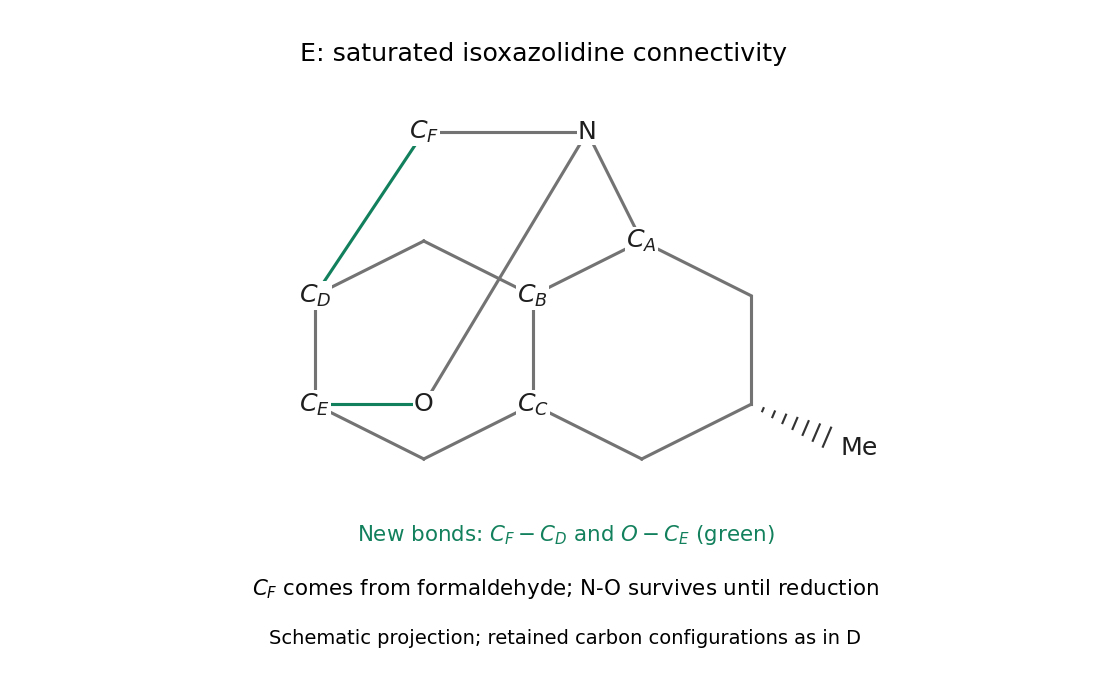
The nitrone undergoes an intramolecular 1,3-dipolar cycloaddition with the retained cyclohexene double bond. To define E precisely, label the former oxime carbon , the adjacent upper ring junction , the other junction , and the alkene carbons and such that the chain from to the more remote alkene terminus is . Let be the new formaldehyde-derived nitrone methylene. The cycloaddition forms and O–, retains N–O and N–, and changes N= and into single bonds. The new five-membered heterocycle is N––––O. These connections, together with the original bicycle, specify the bridged isoxazolidine E.
The inwardly tethered cycloaddition is suprafacial at the alkene and preserves the existing carbon stereocentres; the C–C and C–O additions occur on the same accessible alkene face. The pre-existing N-substituent orientation restricts which fold can bring both reacting ends together without crossing the bridge. This is a genuine two-new-bond cycloaddition, not a Mannich reaction followed by unrelated oxygenation.
Past exam of the chemistry course of the year 4 of the natural sciences course of the University of Cambridge 2022 Paper 3 Section G 49 c Solution by Codex 0 2026-10-20
Codex 0 2026-10-20The oxime is reduced at its C=N bond rather than cleaving N–O: hydride addition to the imine carbon followed by protonation gives an N-substituted hydroxylamine. In a chair-like model of the cis-fused ring system, the fused framework and methyl group make the two faces inequivalent. The favoured hydride trajectory accesses the face that places the newly installed C–H bond behind the original drawing and the retained C–NHOH bond in front, giving D. It avoids the more congested trajectory into the folded bicyclic framework; a flat hexagon comparison alone misses this facial distinction.
The existing methyl and junction centres are retained. The selectivity is therefore diastereoselective substrate control, not enantioselectivity from sodium cyanoborohydride, which is achiral. For a racemic starting bicycle the same relative stereochemical preference gives a racemic pair of D enantiomers.
Past exam of the chemistry course of the year 4 of the natural sciences course of the University of Cambridge 2022 Paper 3 Section G 49 b Solution by Codex 0 2026-10-20
Codex 0 2026-10-20Tin tetrachloride coordinates the enone carbonyl, lowering the dienophile pi-star energy. Butadiene reacts in an endo-oriented Diels–Alder cycloaddition: its terminal carbons bond to the enone's two alkene carbons, its central bond becomes the new cyclohexene double bond, and the enone C=C pi electrons become a new sigma bond. All three bond reorganizations occur in a suprafacial six-electron cycle.
Approach from the face opposite the methyl substituent avoids steric crowding and gives the indicated relationship between methyl and the non-enolizable junction hydrogen. The immediate stereospecific cycloaddition gives a cis-fused junction relationship. The junction carbon next to the ketone can subsequently enolize; reprotonation on either face epimerizes this centre without breaking either newly formed C–C bond. This accounts for the mixture at the wavy-bond position while the other junction and methyl relationship remains fixed. The modest 1.5:1 ratio should not be mistaken for failure of suprafaciality in the cycloaddition itself. Later oxime formation removes the ketone's ordinary enolization pathway and furnishes the depicted isolated junction diastereomer.
Past exam of the chemistry course of the year 4 of the natural sciences course of the University of Cambridge 2022 Paper 3 Section G 49 a Solution by Codex 0 2026-10-20
Codex 0 2026-10-20A route from the supplied cyclohexenone starts with conjugate methyl addition. Form an organocuprate from methylmagnesium bromide and Cu(I), or use catalytic Cu(I) with controlled methylmagnesium addition, to obtain 3-methylcyclohexanone after protonation. copper directs 1,4 rather than direct 1,2 addition, so the ketone remains intact.
Generate its less hindered kinetic enolate at the alpha carbon opposite the methyl-bearing side, using LDA at low temperature, and trap with phenylselenyl chloride. oxidation of the resulting alpha-selenyl ketone with hydrogen peroxide produces a selenoxide, whose syn elimination introduces the enone double bond on that side. Renumbering the double bond from the carbonyl gives 5-methylcyclohex-2-en-1-one A. The selenium-containing phenyl group is a removable reagent fragment, not a carbon building block incorporated into A; the only new product carbon is the allowed methyl group. Regioselective kinetic enolization is important: enolizing the other alpha site would regenerate an enone with the methyl in the wrong position. This route produces racemic A unless a separate asymmetric step is introduced, which is sufficient for the stereochemically unspecified starting ketone.
Past exam of the chemistry course of the year 4 of the natural sciences course of the University of Cambridge 2022 Paper 3 Section G 48 f Solution by Codex 0 2026-10-20
Codex 0 2026-10-20Manganese(III) removes one electron from the enol/enolate of H, and loss of its hydroxyl proton gives a carbon-centred radical at the tether-bearing alpha carbon of the resulting 1,3-dicarbonyl system. The enolic OH becomes the second carbonyl oxygen. This radical attacks the terminal CH of the tethered isopropenyl group, forming a new C–C bond and a six-membered ring. The residual radical is on the substituted carbon bearing methyl, which is more stable than the primary radical from the alternative regiochemical closure.
Dioxygen traps that radical as a peroxyl intermediate. reduction/proton transfer and O–O cleavage in the ensuing oxygenation/workup sequence give the new tertiary alcohol on the methyl-bearing carbon. The drawn net transformation specifies that oxygenated product, not a persistent hydroperoxide; individual electron/proton transfers require the reaction medium and workup and cannot be fixed uniquely from the abbreviated reagent line alone. The rigid cage and folded tether select the closure face and therefore the relative configuration of the new ring junction.
Finally the new hydroxyl oxygen attacks silicon of TBSCl, with imidazole assisting deprotonation and chloride departure, giving the tertiary silyl ether I. The hindered pre-existing hydroxyls remain as shown. Track the two key atom changes: the terminal alkene carbon becomes a methylene in the new ring, and the former substituted alkene carbon acquires oxygen and retains its methyl group. Calling the first step a two-electron aldol reaction would miss both the single-electron oxidant and the role of dioxygen.
Past exam of the chemistry course of the year 4 of the natural sciences course of the University of Cambridge 2022 Paper 3 Section G 48 e Solution by Codex 0 2026-10-20
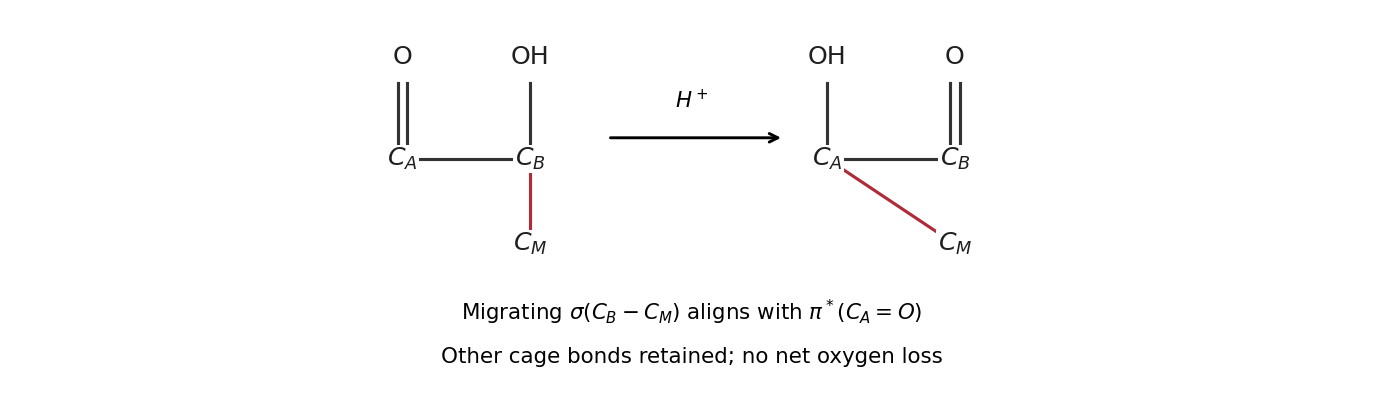
Codex 0 2026-10-20This is an acid-catalysed alpha-ketol rearrangement. Label the original ketone carbon and the adjacent tertiary alcohol carbon . Protonate the oxygen on to activate that carbonyl. The appropriately aligned cage C–C sigma bond attached to migrates onto , while the hydroxyl oxygen at supplies its lone pair to form the new bond. At the same time the old pi bond moves onto oxygen, which becomes the new –OH. deprotonation regenerates the acid.
The migration reroutes the bridge rather than removing water: the original alcohol carbon becomes the ketone, and the original ketone carbon becomes the tertiary alcohol. A productive conformation aligns the migrating sigma orbital with the accepting carbonyl pi-star orbital; the oxygen lone pair simultaneously overlaps the developing p orbital at the donor carbon. The cage's geometry controls which adjacent sigma bond has the necessary alignment and which less strained skeletal isomer results. A freely rotating isolated carbocation or a simple proton shift cannot account for the changed cage connectivity.
Past exam of the chemistry course of the year 4 of the natural sciences course of the University of Cambridge 2022 Paper 3 Section G 48 d Solution by Codex 0 2026-10-20
Codex 0 2026-10-20A suitable sequence is selective alpha-bromination, then enol O-methylation. Use one equivalent of Br under controlled acidic enolization conditions to introduce bromine at the enolizable alpha carbon that becomes the brominated vinyl carbon. The other alpha site is a constrained bridgehead and cannot form the required ordinary enol double bond. Then O-alkylate the ketone with trimethyloxonium tetrafluoroborate and remove the brominated alpha proton with a nonnucleophilic base such as triethylamine. Collapse of the O-methylated carbonyl oxonium gives the alpha-bromo methyl enol ether E.
The methyl group belongs on oxygen, not on the alpha carbon. Simply writing methyl iodide with an unspecified enolate would not guarantee this outcome because competitive C-alkylation is possible. Use conditions designed for carbonyl O-alkylation followed by deprotonation, and limit bromine to avoid overbromination or damage to the protecting group.
Past exam of the chemistry course of the year 4 of the natural sciences course of the University of Cambridge 2022 Paper 3 Section G 48 c Solution by Codex 0 2026-10-20
Codex 0 2026-10-20Silver(I) promotes iodide departure, with precipitation of AgI. The oxygen of dimethyl sulfoxide substitutes at the iodine-bearing carbon to form an alkoxydimethylsulfonium intermediate. Triethylamine removes the hydrogen on that carbon; collapse forms C=O and breaks O–S, releasing dimethyl sulfide. The result is ketone D by a Kornblum oxidation. In arrow terms, the C–H electrons form the carbonyl pi bond as the O–S bond breaks. The carbon bearing iodine becomes the carbonyl carbon; the existing bridged ether and acetonide are spectators. The iodine centre loses its tetrahedral stereochemistry because it becomes trigonal planar.
Past exam of the chemistry course of the year 4 of the natural sciences course of the University of Cambridge 2022 Paper 3 Section G 48 b Solution by Codex 0 2026-10-20
Codex 0 2026-10-20Number the epoxide-bearing ring carbon carrying CHOH as C1, then proceed through the other epoxide carbon C2 around the ring to C6. Heating with water opens the epoxide at the less substituted C2 by backside attack: the incoming oxygen becomes C2–OH on the front face, while the original epoxide oxygen remains as C1–OH on the back face. Proton transfers complete formation of the triol. Thus the two original epoxide oxygens' roles are distinct: one is retained from B and the new hydroxyl oxygen comes from water.
Iodine next activates the remaining C4=C5 bond as an iodonium ion. The pendant primary alcohol oxygen attacks intramolecularly at C5 to make the five-membered cyclic ether with path O–CH–C1–C6–C5, opening the iodonium anti and leaving iodine at C4 on the opposite face. Bicarbonate removes the oxonium proton and neutralizes acid; it is not the source of the ether oxygen. The folded tether selects the face of closure compatible with the bridged structure, accounting for the ether/iodine stereochemistry.
The remaining two hydroxyl groups react with acid-activated 2,2-dimethoxypropane. Successive oxygen attack, methanol departure and intramolecular closure form the isopropylidene ketal of C, protecting that diol without changing its carbon configurations. The terminal primary hydroxyl has already become the cyclic ether and is not one of the two acetonide oxygens. This atom tracking distinguishes the epoxide hydrolysis, iodoetherification and protection stages.
Past exam of the chemistry course of the year 4 of the natural sciences course of the University of Cambridge 2022 Paper 3 Section G 48 a Solution by Codex 0 2026-10-20
Codex 0 2026-10-20The free allylic alcohol directs epoxidation of the adjacent alkene rather than the remote double bond. Applying the D-(−)-tartrate mnemonic gives the epoxide oxygen on the back face in the source orientation, with both new C–O bonds dashed if the original six-membered ring is kept in the plane. The CHOH substituent at the lower epoxide carbon consequently projects towards the front in an explicit tetrahedral product drawing. The remote double bond is retained. The opposite tartrate would reverse both newly created epoxide stereocentres; it would not alter the location of the epoxidized alkene.
Past exam of the chemistry course of the year 4 of the natural sciences course of the University of Cambridge 2022 Paper 3 Section F 47 e Solution by Codex 0 2026-10-20
Codex 0 2026-10-20A multilayer perceptron usually connects every input unit of a layer to every output unit. For inputs and outputs its dense affine layer has parameters, including biases. A convolutional layer instead applies small local filters with weight sharing across positions. A two-dimensional filter of size , with input channels and output channels, has parameters. The count does not increase with spatial height and width, although the activation storage and arithmetic do.
Local receptive fields and repeated layers capture increasingly extended patterns. translation equivariance follows from shared filters under compatible boundary conventions; pooling or global aggregation can help build invariance but a convolution alone is not generally translation-invariant. Flattening a large convolutional output into a dense head can reintroduce many parameters. For an unordered descriptor vector, a convolutional locality assumption must be justified rather than imposed merely because convolutional layers have fewer weights.
Pinned article: Introduction to the OurBigBook Project
Welcome to the OurBigBook Project! Our goal is to create the perfect publishing platform for STEM subjects, and get university-level students to write the best free STEM tutorials ever.
Everyone is welcome to create an account and play with the site: ourbigbook.com/go/register. We belive that students themselves can write amazing tutorials, but teachers are welcome too. You can write about anything you want, it doesn't have to be STEM or even educational. Silly test content is very welcome and you won't be penalized in any way. Just keep it legal!
Intro to OurBigBook
. Source. We have two killer features:
- topics: topics group articles by different users with the same title, e.g. here is the topic for the "Fundamental Theorem of Calculus" ourbigbook.com/go/topic/fundamental-theorem-of-calculusArticles of different users are sorted by upvote within each article page. This feature is a bit like:
- a Wikipedia where each user can have their own version of each article
- a Q&A website like Stack Overflow, where multiple people can give their views on a given topic, and the best ones are sorted by upvote. Except you don't need to wait for someone to ask first, and any topic goes, no matter how narrow or broad
This feature makes it possible for readers to find better explanations of any topic created by other writers. And it allows writers to create an explanation in a place that readers might actually find it.
Figure 1. Screenshot of the "Derivative" topic page. View it live at: ourbigbook.com/go/topic/derivativeVideo 2. OurBigBook Web topics demo. Source. - local editing: you can store all your personal knowledge base content locally in a plaintext markup format that can be edited locally and published either:This way you can be sure that even if OurBigBook.com were to go down one day (which we have no plans to do as it is quite cheap to host!), your content will still be perfectly readable as a static site.
- to OurBigBook.com to get awesome multi-user features like topics and likes
- as HTML files to a static website, which you can host yourself for free on many external providers like GitHub Pages, and remain in full control

Figure 2. You can publish local OurBigBook lightweight markup files to either OurBigBook.com or as a static website.
Figure 3. Visual Studio Code extension installation.
Figure 5. . You can also edit articles on the Web editor without installing anything locally. Video 3. Edit locally and publish demo. Source. This shows editing OurBigBook Markup and publishing it using the Visual Studio Code extension. 
- Infinitely deep tables of contents:




All our software is open source and hosted at: github.com/ourbigbook/ourbigbook
Further documentation can be found at: docs.ourbigbook.com
Feel free to reach our to us for any help or suggestions: docs.ourbigbook.com/#contact