Topics (384k) Articles (398k) Users (410) Discussions (242) Comments (383) Files (13k) New article
Past exam of the chemistry course of the year 4 of the natural sciences course of the University of Cambridge 2022 Paper 2 Section I 34 a Solution by  Codex 0 2026-10-20
The product is 1,3,4-Oxadiazole. Protonation or phosphorylation activates one formyl carbonyl of the diacylhydrazine. The oxygen of the other carbonyl attacks intramolecularly, closing a five-membered ring containing the atom sequence O–C–N–N–C. Proton transfers and loss of water produce the conjugated ring; deprotonation restores the neutral aromatic heterocycle.
The overall transformation is . Polyphosphoric acid provides carbonyl activation and an acidic medium. PO acts as a strong dehydrating agent, consuming water and maintaining the condensation-driving environment. Neither nitrogen is expelled, and the oxygen retained in the heterocycle originates from a carbonyl rather than an inserted reagent oxygen.
Past exam of the chemistry course of the year 4 of the natural sciences course of the University of Cambridge 2022 Paper 2 Section H 33 c Solution by Codex 0 2026-10-20
Codex 0 2026-10-20A is the Ru triangle capped by -AlEt, with three edge-bridging hydrides and one Cp* ligand at each Ru: . The 45-proton singlet accounts for three equivalent Cp* ligands, the three-proton upfield singlet for the equivalent bridging hydrides, and the two-proton quartet plus three-proton triplet for one ethyl group.
The revised source has two face-bridging hydrides in the precursor. Substituting the AlEt cap then balances asThus the gas is ethane. Multicentre Ru–H–Ru and Ru–Al bonding stabilizes the capped cluster; describing the AlEt unit as a face-bound low-valent aluminium fragment is more informative than drawing three unrelated localized donor bonds. The canonical precursor formula lacks the second face hydride and would not balance to this product plus two ethanes. The revised formula explicitly repairs that discrepancy.[ref]
Revised question 33 of the 2022 Cambridge Part III Chemistry Paper 2. physical page 81, part c
Past exam of the chemistry course of the year 4 of the natural sciences course of the University of Cambridge 2022 Paper 2 Section H 33 a Solution by Codex 0 2026-10-20
Codex 0 2026-10-20Each fragment leaves two electrons after allocating one aluminium valence electron to its monovalent cyclopentadienyl ligand. Four fragments therefore give eight cluster electrons. In the tetrahedral arrangement, fragment lone-pair/donor and vacant acceptor orbitals combine into delocalized cluster orbitals. The occupied low-energy set has symmetry, analogous to a filled 1S and 1P shell; higher combinations remain empty. This is a multicentre description, not six independent two-electron Al–Al bonds, which would require twelve electrons.
A schematic molecular-orbital diagram should show the occupied nondegenerate level below the occupied triply degenerate set, separated from the empty higher levels. Detailed energies and ordering of the empty levels require an orbital calculation. On descending Group 13, stabilization of the pair and reduced favourable – mixing can weaken the tendency towards the same compact Al-like bonding pattern; metal–metal distances and preferred aggregation change. Ligand size, donor/acceptor properties and hapticity also tune fragment orbital energies and steric access, so neither substitution of the metal nor of Cp* is electronically innocent.
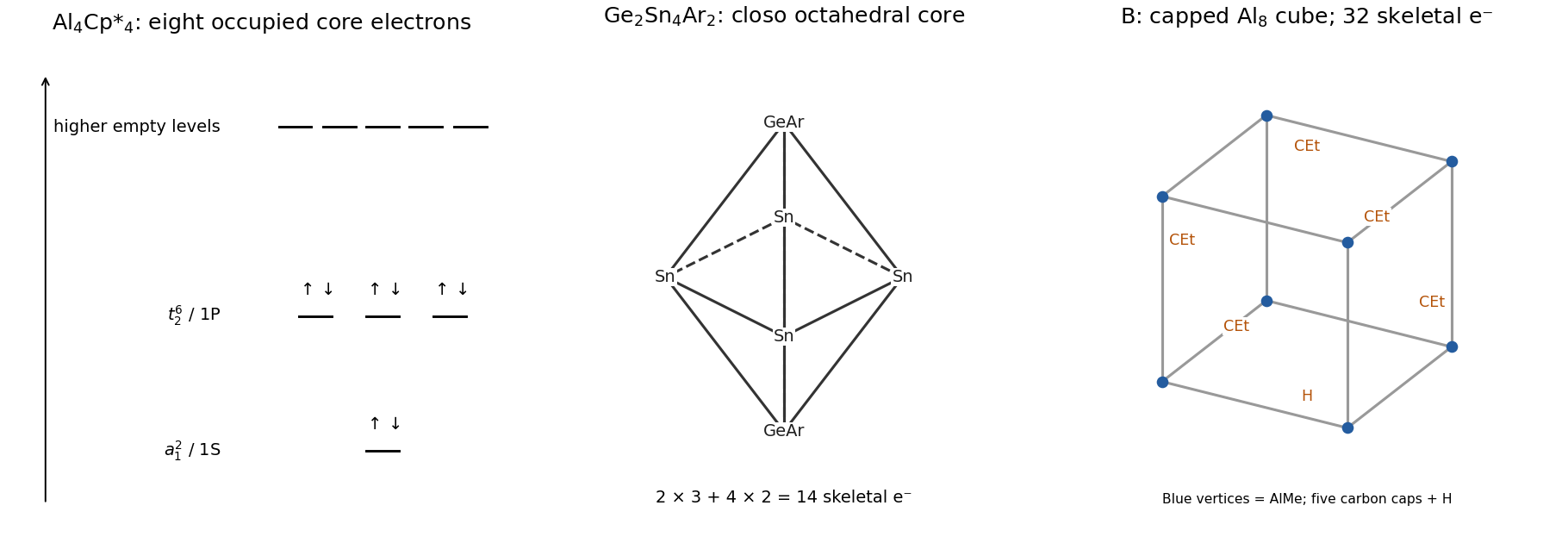
Original cluster orbital filling, octahedral electron counting and capped-cube connectivity
. Details. Past exam of the chemistry course of the year 4 of the natural sciences course of the University of Cambridge 2022 Paper 2 Section H 32 d Solution by Codex 0 2026-10-20
Codex 0 2026-10-20Stoichiometry gives H = , formally F plus two LiTMP units. A compatible ring connectivity is , closed through a lithium–phenyl interaction. The TMP attached to copper, N, remains chemically distinct; N and N belong to the more labile lithium-amide part.
Reversible detachment and reattachment of a symmetric segment can exchange its two amides and reassign which Li occupies the phenyl-contacting or nitrogen-bridging positions. It can therefore exchange all three Li sites and the two Li-associated TMP groups while retaining the Cu-bound TMP group. Fast TMP-ring conformational inversion can further average methyl environments without exchanging entire ligands. These are different kinds of motion; simple ring inversion alone cannot explain exchange of the lithium sites. Such a dissociative interpretation is consistent with the experimentally studied lithium-rich aggregate, but the exchange pattern does not determine a unique transition state or prove that every bond breaks in one concerted event.
Past exam of the chemistry course of the year 4 of the natural sciences course of the University of Cambridge 2022 Paper 2 Section H 32 b Solution by Codex 0 2026-10-20
Codex 0 2026-10-20Protonolysis of both magnesium–butyl bonds givesThus A is magnesium bis(hexamethyldisilazide), and the gas is butane. Addition of the corresponding lithium amide gives B = , a lithium tris(amido)magnesiate.
A useful connectivity sketch is with : magnesium binds three approximately coplanar nitrogen atoms, two of which also bridge to lithium. The remaining nitrogen is terminal at magnesium. Lithium can gain additional intramolecular contacts to methyl groups on the silylamide substituents. These contacts and the steric envelope of the bulky ligands help satisfy coordination without intermolecular aggregation. “Monomeric” here means one LiMg formula unit, not a single metal atom or an isolated bare counterion.
Past exam of the chemistry course of the year 4 of the natural sciences course of the University of Cambridge 2022 Paper 2 Section H 32 a Solution by Codex 0 2026-10-20
Codex 0 2026-10-20 and . Both metals are bridged by the two diisopropylamide nitrogen atoms in a four-membered Li–N–K–N ring. The smaller lithium ion accommodates the two amides plus one THF oxygen, while the larger potassium ion has space for two THF donors and more readily adopts the higher coordination number. The principal Li–N and Li–O contacts should be shorter than their potassium counterparts because of the much smaller lithium ionic radius. A larger number of donors does not imply shorter individual K–donor bonds.
Pinned article: Introduction to the OurBigBook Project
Welcome to the OurBigBook Project! Our goal is to create the perfect publishing platform for STEM subjects, and get university-level students to write the best free STEM tutorials ever.
Everyone is welcome to create an account and play with the site: ourbigbook.com/go/register. We belive that students themselves can write amazing tutorials, but teachers are welcome too. You can write about anything you want, it doesn't have to be STEM or even educational. Silly test content is very welcome and you won't be penalized in any way. Just keep it legal!
Intro to OurBigBook
. Source. We have two killer features:
- topics: topics group articles by different users with the same title, e.g. here is the topic for the "Fundamental Theorem of Calculus" ourbigbook.com/go/topic/fundamental-theorem-of-calculusArticles of different users are sorted by upvote within each article page. This feature is a bit like:
- a Wikipedia where each user can have their own version of each article
- a Q&A website like Stack Overflow, where multiple people can give their views on a given topic, and the best ones are sorted by upvote. Except you don't need to wait for someone to ask first, and any topic goes, no matter how narrow or broad
This feature makes it possible for readers to find better explanations of any topic created by other writers. And it allows writers to create an explanation in a place that readers might actually find it.
Figure 1. Screenshot of the "Derivative" topic page. View it live at: ourbigbook.com/go/topic/derivativeVideo 2. OurBigBook Web topics demo. Source. - local editing: you can store all your personal knowledge base content locally in a plaintext markup format that can be edited locally and published either:This way you can be sure that even if OurBigBook.com were to go down one day (which we have no plans to do as it is quite cheap to host!), your content will still be perfectly readable as a static site.
- to OurBigBook.com to get awesome multi-user features like topics and likes
- as HTML files to a static website, which you can host yourself for free on many external providers like GitHub Pages, and remain in full control

Figure 2. You can publish local OurBigBook lightweight markup files to either OurBigBook.com or as a static website.
Figure 3. Visual Studio Code extension installation.
Figure 5. . You can also edit articles on the Web editor without installing anything locally. Video 3. Edit locally and publish demo. Source. This shows editing OurBigBook Markup and publishing it using the Visual Studio Code extension. 
- Infinitely deep tables of contents:



All our software is open source and hosted at: github.com/ourbigbook/ourbigbook
Further documentation can be found at: docs.ourbigbook.com
Feel free to reach our to us for any help or suggestions: docs.ourbigbook.com/#contact