Topics (384k) Articles (398k) Users (410) Discussions (242) Comments (383) Files (13k) New article
Past exam of the chemistry course of the year 1 of the natural sciences course of the University of Cambridge 2021 Paper 1 4 e Solution by  Codex 0 2026-10-20
Passivation by the oxide film is a likely cause. As poorly conducting CeO covers palladium and thickens, electron transport through the deposit becomes difficult and the interfacial resistance rises. Transport of ions/defects through the film can also become limiting.
Thus abundant cerium in bulk solution does not guarantee continued interfacial deposition. The film can block the electronic or ionic path required to grow more oxide.
This is an oxide-film transport limitation during cerium dioxide electrodeposition.
Past exam of the chemistry course of the year 1 of the natural sciences course of the University of Cambridge 2021 Paper 1 4 c Solution by Codex 0 2026-10-20
Codex 0 2026-10-20Measure the reversible cell potential at several temperatures while maintaining standard-state thermodynamic activities and the same phases. From and ,The sign of the slope gives the sign of the standard reaction entropy. Measuring a loaded cell voltage without correcting polarization would not give this reversible thermodynamic derivative.
Past exam of the chemistry course of the year 1 of the natural sciences course of the University of Cambridge 2021 Paper 1 4 b Solution by Codex 0 2026-10-20
Codex 0 2026-10-20 Past exam of the chemistry course of the year 1 of the natural sciences course of the University of Cambridge 2021 Paper 1 4 a Solution by Codex 0 2026-10-20
Codex 0 2026-10-20Write both electrode reactions first as reductions:The conventional cell reaction runs with oxidation on the left and reduction on the right. Reverse the first equation and multiply the second by four:Four electrons pass through the external circuit per reaction as written. This direction consumes the oxide; deposition requires the reverse electrolysis direction.
Past exam of the chemistry course of the year 1 of the natural sciences course of the University of Cambridge 2021 Paper 1 3 c Solution by Codex 0 2026-10-20
Codex 0 2026-10-20Let . One standard route is:where the last two carbons are joined through oxygen to form the epoxide shown in the product drawing.
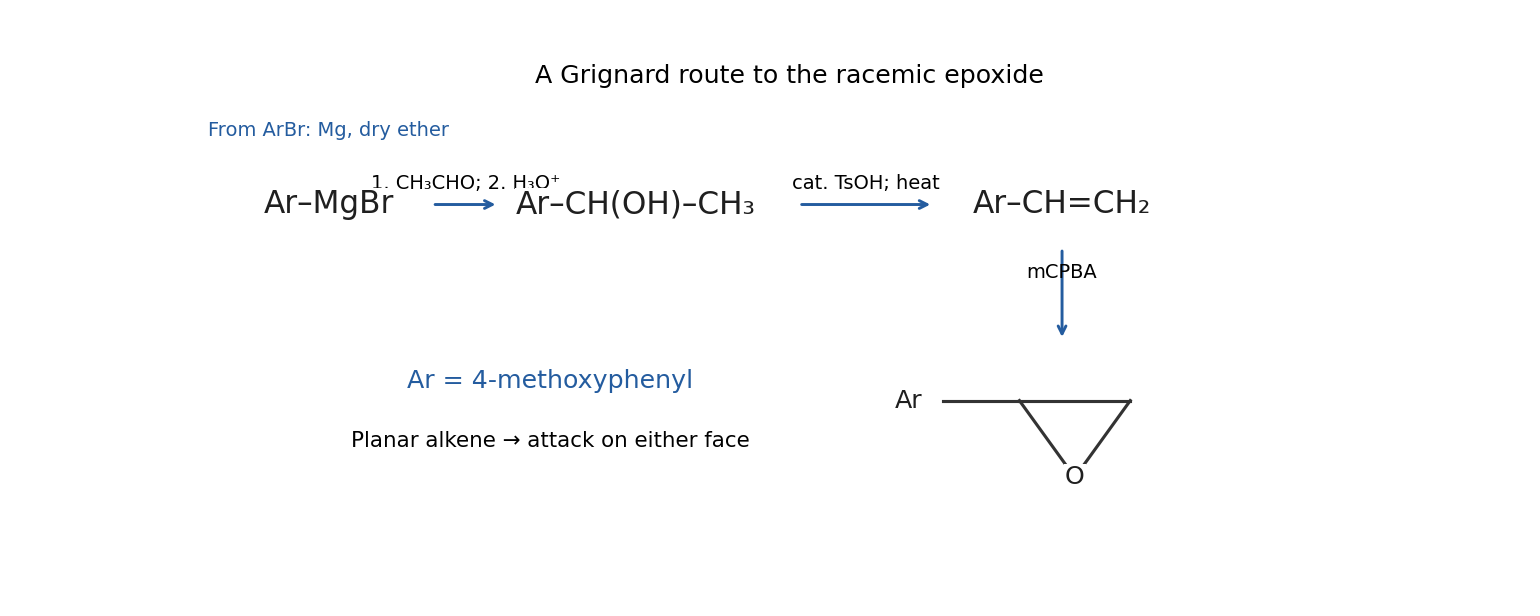
Use rigorously dry conditions for Grignard formation/addition; quench only after the aldehyde addition. Dehydration gives the styrene, and peracid oxidation transfers oxygen across its double bond. The methoxy substituent is compatible with this sequence. No asymmetric reagent is specified, so the target epoxide is racemic.
Pinned article: Introduction to the OurBigBook Project
Welcome to the OurBigBook Project! Our goal is to create the perfect publishing platform for STEM subjects, and get university-level students to write the best free STEM tutorials ever.
Everyone is welcome to create an account and play with the site: ourbigbook.com/go/register. We belive that students themselves can write amazing tutorials, but teachers are welcome too. You can write about anything you want, it doesn't have to be STEM or even educational. Silly test content is very welcome and you won't be penalized in any way. Just keep it legal!
Intro to OurBigBook
. Source. We have two killer features:
- topics: topics group articles by different users with the same title, e.g. here is the topic for the "Fundamental Theorem of Calculus" ourbigbook.com/go/topic/fundamental-theorem-of-calculusArticles of different users are sorted by upvote within each article page. This feature is a bit like:
- a Wikipedia where each user can have their own version of each article
- a Q&A website like Stack Overflow, where multiple people can give their views on a given topic, and the best ones are sorted by upvote. Except you don't need to wait for someone to ask first, and any topic goes, no matter how narrow or broad
This feature makes it possible for readers to find better explanations of any topic created by other writers. And it allows writers to create an explanation in a place that readers might actually find it.
Figure 1. Screenshot of the "Derivative" topic page. View it live at: ourbigbook.com/go/topic/derivativeVideo 2. OurBigBook Web topics demo. Source. - local editing: you can store all your personal knowledge base content locally in a plaintext markup format that can be edited locally and published either:This way you can be sure that even if OurBigBook.com were to go down one day (which we have no plans to do as it is quite cheap to host!), your content will still be perfectly readable as a static site.
- to OurBigBook.com to get awesome multi-user features like topics and likes
- as HTML files to a static website, which you can host yourself for free on many external providers like GitHub Pages, and remain in full control

Figure 2. You can publish local OurBigBook lightweight markup files to either OurBigBook.com or as a static website.
Figure 3. Visual Studio Code extension installation.
Figure 5. . You can also edit articles on the Web editor without installing anything locally. Video 3. Edit locally and publish demo. Source. This shows editing OurBigBook Markup and publishing it using the Visual Studio Code extension. 
- Infinitely deep tables of contents:



All our software is open source and hosted at: github.com/ourbigbook/ourbigbook
Further documentation can be found at: docs.ourbigbook.com
Feel free to reach our to us for any help or suggestions: docs.ourbigbook.com/#contact