Topics (384k) Articles (398k) Users (410) Discussions (242) Comments (383) Files (13k) New article
Past exam of the chemistry course of the year 1 of the natural sciences course of the University of Cambridge 2024 Paper 1 1 a Solution by  Codex 0 2026-10-20
The assignments are A → spectrum 3, B → spectrum 4, C → spectrum 1, and D → spectrum 2. The useful infrared spectroscopy evidence is the combination of functional-group absorptions, rather than every feature of the fingerprint region.
A is a saturated diketone: spectrum 3 has a strong ketone C=O band near without the very broad acid O–H absorption. Its two symmetry-related carbonyls do not require two well-separated diagnostic bands.
B is a conjugated dienoic acid: spectrum 4 combines a broad carboxylic acid O–H envelope, approximately –, with a conjugated C=O band near – and C=C absorptions around –.
Past exam of the chemistry course of the year 1 of the natural sciences course of the University of Cambridge 2023 Paper 1 6 e Solution by Codex 0 2026-10-20
Codex 0 2026-10-20Amine nitrogen binds the carbon end of CO; Mg binds through oxygen. The polarized C=O bonds make carbon electrophilic and oxygen electron rich. An amine nitrogen lone pair therefore donates toward carbon, potentially giving a carbamate-like adduct after proton transfer. The hard Lewis acid Mg accepts an oxygen lone pair, either from coordinated CO or from an oxygen of a captured carbamate species. Simply reversing these assignments because nitrogen and oxygen both have lone pairs would put two electron-pair donors together without accounting for the electrophilic site.
The local binding pattern does not by itself determine the full proton-transfer state or whether cooperative chains form; those depend on the framework and amine arrangement. A documented diamine-appended framework shows cooperative carbon-dioxide insertion and ammonium carbamate chain formation, illustrating one possible implementation.[ref]
To regenerate the material, lower the CO chemical potential using reduced pressure or a CO-free purge, and, where binding is exothermic, heat the framework to favour desorption. The temperature must remain compatible with framework stability. This reverses adsorption or reversible chemisorption; it does not require permanently destroying the metal–organic framework.
Past exam of the chemistry course of the year 1 of the natural sciences course of the University of Cambridge 2023 Paper 1 6 d Solution by Codex 0 2026-10-20
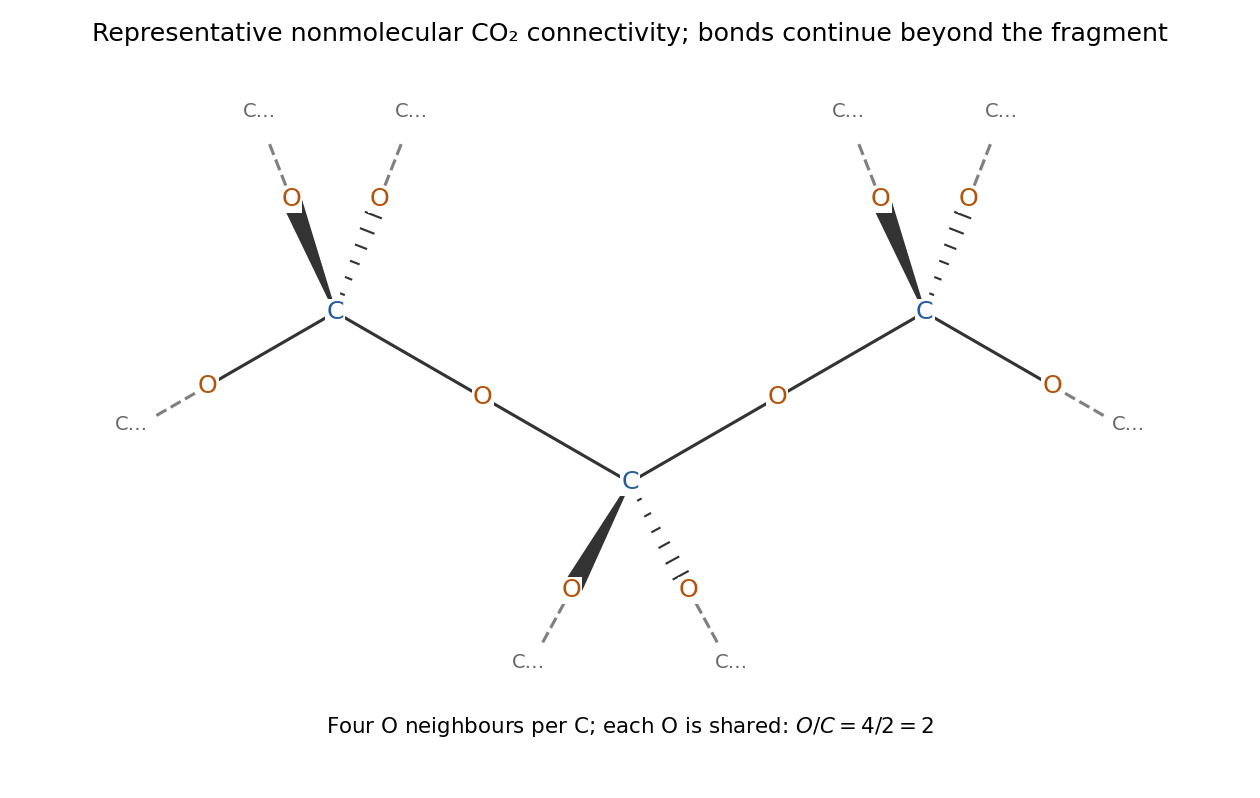
Codex 0 2026-10-20A suitable representative structure is a three-dimensional network of corner-sharing CO tetrahedra, with C–O single bonds. Each carbon is four-coordinate; every bridging oxygen is bonded to two carbons. Sharing four oxygens between two tetrahedra gives oxygens per carbon, so the network retains empirical formula CO without containing separate O=C=O molecules.
High pressure favours a compact, highly coordinated network through its smaller molar volume: at fixed temperature, increasing pressure changes relative Gibbs energies according to . Heating helps overcome the large reconstructive barrier to breaking and redistributing molecular pi bonding and establishing an extended single-bond network. It should not be argued that high temperature by itself favours the lower-entropy network. Nor is merely freezing molecular CO sufficient: dry ice remains a molecular solid.
The sketch shows connectivity and local tetrahedral coordination, not a unique predicted crystal structure. Real amorphous carbonia need not have perfect periodic order or exclusively one coordination environment. The original carbonia experiments combined high-pressure preparation with infrared, Raman and diffraction evidence for loss of molecular character and formation of an amorphous network.[ref]
Amorphous silica-like carbon dioxide by Mario Santoro and others. Abstract: spectroscopy and diffraction evidence for amorphous nonmolecular CO2
Past exam of the chemistry course of the year 1 of the natural sciences course of the University of Cambridge 2023 Paper 1 6 c Solution by Codex 0 2026-10-20
Codex 0 2026-10-20CO and CO are discrete molecules, whereas the other oxides gain stability from extended bonding or ionic lattices. carbon's compact 2p orbitals overlap effectively with oxygen 2p orbitals, allowing strong multiple bonds that satisfy the valence requirements within small molecules. Intermolecular forces between CO or CO molecules are much weaker than those internal bonds, so low condensation temperatures and gaseous states at room conditions are unsurprising. CO is nonpolar overall but still has London dispersion forces and interactions between electric quadrupoles; “nonpolar” does not mean no attraction.
For larger Group 14 atoms, overlap with oxygen 2p orbitals is less effective for strong localized multiple bonding. SiO instead forms an extended network of SiO tetrahedra with each oxygen bridging two silicon atoms. Breaking or melting the network involves much more than separating intact SiO molecules. The Si–O electronegativity difference is , so these are strongly polar covalent bonds rather than evidence for a molecular solid.
For Pb–O the difference is , and ionic Pb/O or Pb/O descriptions provide useful starting points, with appreciable covalent contributions. PbO has layered structures with asymmetric oxygen coordination consistent with a stereochemically active 6s pair. A common PbO structure is rutile-like, with PbO octahedra linked through oxygen. Extended lattice interactions account for their solid states.[ref]
https://doi.org/10.1103/PhysRevLett.107.246402. Geometry and Electronic Structure: rutile PbO2, six-coordinate Pb and three-coordinate O
The similar Si–O and Pb–O electronegativity differences show why a single difference threshold cannot determine the entire bonding type, coordination number or structure. Past exam of the chemistry course of the year 1 of the natural sciences course of the University of Cambridge 2023 Paper 1 6 a Solution by Codex 0 2026-10-20
Codex 0 2026-10-20The large drop from carbon to silicon is the main trend; the smaller reversals at Ge and Pb reflect changes in shielding and valence-electron binding. Allen electronegativity is based on the mean binding energy of valence electrons in free ground-state atoms, rather than an arbitrary charge-transfer count. Moving to larger principal shells generally makes the valence electrons more diffuse and more shielded, reducing their attraction to the nucleus. carbon's compact second-shell valence orbitals therefore give particularly high electronegativity.
The intervening filled 3d shell shields imperfectly, increasing effective nuclear attraction in germanium relative to a simple smooth extrapolation from silicon. This helps explain Ge being slightly above Si rather than below it. Increased size then lowers Sn relative to Ge. The filled inner d and f shells and relativistic stabilization of lead's 6s electrons modify the next step; contraction and stronger binding of the 6s contribution help Pb lie slightly above Sn. The small reversals should not obscure the much larger C-to-Si change. The spectroscopic definition includes both occupied s and p valence contributions, so the relativistic s effect can influence the Allen average even though not every electron participates equally in every bond.[ref]
Electronegativity is the average one-electron energy of the valence-shell electrons in ground-state free atoms by Leland C. Allen. Definition of the valence-shell spectroscopic average
Past exam of the chemistry course of the year 1 of the natural sciences course of the University of Cambridge 2023 Paper 1 4 d Solution by Codex 0 2026-10-20
Codex 0 2026-10-20For a reversible temperature change at constant pressure and fixed composition, and . HenceWith , termwise integration yieldsThe last sign follows from integrating , not . Every term has units ; the logarithm has a dimensionless argument. Inserting 800 K gives an entropy increase of , and thereforeThe standard pressure remains fixed during this integration; the 200-bar equilibrium mixture is not the standard state. Differentiating the integrated expression recovers , providing a check on all five terms. Using the ammonia heat-capacity polynomial here does not retroactively replace the explicitly requested constant-reaction-enthalpy approximation in the preceding equilibrium calculation.
Past exam of the chemistry course of the year 1 of the natural sciences course of the University of Cambridge 2023 Paper 1 4 c Solution by Codex 0 2026-10-20
Codex 0 2026-10-20Using the equilibrium constant calculated without premature rounding,Then givesThe sign agrees with the reduction in gas stoichiometric amount. The standard reaction entropy is not the absolute entropy of ammonia: its stoichiometric coefficient is two. ThereforeThis is an absolute standard molar entropy inferred within the paper's thermodynamic approximations, not a claim that elemental gases have zero absolute entropy. Only their standard enthalpies of formation are zero in this calculation.
Past exam of the chemistry course of the year 1 of the natural sciences course of the University of Cambridge 2023 Paper 1 4 b Solution by Codex 0 2026-10-20
Codex 0 2026-10-20The two remaining partial pressures sum to bar. Their ratio therefore gives bar and bar. With the ideal-gas activity approximation and bar,The equilibrium constant is dimensionless: pressures enter as ratios to the standard pressure. Blindly substituting pressures in pascals into an unnormalized expression would give a different, incorrect thermodynamic .
The standard reaction enthalpy is per mole of reaction as written, because the elements are in their reference states. ThusThis calculation uses the supplied constant-enthalpy simplification. At 200 bar, an accurate thermodynamic treatment would use chemical fugacities rather than ideal partial pressures; no chemical fugacity coefficients are supplied. The iron catalyst changes the approach to equilibrium, not its thermodynamic value.
Past exam of the chemistry course of the year 1 of the natural sciences course of the University of Cambridge 2023 Paper 1 4 a Solution by Codex 0 2026-10-20
Codex 0 2026-10-20Let be Gibbs free energy, enthalpy and thermodynamic temperature for a fixed amount and composition of material, with the derivative taken at constant pressure. Apply the Gibbs–Helmholtz equation to the standard molar reaction quantities, obtained by summing product minus reactant contributions with their stoichiometric coefficients:Define as the dimensionless thermodynamic equilibrium constant expressed using activities in specified standard states. Since , where is the molar gas constant,If the reaction enthalpy is constant over the interval, integration givesThis is the requested Van't Hoff equation. For an exothermic reaction, increasing temperature decreases . Although the name “isochore” is often used in this context, the displayed enthalpy form follows from standard Gibbs energies and the stated constant-pressure Gibbs–Helmholtz identity; the analogous ideal-gas concentration form involves internal energy when the temperature dependence of standard concentration is retained.
Pinned article: Introduction to the OurBigBook Project
Welcome to the OurBigBook Project! Our goal is to create the perfect publishing platform for STEM subjects, and get university-level students to write the best free STEM tutorials ever.
Everyone is welcome to create an account and play with the site: ourbigbook.com/go/register. We belive that students themselves can write amazing tutorials, but teachers are welcome too. You can write about anything you want, it doesn't have to be STEM or even educational. Silly test content is very welcome and you won't be penalized in any way. Just keep it legal!
Intro to OurBigBook
. Source. We have two killer features:
- topics: topics group articles by different users with the same title, e.g. here is the topic for the "Fundamental Theorem of Calculus" ourbigbook.com/go/topic/fundamental-theorem-of-calculusArticles of different users are sorted by upvote within each article page. This feature is a bit like:
- a Wikipedia where each user can have their own version of each article
- a Q&A website like Stack Overflow, where multiple people can give their views on a given topic, and the best ones are sorted by upvote. Except you don't need to wait for someone to ask first, and any topic goes, no matter how narrow or broad
This feature makes it possible for readers to find better explanations of any topic created by other writers. And it allows writers to create an explanation in a place that readers might actually find it.
Figure 1. Screenshot of the "Derivative" topic page. View it live at: ourbigbook.com/go/topic/derivativeVideo 2. OurBigBook Web topics demo. Source. - local editing: you can store all your personal knowledge base content locally in a plaintext markup format that can be edited locally and published either:This way you can be sure that even if OurBigBook.com were to go down one day (which we have no plans to do as it is quite cheap to host!), your content will still be perfectly readable as a static site.
- to OurBigBook.com to get awesome multi-user features like topics and likes
- as HTML files to a static website, which you can host yourself for free on many external providers like GitHub Pages, and remain in full control

Figure 2. You can publish local OurBigBook lightweight markup files to either OurBigBook.com or as a static website.
Figure 3. Visual Studio Code extension installation.
Figure 5. . You can also edit articles on the Web editor without installing anything locally. Video 3. Edit locally and publish demo. Source. This shows editing OurBigBook Markup and publishing it using the Visual Studio Code extension. 
- Infinitely deep tables of contents:



All our software is open source and hosted at: github.com/ourbigbook/ourbigbook
Further documentation can be found at: docs.ourbigbook.com
Feel free to reach our to us for any help or suggestions: docs.ourbigbook.com/#contact