Topics (384k) Articles (398k) Users (410) Discussions (242) Comments (383) Files (13k) New article
Past exam of the chemistry course of the year 3 of the natural sciences course of the University of Cambridge 2021 Paper 1 8 Solution by  Codex 0 2026-10-20
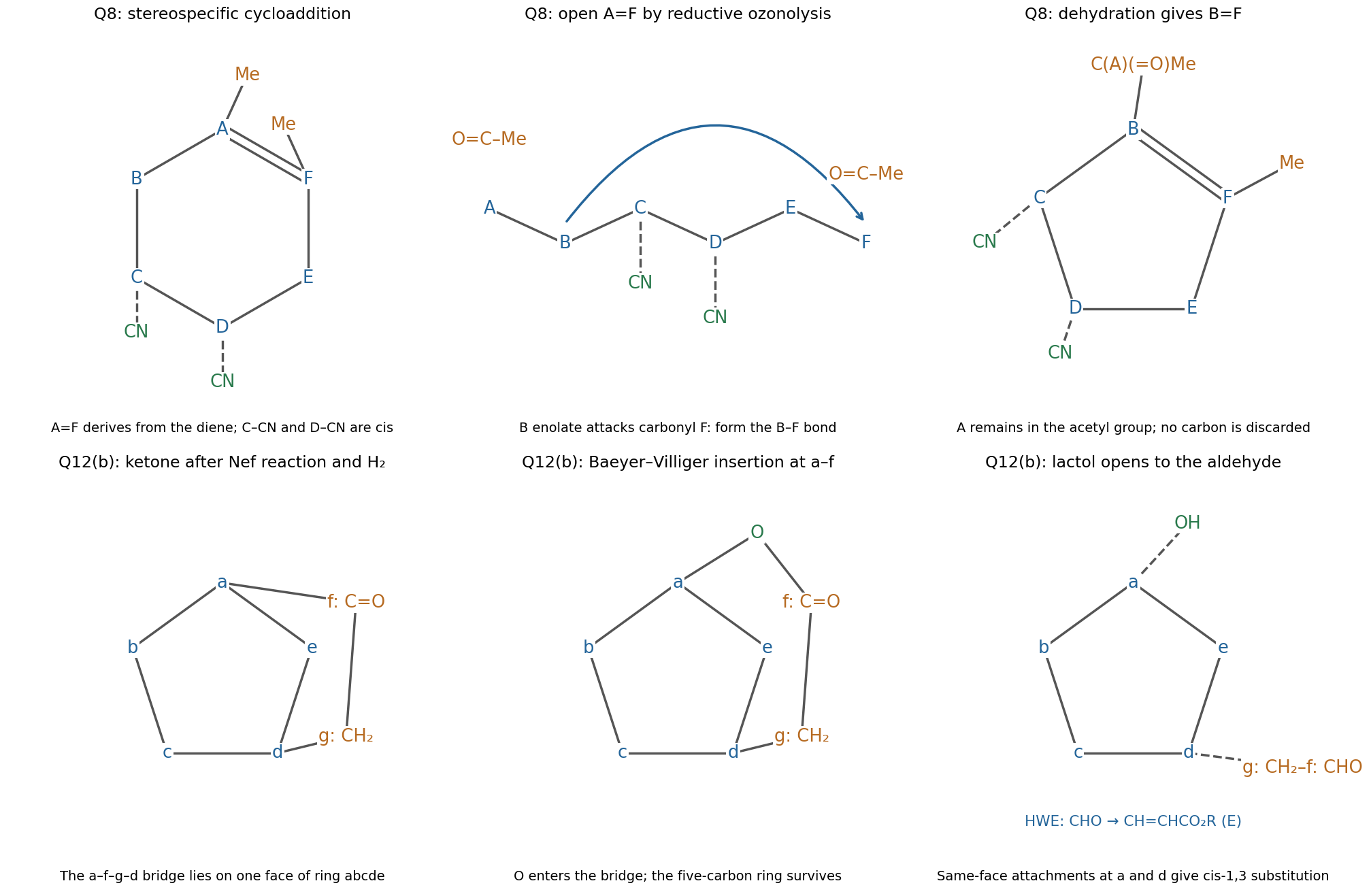
The five-membered enone-like carbon framework can be obtained by an intramolecular aldol condensation ofEnolization at an internal methylene next to one ketone followed by attack on the opposite ketone closes a five-membered ring. dehydration leaves one acetyl group attached to one alkene carbon and one methyl group on the other. The two nitrile-bearing carbons remain adjacent and their original cis relationship is retained if epimerization is avoided.
Now reverse a reductive ozonolysis: the diketone arises by opening a six-membered cyclohexene whose alkene carbons each carry Me. That cyclohexene is the Diels-Alder reaction product of 2,3-dimethylbuta-1,3-diene and maleonitrile. The latter is the supplied cis dinitrile. The stereospecificity of the cycloaddition puts the two CN groups on the same face.
Thus the forward plan is Diels–Alder addition, reductive ozonolysis, then five-membered aldol ring closure and dehydration. Use a reductive ozone work-up that stops at the diketone. During the final step, avoid prolonged strongly basic heating because the carbons bearing CN can be deprotonated and epimerized. Achiral reagents give the racemic pair with the required cis relationship; resolution would be necessary if only the depicted enantiomer were required. The diene supplies six carbons and maleonitrile supplies four, accounting for all ten carbons without an unexplained carbon deletion.
Past exam of the chemistry course of the year 3 of the natural sciences course of the University of Cambridge 2021 Paper 1 7 Solution by Codex 0 2026-10-20
Codex 0 2026-10-20An acetal retrosynthesis separates the target into trans-cyclohexane-1,2-diol and cyclohexyl methyl ketone. Both fragments can be prepared using separate portions of cyclohexene.
For the diol, epoxidation with a peroxy acid such as mCPBA gives cyclohexene oxide. Acid-catalysed opening with water occurs by backside attack on the protonated epoxide, giving the anti, hence trans, diol. A syn dihydroxylation would give the wrong relative configuration.
For the ketone, add HBr to another portion of cyclohexene to obtain bromocyclohexane, form its grignard reagent with Mg in dry ether, and add acetonitrile. Hydrolyse the resulting magnesium imine salt to . A nitrile is useful here because addition followed by hydrolysis stops at the ketone instead of giving the double addition associated with an ester.
Finally combine the isolated trans diol and ketone with catalytic acid and remove water to form the cyclic ketal. The ketone carbon becomes the acetal carbon bearing Me and cyclohexyl; the two original diol C–O bonds retain their relative configuration. Anti epoxide opening supplies the required trans relationship before ketal formation. ketal formation is an equilibrium and the trans-fused product may be less favourable than an unstrained acetal, so effective water removal and isolation are necessary; substituting a cis diol is not an acceptable shortcut.
Past exam of the chemistry course of the year 3 of the natural sciences course of the University of Cambridge 2021 Paper 1 6 Solution by Codex 0 2026-10-20
Codex 0 2026-10-20Open the lactone formally at its acyl–oxygen bond, then replace the resulting secondary alcohol by its ketone precursor. With , the useful sequence of retrosynthetic intermediates isDisconnect the last compound as a Michael addition product of the methyl-side enolate of and ethyl methacrylate:The substituted carbon of the methacrylate becomes the methyl-bearing carbon alpha to the lactone carbonyl. The ketone carbon becomes the oxygen-bearing ring carbon. This checks the six-membered ring connectivity.
The required branched methyl ketone itself comes from butan-2-one by ethyl-side aldol addition to acetone, followed by dehydration and selective hydrogenation:Choose and isolate the aldol regioisomer shown. For the subsequent Michael step, use a bulky base at low temperature to favour its less hindered methyl-side kinetic enolate. Reduce the resulting ketone selectively with while retaining the ester, hydrolyse the ester, then acidify and promote intramolecular esterification with water removal. The hydroxy acid closes to the required six-membered lactone. There is no specified stereochemical relationship to enforce, but a stereochemically pure target would require an additional selectivity or resolution step.
Past exam of the chemistry course of the year 3 of the natural sciences course of the University of Cambridge 2021 Paper 1 5 Solution by Codex 0 2026-10-20
Codex 0 2026-10-20Disconnect the tertiary alcohol at its bond to the alkenyl group. The required carbonyl partner is ; the other partner is an E-configured organometallic reagent. This disconnection fixes the alkene geometry before the alcohol is made.
First form the ethyl-side enolate of butan-2-one under equilibrating conditions, then trap it with ethyl iodide and isolate the required monoalkylated ketone:The incoming group is Et: methylation would give a carbon skeleton one carbon too short. Because an unsymmetrical ketone can form two enolates and undergo repeated alkylation, regioisomer separation and controlled conversion are part of this step.
Independently perform a halo-Wittig reaction on phenylacetaldehyde using and isolate E- from any geometrical mixture. magnesium insertion in dry ether gives the corresponding vinylmagnesium halide; add the isolated ketone at low temperature and protonate the resulting alkoxide. Addition to C=O preserves the pre-existing C=C geometry:The E alkene and the complete fifteen-carbon skeleton are obtained. No absolute configuration is specified at the newly formed alcohol centre, so an unselected stereoisomeric mixture there is acceptable. An alternative carbon–carbon disconnection is acetylide addition to the same ketone followed by a controlled trans-selective alkyne reduction; the vinyl-reagent route avoids relying on reduction of a tertiary propargylic alcohol.
Past exam of the chemistry course of the year 3 of the natural sciences course of the University of Cambridge 2021 Paper 1 3 Solution by Codex 0 2026-10-20
Codex 0 2026-10-20A triangular prism has exactly the required nine metal–metal edges: six edges around two triangular faces and three edges joining corresponding vertices of those faces. It naturally offers two symmetry-distinct edge families, of sizes six and three.
With twelve ligands, neutral has total rhenium oxidation number , hence six formally Re(II), centres. After treating the Re–Cl interactions as ligand bonds, the available metal electrons areTwo localized bond order assignments use those fifteen pairs:In scheme I the three inter-triangle edges should be shorter; in scheme II the six triangle edges should be shorter. Both give each Re five electrons' worth of metal–metal bond-order contributions: two singles plus a triple, or two doubles plus a single. The electron count permits both schemes; identifying which family is shorter distinguishes them at this level. Actual cluster molecular orbitals are delocalized, so these integer bond orders summarize bonding rather than asserting isolated textbook multiple bonds on every edge.
Pinned article: Introduction to the OurBigBook Project
Welcome to the OurBigBook Project! Our goal is to create the perfect publishing platform for STEM subjects, and get university-level students to write the best free STEM tutorials ever.
Everyone is welcome to create an account and play with the site: ourbigbook.com/go/register. We belive that students themselves can write amazing tutorials, but teachers are welcome too. You can write about anything you want, it doesn't have to be STEM or even educational. Silly test content is very welcome and you won't be penalized in any way. Just keep it legal!
Intro to OurBigBook
. Source. We have two killer features:
- topics: topics group articles by different users with the same title, e.g. here is the topic for the "Fundamental Theorem of Calculus" ourbigbook.com/go/topic/fundamental-theorem-of-calculusArticles of different users are sorted by upvote within each article page. This feature is a bit like:
- a Wikipedia where each user can have their own version of each article
- a Q&A website like Stack Overflow, where multiple people can give their views on a given topic, and the best ones are sorted by upvote. Except you don't need to wait for someone to ask first, and any topic goes, no matter how narrow or broad
This feature makes it possible for readers to find better explanations of any topic created by other writers. And it allows writers to create an explanation in a place that readers might actually find it.
Figure 1. Screenshot of the "Derivative" topic page. View it live at: ourbigbook.com/go/topic/derivativeVideo 2. OurBigBook Web topics demo. Source. - local editing: you can store all your personal knowledge base content locally in a plaintext markup format that can be edited locally and published either:This way you can be sure that even if OurBigBook.com were to go down one day (which we have no plans to do as it is quite cheap to host!), your content will still be perfectly readable as a static site.
- to OurBigBook.com to get awesome multi-user features like topics and likes
- as HTML files to a static website, which you can host yourself for free on many external providers like GitHub Pages, and remain in full control

Figure 2. You can publish local OurBigBook lightweight markup files to either OurBigBook.com or as a static website.
Figure 3. Visual Studio Code extension installation.
Figure 5. . You can also edit articles on the Web editor without installing anything locally. Video 3. Edit locally and publish demo. Source. This shows editing OurBigBook Markup and publishing it using the Visual Studio Code extension. 
- Infinitely deep tables of contents:



All our software is open source and hosted at: github.com/ourbigbook/ourbigbook
Further documentation can be found at: docs.ourbigbook.com
Feel free to reach our to us for any help or suggestions: docs.ourbigbook.com/#contact