Topics (119k) Articles (119k) Users (288) Discussions (237) Comments (383) Files (715) New article
FFFFF 000 points to its own physical address FFFFF 000. This kind of translation is called an "identity mapping", and can be very convenient for OS-level debugging.When an exception happens, the CPU jumps to an address that the OS had previously registered as the fault handler. This is usually done at boot time by the OS.
This could happen for example due to a programming error:but there are cases where it is not a bug, for example in Linux when:
int *is = malloc(1);
is[2] = 1;- the program wants to increase its stack.
- the page was swapped to disk.The OS will need to do some work behind the processes back to get the page back into RAM.
The exact format of table entries is fixed by the hardware.
The page table is then an array of
struct.On this simplified example, the page table entries contain only two fields:so in this example the hardware designers could have chosen the size of the page table to b
bits   function
-----  -----------------------------------------
20     physical address of the start of the page
1 present flag21 instead of 32 as we've used so far.All real page table entries have other fields, notably fields to set pages to read-only for Copy-on-write. This will be explained elsewhere.
It would be impractical to align things at 21 bits since memory is addressable by bytes and not bits. Therefore, even in only 21 bits are needed in this case, hardware designers would probably choose 32 to make access faster, and just reserve bits the remaining bits for later usage. The actual value on x86 is 32 bits.
Here is a screenshot from the Intel manual image "Formats of CR3 and Paging-Structure Entries with 32-Bit Paging" showing the structure of a page table in all its glory: Figure 1. "x86 page entry format".
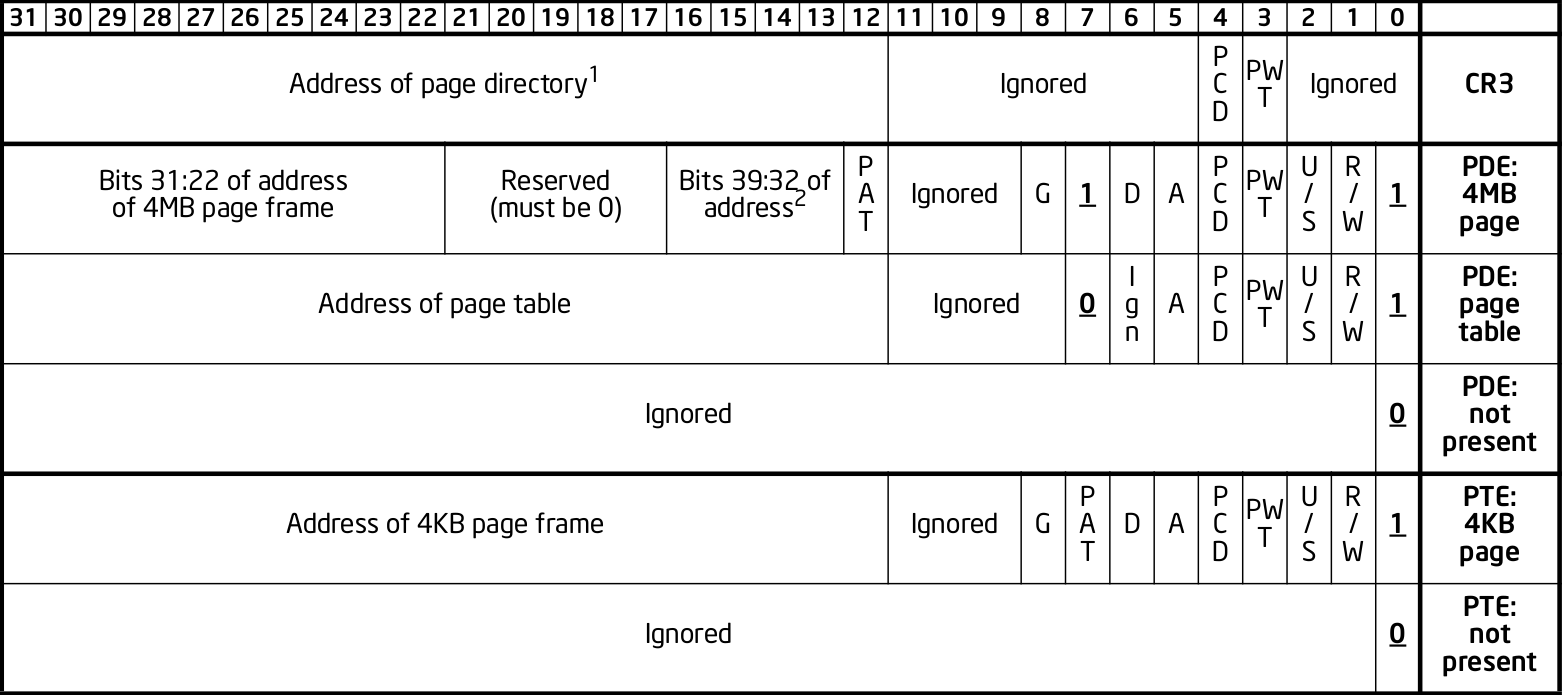
The fields are explained in the manual just after.
The problem with a single-level paging scheme is that it would take up too much RAM: 4G / 4K = 1M entries per process.
If each entry is 4 bytes long, that would make 4M per process, which is too much even for a desktop computer:
ps -A | wc -l says that I am running 244 processes right now, so that would take around 1GB of my RAM!The algorithmically minded will have noticed that paging requires associative array (like Java
Map of Python dict()) abstract data structure where:The single level paging scheme uses a simple array implementation of the associative array:and in C pseudo-code it looks like this:
- the keys are the array index
- this implementation is very fast in time
- but it is too inefficient in memory
linear_address[0]      = physical_address_0
linear_address[1]      = physical_address_1
linear_address[2]      = physical_address_2
...
linear_address[2^20-1] = physical_address_N
But there another simple associative array implementation that overcomes the memory problem: an (unbalanced) k-ary tree.
Using a K-ary tree instead of an array implementation has the following trade-offs:
In C-pseudo code, a 2-level K-ary tree with and we have the following arrays:
K = 2^10 looks like this:level0[0] = &level1_0[0]
level1_0[0] = physical_address_0_0
level1_0[1] = physical_address_0_1
...
level1_0[2^10-1] = physical_address_0_N
level0[1] = &level1_1[0]
level1_1[0] = physical_address_1_0
level1_1[1] = physical_address_1_1
...
level1_1[2^10-1] = physical_address_1_N
...
level0[N] = &level1_N[0]
level1_N[0] = physical_address_N_0
level1_N[1] = physical_address_N_1
...
level1_N[2^10-1] = physical_address_N_Nand it still contains
2^10 * 2^10 = 2^20 possible keys.K-ary trees can save up a lot of space, because if we only have one key, then we only need the following arrays:
Learned readers will ask themselves: so why use an unbalanced tree instead of balanced one, which offers better asymptotic times en.wikipedia.org/wiki/Self-balancing_binary_search_tree?
Addresses are now split as:
| directory (10 bits) | table (10 bits) | offset (12 bits) |Then:
- The top table is called a "directory of page tables".
cr3now points to the location on RAM of the page directory of the current process instead of page tables.Page directory entries are very similar to page table entries except that they point to the physical addresses of page tables instead of physical addresses of pages.Each directory entry also takes up 4 bytes, just like page entries, so that makes 4 KiB per process minimum.Page directory entries also contain a valid flag: if invalid, the OS does not allocate a page table for that entry, and saves memory.Each process has one and only one page directory associated to it (and pointed to bycr3), so it will contain at least2^10 = 1Kpage directory entries, much better than the minimum 1M entries required on a single-level scheme. - Second level entries are also called page tables like the single level scheme.Each page table has only
2^10 = 1Kpage table entries instead of2^20for the single paging scheme. - the offset is again not used for translation, it only gives the offset within a page
One reason for using 10 bits on the first two levels (and not, say,
12 | 8 | 12 ) is that each Page Table entry is 4 bytes long. Then the 2^10 entries of Page directories and Page Tables will fit nicely into 4Kb pages. This means that it faster and simpler to allocate and deallocate pages for that purpose. x86 Paging Tutorial Multi-level paging scheme numerical translation example by  Ciro Santilli 40 Updated 2025-07-16
Ciro Santilli 40 Updated 2025-07-16Page directory given to process by the OS:
entry index   entry address      page table address  present
-----------   ----------------   ------------------  --------
0             CR3 + 0      * 4   0x10000             1
1             CR3 + 1      * 4                       0
2             CR3 + 2      * 4   0x80000             1
3             CR3 + 3      * 4                       0
...
2^10-1        CR3 + 2^10-1 * 4                       0
Page tables given to process by the OS at
PT1 = 0x10000000 (0x10000 * 4K):entry index entry address page address present
----------- ---------------- ------------ -------
0 PT1 + 0 * 4 0x00001 1
1 PT1 + 1 * 4 0
2 PT1 + 2 * 4 0x0000D 1
... ...
2^10-1 PT1 + 2^10-1 * 4 0x00005 1Page tables given to process by the OS at where
PT2 = 0x80000000 (0x80000 * 4K):entry index entry address page address present
----------- --------------- ------------ ------------
0 PT2 + 0 * 4 0x0000A 1
1 PT2 + 1 * 4 0x0000C 1
2 PT2 + 2 * 4 0
...
2^10-1 PT2 + 0x3FF * 4 0x00003 1PT1 and PT2: initial position of page table 1 and page table 2 for process 1 on RAM.With that setup, the following translations would happen:
linear    10 10 12 split  physical
--------  --------------  ----------
00000001  000 000 001     00001001
00001001  000 001 001     page fault
003FF001  000 3FF 001     00005001
00400000  001 000 000     page fault
00800001  002 000 001     0000A001
00801004  002 001 004     0000C004
00802004  002 002 004     page fault
00B00001 003 000 000 page faultLet's translate the linear address
0x00801004 step by step:- In binary the linear address is:
0 0 8 0 1 0 0 4 0000 0000 1000 0000 0001 0000 0000 0100 - Grouping as
10 | 10 | 12gives:which gives:0000000010 0000000001 000000000100 0x2 0x1 0x4So the hardware looks for entry 2 of the page directory.page directory entry = 0x2 page table entry = 0x1 offset = 0x4 - The page directory table says that the page table is located at
0x80000 * 4K = 0x80000000. This is the first RAM access of the process. - Finally, the paging hardware adds the offset, and the final address is
0x0000C004.
The Intel manual gives a picture of this translation process in the image "Linear-Address Translation to a 4-KByte Page using 32-Bit Paging": Figure 1. "x86 page translation process"

x86 page translation process
. The Quantum Story by Jim Baggott (2011) page 2 mentions how newton's support for the corpuscular theory of light led it to be held for a very long time, even when evidence of the wave theory of light was becoming overwhelming.
Their crash system does not have an amazing user interface.
Tested on Ubuntu 21.10.
After something crashes, look under
/var/crash for a crash file, which helps to determine which package to report under on Launchpad.E.g. a file
/var/crash/_usr_sbin_gdm3.0.crash makes you want to file the bug under gdm at: bugs.launchpad.net/ubuntu/+source/gdm/+filebugThen, while reporting the bug, you want to give the developpers access to that Ubuntu's crash report system has already uploaded the
.crash file. But you can't publicly upload it because it contains memory dumps and could contain secret information. The way to do it is to look at the ID under:sudo cat /var/crash/_usr_sbin_gdm3.0.uploaded.crash for you, so you just have to confirm it and give the ID on the ticket.You can view a list of all your uploaded errors at:and each of those contain a link to:which you yourself cannot see.
xdg-open https://errors.ubuntu.com/user/$(sudo cat /var/lib/whoopsie/whoopsie-id)https://errors.ubuntu.com/oops/<.uloaded error id>askubuntu.com/questions/434431/how-can-i-read-a-crash-file-from-var-crash asks how to read the
.crash files.Running:splits it up into a few files, but does not make any major improvements.
sudo apport-unpack /var/crash/_usr_sbin_gdm3.0.crash /tmp/appapport-retracesudo apt install apport-retrace
sudo chmod 666 /var/crash/_usr_sbin_gdm3.0.crash
apport-retrace -g /var/crash/_usr_sbin_gdm3.0.crashTried:but then
echo "deb http://ddebs.ubuntu.com $(lsb_release -cs) main restricted universe multiverse" | sudo tee -a /etc/apt/sources.list.d/ddebs.list
echo -e "deb http://ddebs.ubuntu.com $(lsb_release -cs)-updates main restricted universe multiverse\ndeb http://ddebs.ubuntu.com $(lsb_release -cs)-proposed main restricted universe multiverse" | sudo tee -a /etc/apt/sources.list.d/ddebs.list
sudo apt install ubuntu-dbgsym-keyringsudo apt update fails with:E: The repository 'http://ddebs.ubuntu.com impish-security Release' does not have a Release file. Pinned article: Introduction to the OurBigBook Project
Welcome to the OurBigBook Project! Our goal is to create the perfect publishing platform for STEM subjects, and get university-level students to write the best free STEM tutorials ever.
Everyone is welcome to create an account and play with the site: ourbigbook.com/go/register. We belive that students themselves can write amazing tutorials, but teachers are welcome too. You can write about anything you want, it doesn't have to be STEM or even educational. Silly test content is very welcome and you won't be penalized in any way. Just keep it legal!
Intro to OurBigBook
. Source. We have two killer features:
- topics: topics group articles by different users with the same title, e.g. here is the topic for the "Fundamental Theorem of Calculus" ourbigbook.com/go/topic/fundamental-theorem-of-calculusArticles of different users are sorted by upvote within each article page. This feature is a bit like:
- a Wikipedia where each user can have their own version of each article
- a Q&A website like Stack Overflow, where multiple people can give their views on a given topic, and the best ones are sorted by upvote. Except you don't need to wait for someone to ask first, and any topic goes, no matter how narrow or broad
This feature makes it possible for readers to find better explanations of any topic created by other writers. And it allows writers to create an explanation in a place that readers might actually find it.
Figure 1. Screenshot of the "Derivative" topic page. View it live at: ourbigbook.com/go/topic/derivativeVideo 2. OurBigBook Web topics demo. Source. - local editing: you can store all your personal knowledge base content locally in a plaintext markup format that can be edited locally and published either:This way you can be sure that even if OurBigBook.com were to go down one day (which we have no plans to do as it is quite cheap to host!), your content will still be perfectly readable as a static site.
- to OurBigBook.com to get awesome multi-user features like topics and likes
- as HTML files to a static website, which you can host yourself for free on many external providers like GitHub Pages, and remain in full control

Figure 2. You can publish local OurBigBook lightweight markup files to either OurBigBook.com or as a static website.
Figure 3. Visual Studio Code extension installation.
Figure 5. . You can also edit articles on the Web editor without installing anything locally. Video 3. Edit locally and publish demo. Source. This shows editing OurBigBook Markup and publishing it using the Visual Studio Code extension. 
- Infinitely deep tables of contents:


All our software is open source and hosted at: github.com/ourbigbook/ourbigbook
Further documentation can be found at: docs.ourbigbook.com
Feel free to reach our to us for any help or suggestions: docs.ourbigbook.com/#contact