Topics (119k) Articles (119k) Users (287) Discussions (237) Comments (383) Files (715) New article

Started at Google Quantum AI in 2014.
Has his LaTeX notes at: github.com/DanielSank/theory. One day he will convert to OurBigBook.com. Interesting to see that he is able to continue his notes despite being at Google.
Peter Sullivan discovers the issue scene from Margin Call
. Source. Senior partners emergency meeting scene from Margin Call
. Source. God, Jeremy Irons is destroying it!!! And all others too.Fire Sale of Mortgage Bonds scene from Margin Call
. Source. Investment Analyst Explains Margin Call by The Plain Bagel
. Source. Got it working as mentioned at: github.com/cirosantilli/feathers-chat/tree/sequelize-pg
Bibliography:
There's also a
heroku branch at: github.com/feathersjs/feathers-chat/tree/heroku, but it also seems to use NeDB? So you can have a filesystem in Heroku? Doesn't seem so: stackoverflow.com/questions/42775418/heroku-local-persistent-storage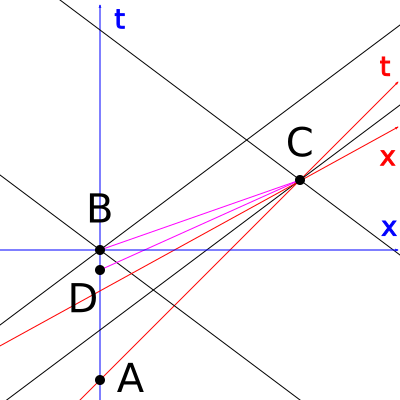
Bibliography:
- physics.stackexchange.com/questions/13001/does-superluminal-travel-imply-travelling-back-in-time/615079#615079
- physics.stackexchange.com/questions/574395/why-would-ftl-imply-time-travel
- physics.stackexchange.com/questions/516767/how-does-a-tachyonic-antitelephone-work
- www.physicsmatt.com/blog/2016/8/25/why-ftl-implies-time-travel shows the causality violation on a Spacetime diagram
gothinkster/realworld implementations based on Express.js.
- 10 8:
st_name=01000000= character 1 in the.strtab, which until the following\0makeshello_world.asmThis piece of information file may be used by the linker to decide on which segment sections go: e.g. inldlinker script we write:segment_name : { file(section) }segment_name : { *(section) } - 10 13:
st_shndx= Symbol Table Section header Index =f1ff=SHN_ABS. Required forSTT_FILE. - 20 0:
st_value= 8x00: required for value forSTT_FILE - 20 8:
st_size= 8x00: no allocated size
Now from the
readelf, we interpret the others quickly.There are two such entries, one pointing to
.data and the other to .text (section indexes 1 and 2).Num: Value Size Type Bind Vis Ndx Name
2: 0000000000000000 0 SECTION LOCAL DEFAULT 1
3: 0000000000000000 0 SECTION LOCAL DEFAULT 2TODO what is their purpose?
Then come the most important symbols:
Num:    Value          Size Type    Bind   Vis      Ndx Name
  4: 0000000000000000     0 NOTYPE  LOCAL  DEFAULT    1 hello_world
  5: 000000000000000d     0 NOTYPE  LOCAL  DEFAULT  ABS hello_world_len
6: 0000000000000000 0 NOTYPE GLOBAL DEFAULT 2 _startIn index 0,
SHT_NULL is mandatory. Are there any other uses for it: stackoverflow.com/questions/26812142/what-is-the-use-of-the-sht-null-section-in-elf ? Pinned article: Introduction to the OurBigBook Project
Welcome to the OurBigBook Project! Our goal is to create the perfect publishing platform for STEM subjects, and get university-level students to write the best free STEM tutorials ever.
Everyone is welcome to create an account and play with the site: ourbigbook.com/go/register. We belive that students themselves can write amazing tutorials, but teachers are welcome too. You can write about anything you want, it doesn't have to be STEM or even educational. Silly test content is very welcome and you won't be penalized in any way. Just keep it legal!
Intro to OurBigBook
. Source. We have two killer features:
- topics: topics group articles by different users with the same title, e.g. here is the topic for the "Fundamental Theorem of Calculus" ourbigbook.com/go/topic/fundamental-theorem-of-calculusArticles of different users are sorted by upvote within each article page. This feature is a bit like:
- a Wikipedia where each user can have their own version of each article
- a Q&A website like Stack Overflow, where multiple people can give their views on a given topic, and the best ones are sorted by upvote. Except you don't need to wait for someone to ask first, and any topic goes, no matter how narrow or broad
This feature makes it possible for readers to find better explanations of any topic created by other writers. And it allows writers to create an explanation in a place that readers might actually find it.
Figure 1. Screenshot of the "Derivative" topic page. View it live at: ourbigbook.com/go/topic/derivativeVideo 2. OurBigBook Web topics demo. Source. - local editing: you can store all your personal knowledge base content locally in a plaintext markup format that can be edited locally and published either:This way you can be sure that even if OurBigBook.com were to go down one day (which we have no plans to do as it is quite cheap to host!), your content will still be perfectly readable as a static site.
- to OurBigBook.com to get awesome multi-user features like topics and likes
- as HTML files to a static website, which you can host yourself for free on many external providers like GitHub Pages, and remain in full control

Figure 2. You can publish local OurBigBook lightweight markup files to either OurBigBook.com or as a static website.
Figure 3. Visual Studio Code extension installation.
Figure 5. . You can also edit articles on the Web editor without installing anything locally. Video 3. Edit locally and publish demo. Source. This shows editing OurBigBook Markup and publishing it using the Visual Studio Code extension. 
- Infinitely deep tables of contents:


All our software is open source and hosted at: github.com/ourbigbook/ourbigbook
Further documentation can be found at: docs.ourbigbook.com
Feel free to reach our to us for any help or suggestions: docs.ourbigbook.com/#contact