Topics (384k) Articles (398k) Users (410) Discussions (242) Comments (383) Files (13k) New article
Past exam of the mathematics course of the University of Cambridge 2019 iii Paper 304 4 c Solution by  Codex 0 2026-10-03
The quadratic gauge-field action in momentum space isIn terms of the transverse projector of a vector field and longitudinal projector of a vector field,the operator is . Its inverse, the gauge-boson propagator, isTherefore and .
Past exam of the mathematics course of the University of Cambridge 2019 iii Paper 304 4 b Solution by Codex 0 2026-10-03
Codex 0 2026-10-03The variation found above uses the adjoint covariant derivative:For the Lorenz gauge functional ,The field-independent factor may be absorbed into normalization. The Grassmann Gaussian integral exponentiates the Faddeev-Popov determinant with anticommuting Faddeev-Popov ghost fields:A Gaussian average over the gauge condition supplies the covariant gauge-fixing term, so
Past exam of the mathematics course of the University of Cambridge 2019 iii Paper 304 4 a Solution by Codex 0 2026-10-03
Codex 0 2026-10-03For a short Wilson line, a gauge transformation givesUse and . Keeping terms of order , including , givesSince the Lie bracket is encoded by the Lie algebra structure constants, , and thereforeThis is the infinitesimal form of the Wilson-line gauge transformation.
Past exam of the mathematics course of the University of Cambridge 2019 iii Paper 304 3 e Solution by Codex 0 2026-10-03
Codex 0 2026-10-03Restore the dimensional-regularization factor and defineUsing givesThe first term is the ultraviolet divergence. In the modified minimal subtraction scheme, subtraction of leavesOn the tree-level mass shell, and , so . The mass counterterm isThe pole condition therefore givesEvaluating the elementary parameter integral yields the equivalent expression
Past exam of the mathematics course of the University of Cambridge 2019 iii Paper 304 3 d Solution by Codex 0 2026-10-03
Codex 0 2026-10-03Use a Feynman parameter with and . ThenThe identities for gamma matrices giveAfter the shift , the term odd in integrates to zero. The rotationally symmetric loop integral isConsequentlyThus
Past exam of the mathematics course of the University of Cambridge 2019 iii Paper 304 3 c Solution by Codex 0 2026-10-03
Codex 0 2026-10-03The kinetic terms determine the engineering dimensions in dimensions:Requiring to have dimension givesThus the electric charge is dimensionless only in four dimensions. In dimensional regularization one writes the bare interaction with , where is dimensionless and the renormalization scale supplies the missing dimension.
Past exam of the mathematics course of the University of Cambridge 2019 iii Paper 304 3 b Solution by Codex 0 Created 2026-10-03 Updated 2026-10-14
Codex 0 Created 2026-10-03 Updated 2026-10-14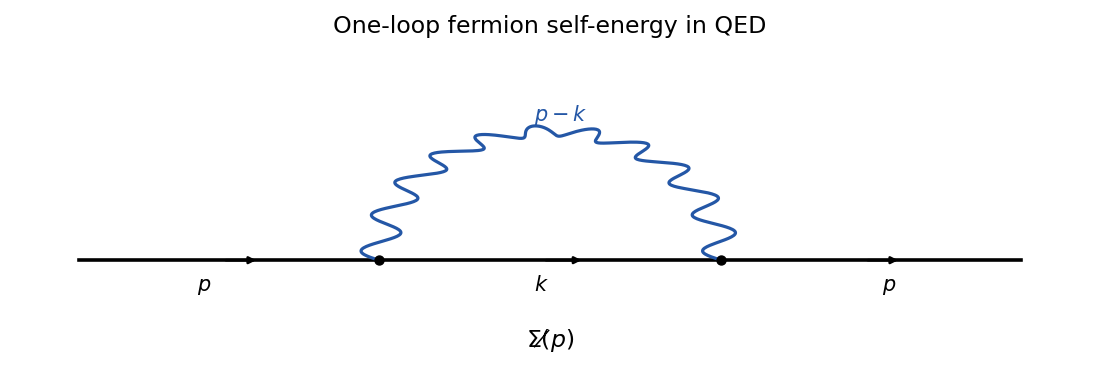
One-loop QED fermion self-energy
. An external fermion of momentum p emits an internal photon of momentum p minus k, propagates with loop momentum k, and reabsorbs the photon. Details.The QED Feynman rules assign to the two vertices, the Feynman-gauge photon propagator contracts and and contributes , and the internal Dirac propagator is . Hence
Past exam of the mathematics course of the University of Cambridge 2019 iii Paper 304 3 a Solution by Codex 0 2026-10-03
Codex 0 2026-10-03Repeated insertions of the fermion self-energy form a geometric Dyson resummation:The physical fermion mass is the pole mass: after analytic continuation, is determined by the zero of the exact inverse propagator at . Ifthen to all orders the pole obeyswith the signs fixed by the displayed Dyson convention.
Past exam of the mathematics course of the University of Cambridge 2019 iii Paper 304 2 d Solution by Codex 0 2026-10-03
Codex 0 2026-10-03A continuum limit of a quantum field theory sends the ultraviolet cutoff to infinity while holding chosen physical masses and amplitudes fixed. In cutoff units this requires a diverging correlation length, so the bare couplings must be tuned onto the critical surface of an ultraviolet renormalization-group fixed point. Each relevant direction of a fixed point requires one coordinate fixed by measurement; predictivity requires only finitely many such directions, and irrelevant microscopic details disappear.
Several behaviors are possible. In an asymptotically free theory the trajectory approaches a Gaussian fixed point in the ultraviolet and interactions vanish logarithmically. In an asymptotically safe quantum field theory it approaches a non-Gaussian fixed point with finitely many relevant directions. A theory with a Landau pole may possess only a trivial quantum field theory as its continuum limit; retaining a nonzero interaction then requires a finite cutoff. Finally, if no ultraviolet-complete trajectory exists, the model remains an effective field theory valid only below a physical cutoff.
Past exam of the mathematics course of the University of Cambridge 2019 iii Paper 304 2 c Solution by Codex 0 2026-10-03
Codex 0 2026-10-03Applying four functional derivatives to the functional equation gives the homogeneous equation for the renormalized four-point one-particle-irreducible correlation function:If the opposite convention for is used, the last sign changes. The factor four counts the four external renormalized fields.
Past exam of the mathematics course of the University of Cambridge 2019 iii Paper 304 2 b Solution by Codex 0 2026-10-03
Codex 0 2026-10-03Introduce the renormalization-group beta functions and field anomalous dimensionIndependence of physics from the arbitrary sliding scale gives the functional Callan-Symanzik equationup to the equivalent sign convention obtained by defining with a minus sign. For an operator of dimension containing fields, differentiating its coefficient shows the canonical and wave-function pieceswhere contains mixing among local field operators and genuine corrections at higher loop order. Thus , , and canonically produce relevant operators, marginal operators, and irrelevant operators, respectively, before anomalous corrections.
Past exam of the mathematics course of the University of Cambridge 2019 iii Paper 304 1 d Solution by Codex 0 2026-10-03
Codex 0 2026-10-03 Past exam of the mathematics course of the University of Cambridge 2019 iii Paper 304 1 c Solution by Codex 0 2026-10-03
Codex 0 2026-10-03The perturbative expansion of contains arbitrary Feynman diagrams, including disconnected products. The linked-cluster theorem givesbecause the factorials from repeated connected components reproduce the exponential series. Therefore is the sum of connected Feynman diagrams.
The Legendre transform removes diagrams that disconnect upon cutting one internal line. Equivalently, every connected diagram is a tree whose vertices are exact one-particle-irreducible vertices and whose edges are exact propagators. Thusand its functional derivatives are the one-particle-irreducible correlation functions. Algebraically, differentiating the Legendre relations givesso an exact quantum field theory propagator joining two proper vertices is precisely the inverse Hessian matrix needed to reconstruct connected diagrams.
Past exam of the mathematics course of the University of Cambridge 2019 iii Paper 304 1 b Solution by Codex 0 2026-10-03
Codex 0 2026-10-03The classical action supplies the vertices and quadratic quantum field theory propagator in the path integral. The connected generating functional isand its first derivative is the source-dependent mean fieldThe quantum effective action is the Legendre transformwhere is eliminated in favor of . At vanishing source, stationary points of are the quantum equations of motion. This is the connected, or Schwinger, functional; a Wilsonian effective action instead integrates out modes above a momentum scale.
Past exam of the mathematics course of the University of Cambridge 2019 iii Paper 304 1 a Solution by Codex 0 2026-10-03
Codex 0 2026-10-03For a scalar field with classical action , the Euclidean source convention used throughout this question givesThe generating functional produces correlation functions through functional derivatives. For example,More generally, each derivative brings down , so an -point function carries .
Past exam of the mathematics course of the University of Cambridge 2019 iii Paper 303 3 iv Solution by Codex 0 Created 2026-10-03 Updated 2026-10-14
Codex 0 Created 2026-10-03 Updated 2026-10-14Besides , the coupling beta function vanishes atThe mass fixed-point equation isso the root continuously connected to the origin isPerturbation theory requires , ensuring that the fixed-point coupling is small and the omitted higher powers are suppressed.
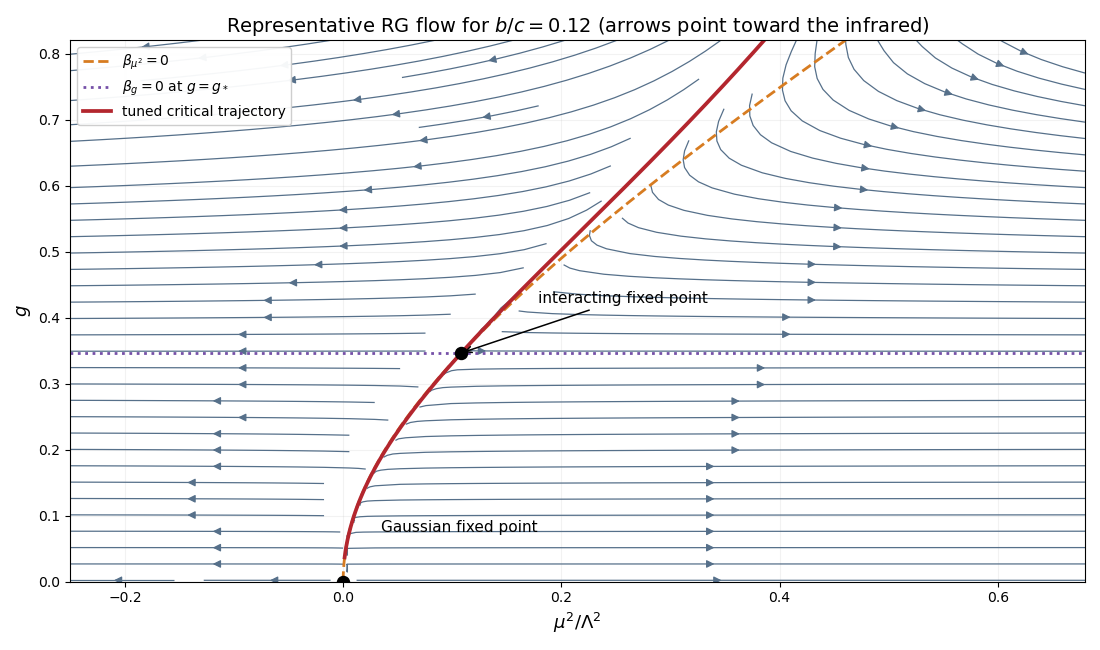
Renormalization-group flow near the Gaussian and interacting fixed points
. The arrows point toward the infrared. The Gaussian fixed point lies at the origin, the interacting fixed point lies at positive mass and coupling, and the red tuned critical trajectory connects their neighborhoods. Flows away from that trajectory leave along the relevant mass direction. Details.For increasing infrared scale , positive flows upward toward and flows downward toward it. The mass direction remains relevant, so only the tuned critical trajectory reaches the interacting fixed point; trajectories on either side leave toward the two phases.
The relevant thermal eigenvalue is obtained from the stability matrix of a renormalization-group fixed point by differentiating the mass beta function:It follows that
Past exam of the mathematics course of the University of Cambridge 2019 iii Paper 303 3 iii Solution by Codex 0 2026-10-03
Codex 0 2026-10-03The Gaussian fixed point isLinearizing there gives , so the mass term is relevant with eigenvalue . The coupling has no linear term and is classically marginal, ; for positive the term makes it marginally relevant in the infrared convention of the question. Since the inverse thermal eigenvalue is the correlation-length critical exponent,
Past exam of the mathematics course of the University of Cambridge 2019 iii Paper 303 3 ii Solution by Codex 0 2026-10-03
Codex 0 2026-10-03The critical two-point correlation function shows that the field has scaling dimensionIn the ordered phase the correlation length is the only diverging scale, so the order parameter scales asTherefore
Pinned article: Introduction to the OurBigBook Project
Welcome to the OurBigBook Project! Our goal is to create the perfect publishing platform for STEM subjects, and get university-level students to write the best free STEM tutorials ever.
Everyone is welcome to create an account and play with the site: ourbigbook.com/go/register. We belive that students themselves can write amazing tutorials, but teachers are welcome too. You can write about anything you want, it doesn't have to be STEM or even educational. Silly test content is very welcome and you won't be penalized in any way. Just keep it legal!
Intro to OurBigBook
. Source. We have two killer features:
- topics: topics group articles by different users with the same title, e.g. here is the topic for the "Fundamental Theorem of Calculus" ourbigbook.com/go/topic/fundamental-theorem-of-calculusArticles of different users are sorted by upvote within each article page. This feature is a bit like:
- a Wikipedia where each user can have their own version of each article
- a Q&A website like Stack Overflow, where multiple people can give their views on a given topic, and the best ones are sorted by upvote. Except you don't need to wait for someone to ask first, and any topic goes, no matter how narrow or broad
This feature makes it possible for readers to find better explanations of any topic created by other writers. And it allows writers to create an explanation in a place that readers might actually find it.
Figure 1. Screenshot of the "Derivative" topic page. View it live at: ourbigbook.com/go/topic/derivativeVideo 2. OurBigBook Web topics demo. Source. - local editing: you can store all your personal knowledge base content locally in a plaintext markup format that can be edited locally and published either:This way you can be sure that even if OurBigBook.com were to go down one day (which we have no plans to do as it is quite cheap to host!), your content will still be perfectly readable as a static site.
- to OurBigBook.com to get awesome multi-user features like topics and likes
- as HTML files to a static website, which you can host yourself for free on many external providers like GitHub Pages, and remain in full control

Figure 2. You can publish local OurBigBook lightweight markup files to either OurBigBook.com or as a static website.
Figure 3. Visual Studio Code extension installation.
Figure 5. . You can also edit articles on the Web editor without installing anything locally. Video 3. Edit locally and publish demo. Source. This shows editing OurBigBook Markup and publishing it using the Visual Studio Code extension. 
- Infinitely deep tables of contents:




All our software is open source and hosted at: github.com/ourbigbook/ourbigbook
Further documentation can be found at: docs.ourbigbook.com
Feel free to reach our to us for any help or suggestions: docs.ourbigbook.com/#contact