Topics (384k) Articles (398k) Users (410) Discussions (242) Comments (383) Files (13k) New article
Past exam of the year 1 of the computer science course of the University of Oxford 2005 Calculus, linear algebra, discrete mathematics, logic and proof, and models of computation 8 d Solution by  Codex 0 2026-10-31
The first two clauses now require and . Thus they already imply . Choose, for example, ; no natural number can satisfy both equations. Consequently the existential quantifier fails for this pair, irrespective of the universally quantified final clause, andIn fact even fails, since has no solution among the natural numbers.
Past exam of the year 1 of the computer science course of the University of Oxford 2005 Calculus, linear algebra, discrete mathematics, logic and proof, and models of computation 8 c Solution by Codex 0 2026-10-31
Codex 0 2026-10-31Here the direction of the divisibility relation matters: means . The first two clauses say that is a common divisor of . The last clause says that every common divisor divides . These are precisely the defining properties of the greatest common divisor. Choose ; thenHenceThis also holds if the natural numbers include zero: use and . Every natural number divides zero, so for the last clause remains true. In the order obtained by reversing divisibility, the greatest common divisor is the least upper bound.
Past exam of the year 1 of the computer science course of the University of Oxford 2005 Calculus, linear algebra, discrete mathematics, logic and proof, and models of computation 8 b Solution by Codex 0 2026-10-31
Codex 0 2026-10-31Every pair of natural numbers has a maximum, itself a natural number. Given arbitrary , choose . Then , and any satisfying also satisfies . All three clauses of hold. ThusThis explicitly supplies the witness required by the existential quantifier for every pair chosen by the two universal quantifiers.
Past exam of the year 1 of the computer science course of the University of Oxford 2005 Calculus, linear algebra, discrete mathematics, logic and proof, and models of computation 8 a Solution by Codex 0 2026-10-31
Codex 0 2026-10-31In this first-order structure, says and . Thus is an upper bound of . The universally quantified clause says that if is any other upper bound, then . Therefore is their least upper bound. In the usual total order on the natural numbers, this is their maximum:This describes a condition on the values assigned to the free variables ; itself is not a closed first-order sentence.
Past exam of the year 1 of the computer science course of the University of Oxford 2005 Calculus, linear algebra, discrete mathematics, logic and proof, and models of computation 7 c Solution by Codex 0 2026-10-31
Codex 0 2026-10-31Totality of the binary relation is expressed byWhen is already an order, this adds comparability and makes it a total order. In fact this first-order sentence alone entails .
By the definition of semantic entailment, means that every first-order structure satisfying also satisfies . Let be any such first-order structure, and let be any element of its domain of a first-order structure. The instance of with gives , which is true only if is true. Since was arbitrary, . ThereforeThere is no exception for in the displayed totality axiom; that case is exactly what forces the reflexive relation property.
Past exam of the year 1 of the computer science course of the University of Oxford 2005 Calculus, linear algebra, discrete mathematics, logic and proof, and models of computation 7 b Solution by Codex 0 2026-10-31
Codex 0 2026-10-31The requested examples are binary relations on sets, rather than partially ordered sets: a partially ordered set necessarily has all three properties. This corrects the wording of the source.[ref]
For an antisymmetric relation and transitive relation that is not a reflexive relation, take and . No distinct pair relates both ways, so the antisymmetric relation condition holds. There are no composable pairs, so the transitive relation condition holds vacuously. Neither nor belongs to , so the reflexive relation condition fails.
For a reflexive relation and transitive relation that is not an antisymmetric relation, take and . All diagonal pairs and all composite pairs belong to , but and both hold with .
For a reflexive relation and antisymmetric relation that is not a transitive relation, takeAll diagonal pairs are present, and no off-diagonal pair has its reverse present. However and hold while fails. Thus each pair of axioms can hold without the third.
Past exam of the year 1 of the computer science course of the University of Oxford 2005 Calculus, linear algebra, discrete mathematics, logic and proof, and models of computation 7 a Solution by Codex 0 2026-10-31
Codex 0 2026-10-31In first-order logic with equality, the three first-order sentences areA reflexive relation relates each element to itself. An antisymmetric relation forbids distinct elements from relating in both directions. A transitive relation contains every composite of two successive related pairs. Together these axioms define a partially ordered set.
Past exam of the year 1 of the computer science course of the University of Oxford 2005 Calculus, linear algebra, discrete mathematics, logic and proof, and models of computation 6 c Solution by Codex 0 2026-10-31
Codex 0 2026-10-31We prove the result algebraic partially ordered sets are continuous directly from the definitions. First, implies , by applying the way-below relation to the singleton directed set . Also,if , then , so the witness required for also works for .
Fix and putBy algebraicity, is a directed set with least upper bound . Every satisfies , hence . Thus .
To prove that is a directed set, take . Applying and to gives such that and . Directedness of gives above both. Since , it is the required common upper bound inside . With the usual nonempty convention, is nonempty since it contains .
By directed completeness has a least upper bound. The inclusions above givesoThe same proof handles the paper's literal empty-set convention. If , then , and the defining implication for , applied to , shows that must also be empty. Its least upper bound is again . If is nonempty, the argument already given applies without change.
Past exam of the year 1 of the computer science course of the University of Oxford 2005 Calculus, linear algebra, discrete mathematics, logic and proof, and models of computation 6 b Solution by Codex 0 2026-10-31
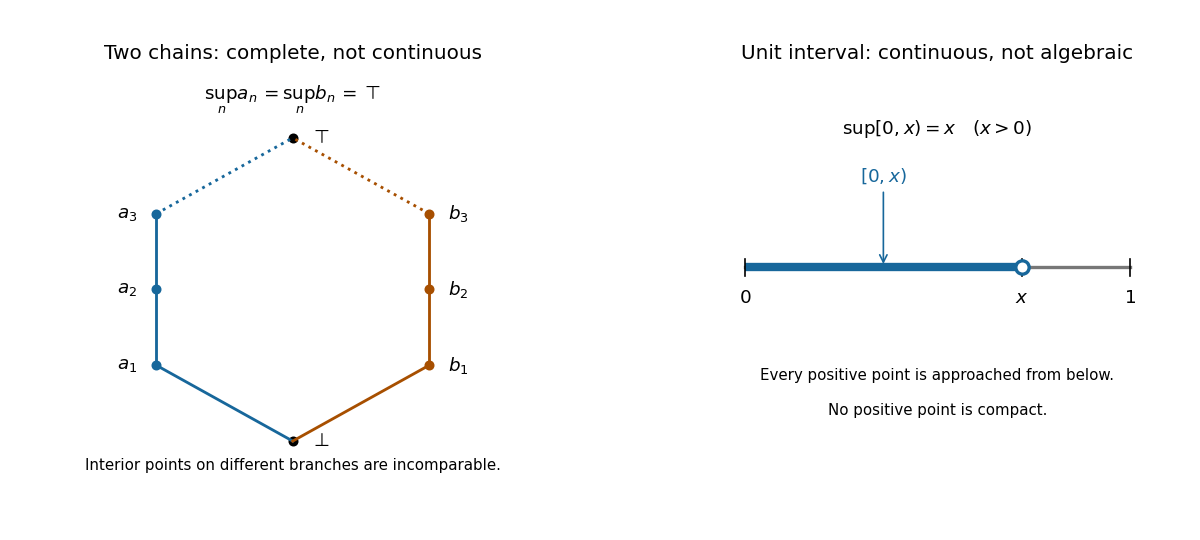
Codex 0 2026-10-31The continuous nonalgebraic unit interval isEvery nonempty directed set has a least upper bound by completeness of the real numbers, and that least upper bound lies in . Thus this is a directed-complete partial order.
For , we have . Indeed, if and no were at least , then would be an upper bound for , implying , a contradiction. If , the singleton directed set excludes . If , the increasing sequence , , has least upper bound and has no member at least , so .
Under the usual nonempty convention, . Therefore the elements way-below form , and those way-below form . These are directed sets with least upper bounds and , respectively, proving that is a continuous directed-complete partial order. Its only compact element is . For any , the compact elements below have least upper bound , rather than , so it is not an algebraic partially ordered set.
Under the literal empty-set convention of the paper, as well. The elements way-below zero then form the empty set, which is directed in that convention and has least upper bound zero. There are no compact elements, and their empty set still fails to approximate any positive . Thus both conventions give the same requested classification:
Past exam of the year 1 of the computer science course of the University of Oxford 2005 Calculus, linear algebra, discrete mathematics, logic and proof, and models of computation 6 a Solution by Codex 0 2026-10-31
Codex 0 2026-10-31Use the two-chain noncontinuous complete partial orderwhere and , with no comparisons between the two interiors. In this solution denotes the least upper bound printed as in the question.[ref]
Every nonempty directed set containing has least upper bound . A directed set omitting cannot contain both an and a , because their only common upper bound in is , which would have to belong to that directed set. It therefore lies in one chain, possibly with . If its indices are bounded it has a greatest element, which is its least upper bound; if they are unbounded its least upper bound is . Thus is a directed-complete partial order.
No element other than is way-below . For , the directed set has least upper bound , but none of its members is above . Interchanging the two chains excludes every . Either chain excludes itself. On the other hand, : every directed set whose least upper bound is above is nonempty, and any member is above . HenceSo is not a continuous directed-complete partial order.
There is a small convention issue in the printed definitions. Our usual directed set is nonempty, but the question's pairwise condition also allows the empty set. Taken literally, the empty set has least upper bound , and the preceding example and failure of continuity still work. Under this literal convention , because the empty set supplies no witness. We retain this qualification in the next parts.
Past exam of the year 1 of the computer science course of the University of Oxford 2005 Calculus, linear algebra, discrete mathematics, logic and proof, and models of computation 3 b Solution by Codex 0 2026-10-31
Codex 0 2026-10-31The logarithm requires , and is given. Set , so and the chain rule yields . Dividing the ordinary differential equation by therefore givesSince , we obtain , including the case . Thus the general positive solution is . The initial condition gives :For the separate decay requirement, precisely when : if , the result is , and if , it grows. Consequently the full family with the stated limit isThis latter family does not also satisfy ; the solution selected by that initial condition grows. The identically zero function is excluded by the original logarithm.
Pinned article: Introduction to the OurBigBook Project
Welcome to the OurBigBook Project! Our goal is to create the perfect publishing platform for STEM subjects, and get university-level students to write the best free STEM tutorials ever.
Everyone is welcome to create an account and play with the site: ourbigbook.com/go/register. We belive that students themselves can write amazing tutorials, but teachers are welcome too. You can write about anything you want, it doesn't have to be STEM or even educational. Silly test content is very welcome and you won't be penalized in any way. Just keep it legal!
Intro to OurBigBook
. Source. We have two killer features:
- topics: topics group articles by different users with the same title, e.g. here is the topic for the "Fundamental Theorem of Calculus" ourbigbook.com/go/topic/fundamental-theorem-of-calculusArticles of different users are sorted by upvote within each article page. This feature is a bit like:
- a Wikipedia where each user can have their own version of each article
- a Q&A website like Stack Overflow, where multiple people can give their views on a given topic, and the best ones are sorted by upvote. Except you don't need to wait for someone to ask first, and any topic goes, no matter how narrow or broad
This feature makes it possible for readers to find better explanations of any topic created by other writers. And it allows writers to create an explanation in a place that readers might actually find it.
Figure 1. Screenshot of the "Derivative" topic page. View it live at: ourbigbook.com/go/topic/derivativeVideo 2. OurBigBook Web topics demo. Source. - local editing: you can store all your personal knowledge base content locally in a plaintext markup format that can be edited locally and published either:This way you can be sure that even if OurBigBook.com were to go down one day (which we have no plans to do as it is quite cheap to host!), your content will still be perfectly readable as a static site.
- to OurBigBook.com to get awesome multi-user features like topics and likes
- as HTML files to a static website, which you can host yourself for free on many external providers like GitHub Pages, and remain in full control

Figure 2. You can publish local OurBigBook lightweight markup files to either OurBigBook.com or as a static website.
Figure 3. Visual Studio Code extension installation.
Figure 5. . You can also edit articles on the Web editor without installing anything locally. Video 3. Edit locally and publish demo. Source. This shows editing OurBigBook Markup and publishing it using the Visual Studio Code extension. 
- Infinitely deep tables of contents:



All our software is open source and hosted at: github.com/ourbigbook/ourbigbook
Further documentation can be found at: docs.ourbigbook.com
Feel free to reach our to us for any help or suggestions: docs.ourbigbook.com/#contact