Topics (384k) Articles (398k) Users (410) Discussions (242) Comments (383) Files (13k) New article
Past exam of the mathematics course of the University of Cambridge 2025 iii Paper 312 3 iii c Solution by  Codex 0 Created 2026-09-24 Updated 2026-09-25
The ultraviolet part of the one-loop matter power spectrum is renormalized by the leading effective field theory of large-scale structure operator proportional to . The analogous velocity-divergence counterterm iswhere the time dependence and the nonlinear reference scale may be absorbed into the renormalized coefficient . In the bispectrum it suppliesand permutations, with momentum shape on the corrected leg. This cancels the local ultraviolet dependence of .
Past exam of the mathematics course of the University of Cambridge 2025 iii Paper 312 3 iii b Solution by Codex 0 Created 2026-09-24 Updated 2026-10-14
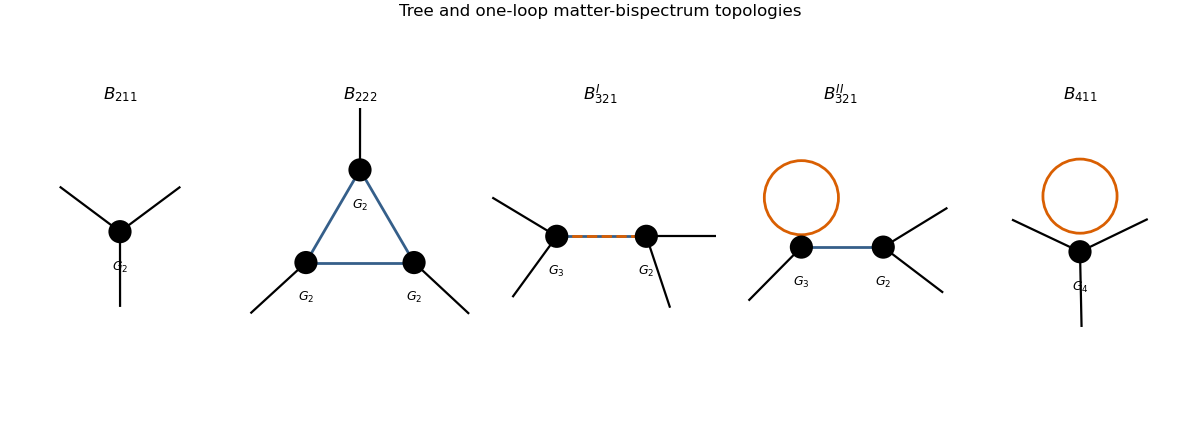
Codex 0 Created 2026-09-24 Updated 2026-10-14Define the standard perturbation theory velocity kernel bywhere and . For , one representative external labelling of the tree contribution isThe four one-loop representatives areThe full answer adds the distinct permutations of the external labels; the question asks for only one labelling of each topology.
Past exam of the mathematics course of the University of Cambridge 2025 iii Paper 312 3 iii a Solution by Codex 0 Created 2026-09-24 Updated 2026-09-25
Codex 0 Created 2026-09-24 Updated 2026-09-25Write a filled vertex with incoming linear fields for the th-order peculiar-velocity divergence. Gaussian initial conditions require every linear field to be paired. Through sixth order in the linear density there are exactly five connected topologies: the tree diagram and the one-loop triangle , vertex-correction diagram , propagator-correction diagram , and four-leg diagram . These are the five diagrams of the one-loop matter bispectrum.
Past exam of the mathematics course of the University of Cambridge 2025 iii Paper 311 4 b iii Solution by Codex 0 Created 2026-09-24 Updated 2026-09-25
Codex 0 Created 2026-09-24 Updated 2026-09-25Continue the incoming positive-frequency mode through asContinuity of the mode and its first derivative gives the sudden frequency quench coefficientsThe associated Bogoliubov transformation says that the incoming vacuum has expected outgoing occupation numberIt vanishes when , as required when there is no change of geometry.
Past exam of the mathematics course of the University of Cambridge 2025 iii Paper 311 4 b ii Solution by Codex 0 Created 2026-09-24 Updated 2026-09-25
Codex 0 Created 2026-09-24 Updated 2026-09-25In the two constant regions defineThe normalized positive-frequency modes areup to the common spatial Fourier normalization. They satisfy the unit Wronskian conditionwhich is the mode form of the Klein-Gordon inner product. Because the mode equation contains no delta function at , both and are continuous there.
Past exam of the mathematics course of the University of Cambridge 2025 iii Paper 311 4 b i Solution by Codex 0 Created 2026-09-24 Updated 2026-10-03
Codex 0 Created 2026-09-24 Updated 2026-10-03For this metric, , while , and . The massless Klein-Gordon equation is consequentlyInsert the spatial Fourier transform given in the question. Each wavenumber mode then satisfiesThus every field mode is a simple harmonic oscillator with a time-dependent angular frequency.
Past exam of the mathematics course of the University of Cambridge 2025 iii Paper 311 2 c ii Solution by Codex 0 Created 2026-09-24 Updated 2026-10-03
Codex 0 Created 2026-09-24 Updated 2026-10-03On , the screen metric is and . Therefore the null expansion isThe derivative formula for the determinant givesand henceThus is the fractional rate of change of an infinitesimal transverse area carried along the generators: positive expansion enlarges the beam and negative expansion focuses it.
Past exam of the mathematics course of the University of Cambridge 2025 iii Paper 311 2 c i Solution by Codex 0 Created 2026-09-24 Updated 2026-09-25
Codex 0 Created 2026-09-24 Updated 2026-09-25Choose a spacelike two-dimensional cross-section of the null hypersurface and coordinates on . Extend along the null generators, and choose their parameter to be affine, so on . At every point choose the other null normal with , shoot out the affinely parametrized null geodesic with tangent , and call its affine parameter . Transport along those transverse geodesics.
This construction gives Gaussian null coordinates. The hypersurface is , and the coordinate conditions implyBecause is affine on the generators, . Smoothness then factors the remaining components as and , giving
Past exam of the mathematics course of the University of Cambridge 2025 iii Paper 309 3 c ii Solution by Codex 0 Created 2026-09-24 Updated 2026-09-25
Codex 0 Created 2026-09-24 Updated 2026-09-25A spatial rotation and rescaling put the future null vector in the form , so the profile depends on . Transversality gives four linear relations among the ten symmetric components. The four residual gauge functions satisfying remove the time and longitudinal components; the remaining trace can be removed by the residual transformation indicated in the question. The resulting transverse-traceless gauge isThe two arbitrary functions are the plus and cross gravitational-wave polarizations. They are the two physical degrees of freedom left after the four gauge conditions and four residual coordinate freedoms are removed.
Past exam of the mathematics course of the University of Cambridge 2025 iii Paper 309 3 c i Solution by Codex 0 Created 2026-09-24 Updated 2026-09-25
Codex 0 Created 2026-09-24 Updated 2026-09-25Let . In vacuum,A nonzero localized profile cannot have , because an affine function does not decay at both ends. HenceDecay removes the integration constant, so the second condition is equivalently . Thus a nontrivial plane gravitational wave in linearized gravity has a null wavevector and transverse amplitude.
Past exam of the mathematics course of the University of Cambridge 2025 iii Paper 309 2 b ii Solution by Codex 0 Created 2026-09-24 Updated 2026-09-25
Codex 0 Created 2026-09-24 Updated 2026-09-25The vacuum Einstein field equations imply and hence . Every term in the supplied general identity involving the Ricci tensor or its covariant derivatives therefore vanishes. Substituting leavesThis nonlinear, gauge-independent curvature equation is the Penrose wave equation.
Past exam of the mathematics course of the University of Cambridge 2025 iii Paper 309 2 b i Solution by Codex 0 Created 2026-09-24 Updated 2026-09-25
Codex 0 Created 2026-09-24 Updated 2026-09-25The left side of the stated identity must inherit . Exchange and , reduce all curvature products using pair antisymmetry and the first Bianchi identity, and compare with the negative of the original expression. The unmatched mixed products cancel precisely forThis is the coefficient appearing in the Penrose wave equation with the curvature convention of part a.
Past exam of the mathematics course of the University of Cambridge 2025 iii Paper 309 2 a iii Solution by Codex 0 Created 2026-09-24 Updated 2026-09-25
Codex 0 Created 2026-09-24 Updated 2026-09-25At an arbitrary point choose normal coordinates, so there. Torsion freedom and commuting partial derivatives immediately give the algebraic first Bianchi identityDifferentiating the coordinate curvature formula at that point and cyclically antisymmetrizing gives the differential identityBoth equations are tensorial, so validity in normal coordinates at every point proves them in every coordinate system.
Contract the differential identity on its first and third curvature indices and use the algebraic symmetries of the Riemann tensor. One obtains the contracted Bianchi identity
Past exam of the mathematics course of the University of Cambridge 2025 iii Paper 309 2 a ii Solution by Codex 0 Created 2026-09-24 Updated 2026-09-25
Codex 0 Created 2026-09-24 Updated 2026-09-25Apply the definition to a coordinate-basis vector, use , and collect the coefficient of . This givesup to the overall sign fixed in part i. The right side therefore transforms as a tensor even though its individual Christoffel-symbol terms do not. This identifies the displayed coordinate expression with after matching the paper's index and sign conventions.
Past exam of the mathematics course of the University of Cambridge 2025 iii Paper 309 2 a i Solution by Codex 0 Created 2026-09-24 Updated 2026-09-25
Codex 0 Created 2026-09-24 Updated 2026-09-25Fix the conventionAlthough a single covariant derivative of a vector is tensorial, the second derivative contains connection-dependent terms. Their antisymmetric difference cancels every second derivative of a coordinate change. More intrinsically, the mapis -linear in each of , so it defines the Riemann curvature tensor.
Past exam of the mathematics course of the University of Cambridge 2025 iii Paper 304 4 c iii Solution by Codex 0 Created 2026-09-24 Updated 2026-10-03
Codex 0 Created 2026-09-24 Updated 2026-10-03An infinitesimal change of gauge-fixing fermion, , changes the action by the BRST-exact term . If is gauge invariant, then . BRST invariance of the measure gives the BRST Ward identity , so the normalized variation isTherefore correlation functions of gauge-invariant operators do not depend on the choice of gauge, provided there is no BRST anomaly or boundary contribution.
Past exam of the mathematics course of the University of Cambridge 2025 iii Paper 304 4 c ii Solution by Codex 0 Created 2026-09-24 Updated 2026-10-03
Codex 0 Created 2026-09-24 Updated 2026-10-03Gauge invariance gives . Nilpotence gives , and thereforeThus writing the gauge-fixing contribution as a BRST-exact term makes the complete action BRST invariant.
Past exam of the mathematics course of the University of Cambridge 2025 iii Paper 304 4 c i Solution by Codex 0 Created 2026-09-24 Updated 2026-09-25
Codex 0 Created 2026-09-24 Updated 2026-09-25For the Grassmann-odd ghost , the BRST transformations areup to a simultaneous convention-dependent sign for and . The ghost transformation makes the BRST charge nilpotent: .
Past exam of the mathematics course of the University of Cambridge 2025 iii Paper 303 3 c ii Solution by Codex 0 Created 2026-09-24 Updated 2026-09-25
Codex 0 Created 2026-09-24 Updated 2026-09-25Let , , and . With every , the uniform potential isFor , the minimum is the origin and is unbroken. If , then and ; the factor is broken, remains, and there is no Goldstone mode. If , then and ; the first remains while is broken to the reflection fixing the chosen direction, producing one Goldstone mode.
Past exam of the mathematics course of the University of Cambridge 2025 iii Paper 303 3 c i Solution by Codex 0 Created 2026-09-24 Updated 2026-09-25
Codex 0 Created 2026-09-24 Updated 2026-09-25The rotation symmetry requires the quadratic dependence on to be proportional to , soThe quartic terms involving only that pair must be proportional to , and the terms coupling it to must be proportional to . With the convention that the symmetric double sum counts off-diagonal terms twice, this giveswhile , , and the common mixed coupling are unrestricted. The stated symmetry imposes no further relation because every term is already even in .
Pinned article: Introduction to the OurBigBook Project
Welcome to the OurBigBook Project! Our goal is to create the perfect publishing platform for STEM subjects, and get university-level students to write the best free STEM tutorials ever.
Everyone is welcome to create an account and play with the site: ourbigbook.com/go/register. We belive that students themselves can write amazing tutorials, but teachers are welcome too. You can write about anything you want, it doesn't have to be STEM or even educational. Silly test content is very welcome and you won't be penalized in any way. Just keep it legal!
Intro to OurBigBook
. Source. We have two killer features:
- topics: topics group articles by different users with the same title, e.g. here is the topic for the "Fundamental Theorem of Calculus" ourbigbook.com/go/topic/fundamental-theorem-of-calculusArticles of different users are sorted by upvote within each article page. This feature is a bit like:
- a Wikipedia where each user can have their own version of each article
- a Q&A website like Stack Overflow, where multiple people can give their views on a given topic, and the best ones are sorted by upvote. Except you don't need to wait for someone to ask first, and any topic goes, no matter how narrow or broad
This feature makes it possible for readers to find better explanations of any topic created by other writers. And it allows writers to create an explanation in a place that readers might actually find it.
Figure 1. Screenshot of the "Derivative" topic page. View it live at: ourbigbook.com/go/topic/derivativeVideo 2. OurBigBook Web topics demo. Source. - local editing: you can store all your personal knowledge base content locally in a plaintext markup format that can be edited locally and published either:This way you can be sure that even if OurBigBook.com were to go down one day (which we have no plans to do as it is quite cheap to host!), your content will still be perfectly readable as a static site.
- to OurBigBook.com to get awesome multi-user features like topics and likes
- as HTML files to a static website, which you can host yourself for free on many external providers like GitHub Pages, and remain in full control

Figure 2. You can publish local OurBigBook lightweight markup files to either OurBigBook.com or as a static website.
Figure 3. Visual Studio Code extension installation.
Figure 5. . You can also edit articles on the Web editor without installing anything locally. Video 3. Edit locally and publish demo. Source. This shows editing OurBigBook Markup and publishing it using the Visual Studio Code extension. 
- Infinitely deep tables of contents:



All our software is open source and hosted at: github.com/ourbigbook/ourbigbook
Further documentation can be found at: docs.ourbigbook.com
Feel free to reach our to us for any help or suggestions: docs.ourbigbook.com/#contact