Antiproton mass from momentum and velocity
ID: antiproton-mass-from-momentum-and-velocity

For a singly charged track perpendicular to a uniform magnetic field, its curvature gives magnetic rigidity , and the bend direction gives the sign of electric charge. The mass shell relation and four-momentum relation between energy and velocity giveFor a known path length and constant velocity, time of flight therefore givesThis measures rest mass under an assigned electric charge magnitude. Curvature alone measures , so independent evidence for matters. In material, the measured delay is instead ; matching a local Cherenkov detector velocity to an upstream momentum requires an energy-loss correction.
As an original illustrative calculation, choose and , with rounded input rest energies and . Constant-velocity propagation givesBoth particles have the same selected momentum and negative electric charge, yet their time of flight separation is about . These are calculated values for a deliberately simplified example, not measured discovery events.
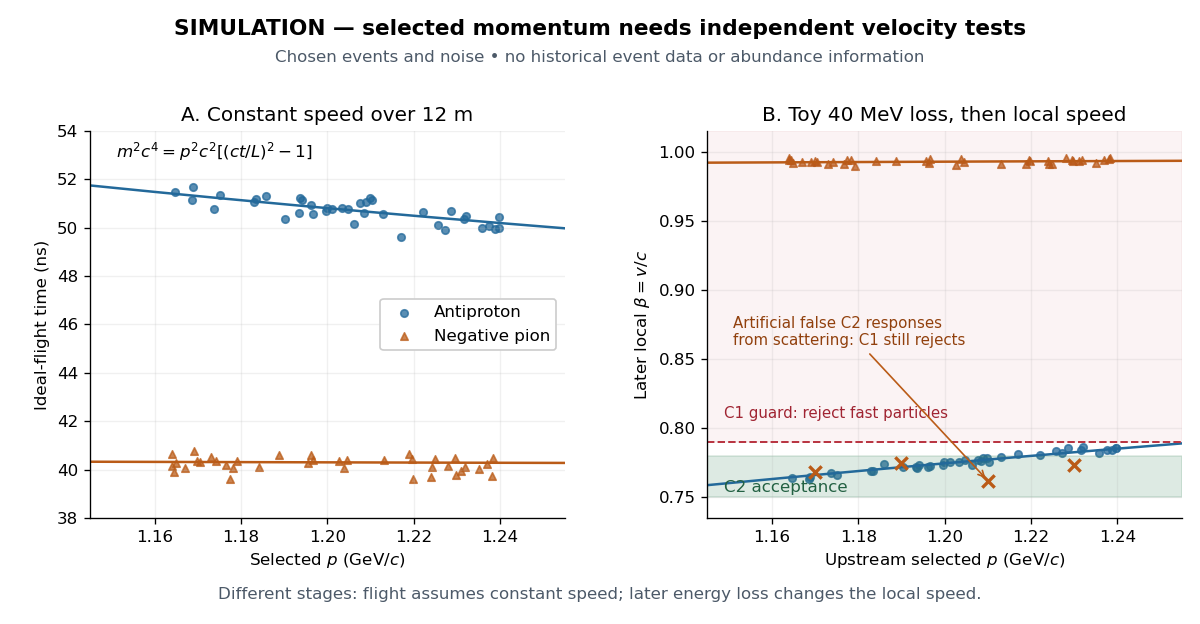

For example, the toy energy loss changes the central antiproton velocity from to . Directly substituting the slower downstream value together with the upstream momentum would overestimate the rest mass. The two panels thus describe different stages of a deliberately specified model; their numerical consistency depends on propagating energy between stages. Likewise, the scattered-pion markers represent an erroneous C2 response, not actual slow pions; an upstream C1 signal still rejects them.
New to topics? Read the docs here!