Aston velocity focusing
ID: aston-velocity-focusing

In Mass spectra and isotopes by Francis William Aston, printed pp. 10–12, Fig. 1, Francis William Aston describes successive electric and magnetic deflections in one plane, with opposite senses. This geometry focuses a range of ion speeds; it does not require the straight-through cancellation of a velocity selector.
The reason compensation is possible follows from the Lorentz force. In a short region of length , a small electric deflection angle has magnitude : the transverse acceleration acts for a time , and the deflection angle is the acquired transverse velocity divided by . A short magnetic region of length gives , since the magnetic force already contains one factor of speed. Slower ions therefore receive a disproportionately larger electric deflection.
An original local approximation makes the focusing idea explicit. At fixed mass-to-charge ratio, replace each region by a small angular kick and include the drift distances in two positive constants and . With , write the detector coordinate asChoosing the geometry and fields so that eliminates the first-order speed sensitivity. Indeed,A fractional speed error then contributes only at order in this approximation. This is a local thin-kick explanation, not Aston's exact pole geometry, focal-plane equation, or a prediction of its measured mass resolution. Finite slit widths, initial directions, and field boundaries still matter. Unlike a velocity selector, focusing can collect nearby speeds into a narrow image instead of discarding all but a narrow accepted range.
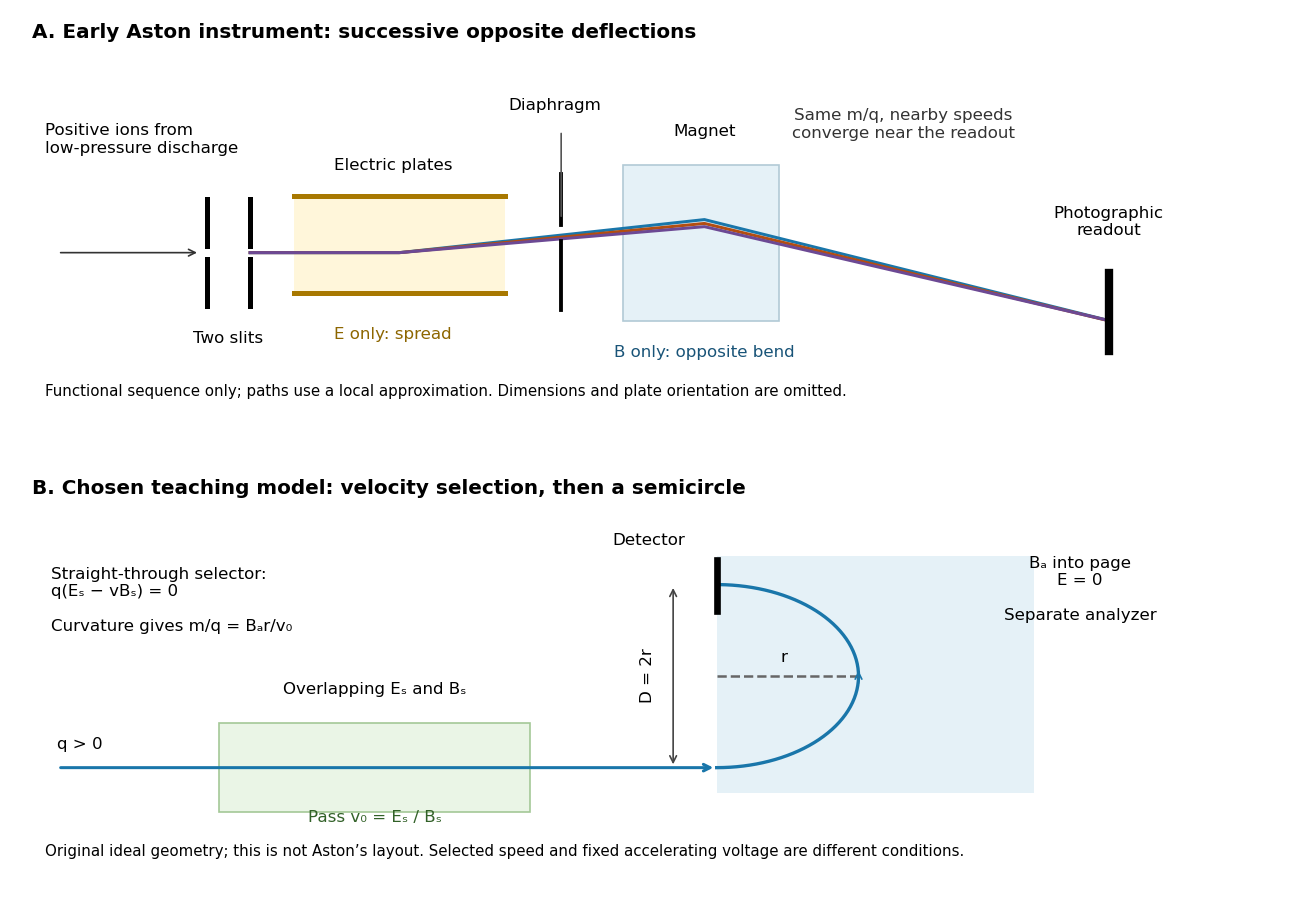
Successive opposite deflections in an early mass spectrograph, compared with a chosen velocity selector and magnetic analyzer
. Top: functional schematic of the sequence described by Francis William Aston; colored paths indicate one mass-to-charge ratio at nearby speeds. Paths use the local thin-kick illustration, and dimensions and plate orientation are not a reconstruction. Bottom: an independently chosen teaching geometry has overlapping selector fields followed by a separate semicircular magnetic path. Both diagrams show positive ions; the Thomson charge-to-mass experiment gives the corresponding negative-electric charge example. Details.
New to topics? Read the docs here!