A velocity selector uses perpendicular electric field and magnetic field to transmit a narrow range of speeds along a chosen beam direction. Assume uniform static electric field and magnetic field , with , and an incident velocity . The cross product gives , so the transverse Lorentz force isFor an Electron, the electric force points downward and the magnetic force upward. A faster Electron initially bends upward; a slower one initially bends downward. At the selected speed, both forces cancel along the whole straight trajectory. The cancellation is independent of mass and nonzero electric charge; it selects velocity, not a particular charge-to-mass ratio. A component of velocity parallel to the magnetic field is not constrained by the cancellation, so the incident beam must also have its direction restricted.
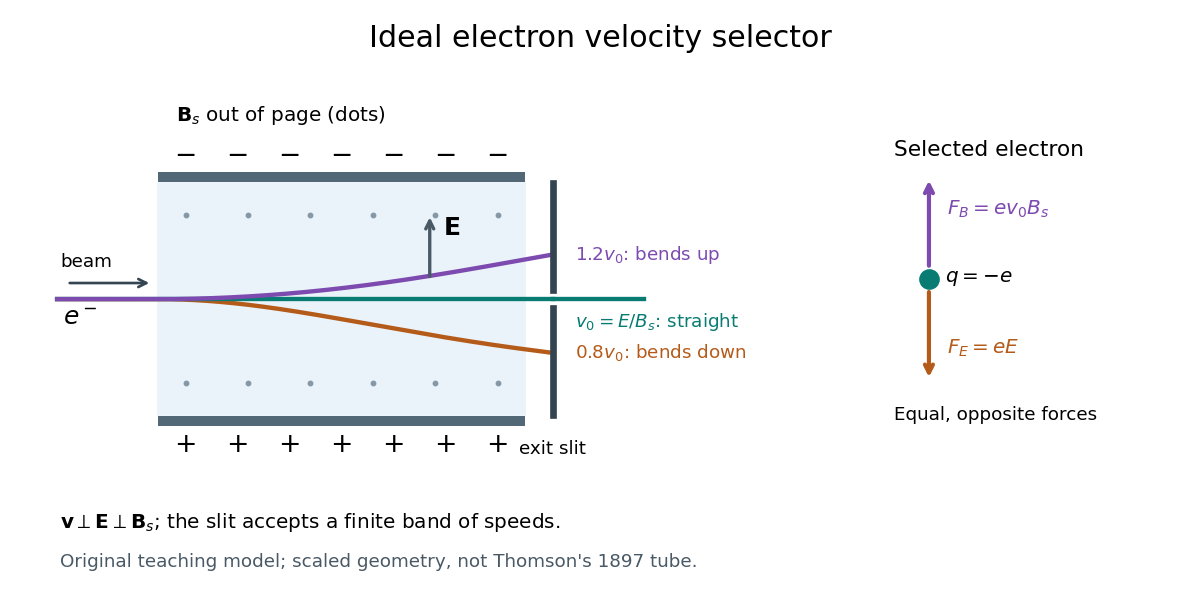

A real exit slit accepts a finite range of speeds and incident directions. A zero displacement at one screen alone does not establish zero force throughout the path: a curved trajectory could return to that screen position. The ideal velocity selector interpretation requires a straight aligned beam, known overlapping electric field and magnetic field, and sufficiently narrow entrance and exit slits. Its useful role in the Thomson charge-to-mass experiment teaching model is to supply speed independently of the subsequent magnetic bending.
Articles by others on the same topic
There are currently no matching articles.