A mass spectrometry instrument with a photographic readout. In the 1919 apparatus described in Chapter V: The Mass-Spectrograph, a gas discharge produced positive ions. Two narrow slits formed a ribbon beam in a vacuum; plates applied an electric field to spread it, an aperture selected part of it, and a magnetic field bent it oppositely. Focusing reduced the spread caused by differing ion speeds, concentrating a given mass-to-charge ratio into a line on a photographic plate.
The observed quantity was line displacement from a fiducial spot. Known reference lines calibrated displacement against mass-to-charge ratio; repeated exposures with changed magnetic field tested the calibration. Evacuation limited collisions. Comparing line shapes with narrow and wide apertures helped distinguish geometric broadening from photographic spreading. Finite slit widths, plate response, and overlapping molecular or multiply charged ions limited interpretation. See Chapter V: The Mass-Spectrograph (§§33–40: apparatus and photographic procedure; §§43 and 45–46: calibration, aperture comparisons, and accuracy).
In Mass spectra and isotopes by Francis William Aston (Nobel lecture, 12 December 1922), the reported neon lines at 20 and 22 have companions at 10 and 11 from doubly charged ions. That paired pattern and comparison with reference lines support different atomic masses within one chemical element, rather than an atomic mass concentrated at the bulk average. The lecture also describes an earlier failed separation by distillation and partial separation by diffusion, showing why the focused mass spectrum supplied stronger evidence. These numbers used a historical oxygen-based reference scale. The lecture's whole-number rule was an empirical approximation at its stated accuracy, not the modern exact definition .[ref]
Mass spectra and isotopes by Francis William Aston. pp. 9–13: separation attempts, focusing, reference lines, charge orders, and neon; pp. 15–17: whole-number rule and historical nuclear interpretation
In Mass spectra and isotopes by Francis William Aston, printed pp. 10–12, Fig. 1, Francis William Aston describes successive electric and magnetic deflections in one plane, with opposite senses. This geometry focuses a range of ion speeds; it does not require the straight-through cancellation of a velocity selector.
The reason compensation is possible follows from the Lorentz force. In a short region of length , a small electric deflection angle has magnitude : the transverse acceleration acts for a time , and the deflection angle is the acquired transverse velocity divided by . A short magnetic region of length gives , since the magnetic force already contains one factor of speed. Slower ions therefore receive a disproportionately larger electric deflection.
An original local approximation makes the focusing idea explicit. At fixed mass-to-charge ratio, replace each region by a small angular kick and include the drift distances in two positive constants and . With , write the detector coordinate asChoosing the geometry and fields so that eliminates the first-order speed sensitivity. Indeed,A fractional speed error then contributes only at order in this approximation. This is a local thin-kick explanation, not Aston's exact pole geometry, focal-plane equation, or a prediction of its measured mass resolution. Finite slit widths, initial directions, and field boundaries still matter. Unlike a velocity selector, focusing can collect nearby speeds into a narrow image instead of discarding all but a narrow accepted range.
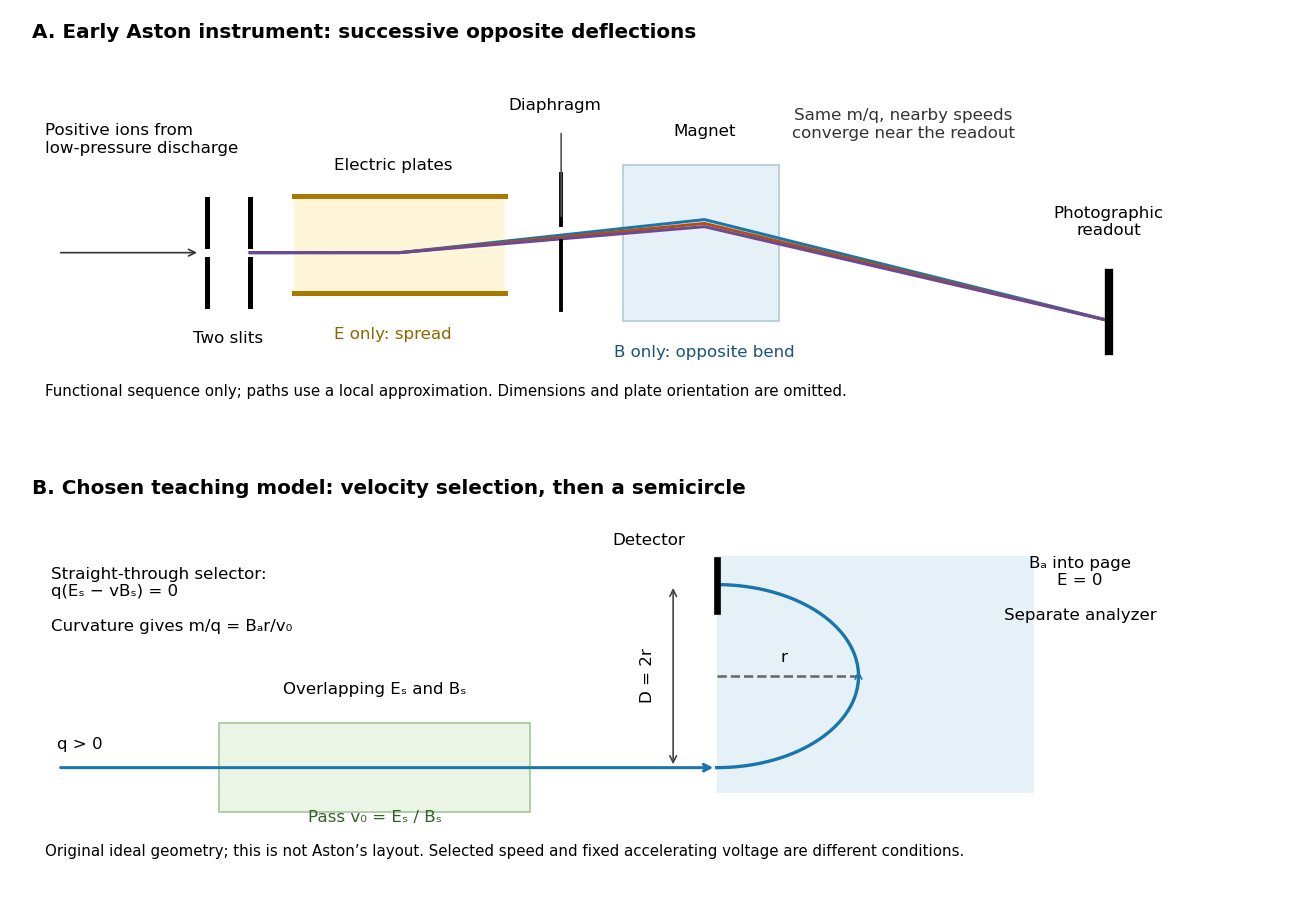
Successive opposite deflections in an early mass spectrograph, compared with a chosen velocity selector and magnetic analyzer
. Top: functional schematic of the sequence described by Francis William Aston; colored paths indicate one mass-to-charge ratio at nearby speeds. Paths use the local thin-kick illustration, and dimensions and plate orientation are not a reconstruction. Bottom: an independently chosen teaching geometry has overlapping selector fields followed by a separate semicircular magnetic path. Both diagrams show positive ions; the Thomson charge-to-mass experiment gives the corresponding negative-electric charge example. Details.
Articles by others on the same topic
There are currently no matching articles.