Battery load power and efficiency
ID: battery-load-power-and-efficiency

In the constant-parameter battery internal resistance model, the source's available electrical power splits between the electrical load and internal dissipation:The stipulated , , calculation gives , , and . A resistive electrical load converts its share to Joule heating; another electrical load might convert some of it to mechanical work or light. The source term is available electrical work per time, not a complete cell heat budget: reaction entropy can also matter.
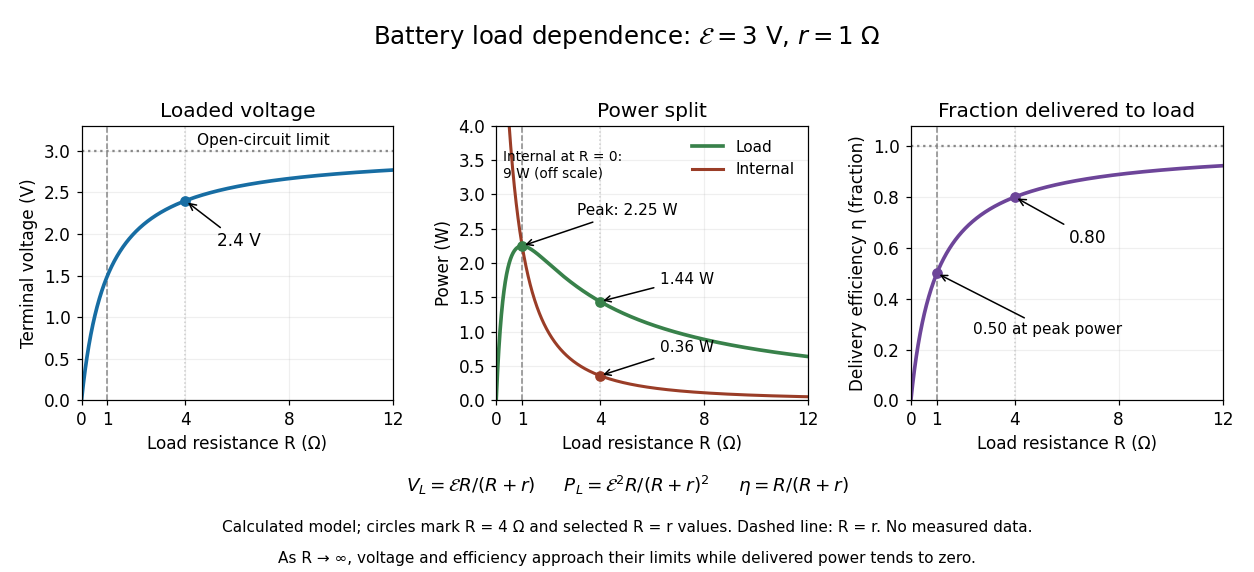

Define the delivery efficiency relative to the source's available electrical work, rather than to all chemical energy or to a complete charging cycle:Here . The largest load power occurs at : since ,Thus maximum load power and maximum delivery efficiency ask different questions. As , and , but and : a high nearly unloaded voltage supplies almost no power. As , the model gives , and internal power tending to . Real high-current operation can invalidate constant and ; the mathematical maximum does not establish a permissible operating point for an actual battery.
New to topics? Read the docs here!