
The Born rule connects a quantum state to measurement probabilities. Let be a complete orthonormal basis, finite or countably infinite, for a Hilbert space, and letAn ideal measurement distinguishing these basis vectors returns label with probabilityThis assignment is a physical measurement rule. Its compatibility with total probability one follows from orthonormality and normalization:The probabilities are the squared moduli, not the amplitudes themselves or the squares . [ref].
If the basis is an eigenbasis of an observable, the reported numerical value is its eigenvalue. Several vectors can share one eigenvalue; the probability of that value is then the sum over the corresponding basis labels. More generally, a projective measurement with orthogonal projections assignsfor a pure state and a general density matrix , respectively. This also covers mixed states and degenerate eigenspaces. The Born rule determines outcome statistics; the ideal conditional state change is specified separately by the Lüders rule. See projective measurement for that formulation and its assumptions. [ref]
https://quantum.cloud.ibm.com/learning/en/courses/general-formulation-of-quantum-information/general-measurements/formulations-of-measurements. Watrous, IBM Quantum Learning, Mathematical formulations of measurements, Projective measurements
.For a worked example, take the normalized qubit quantum stateThe squared moduli add to . A computational-basis measurement, equivalently a measurement of the Pauli matrix, hasThese probabilities do not depend on the relative quantum phase . Now choose the Hadamard basiswhose vectors are eigenstates of the Pauli matrix, also used by the Pauli X gate. The new probability amplitudes and probabilities areBoth probabilities are nonnegative and their sum is one. The relative quantum phase becomes visible because the two probability amplitudes add before their squared modulus is taken:
- At , and .
- At , .
- At , and .
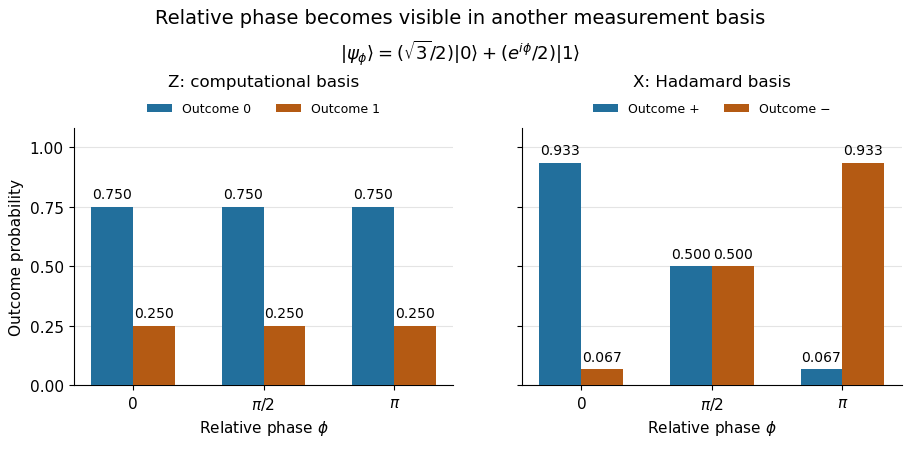
The same qubit preparation has phase-independent Z probabilities and phase-sensitive X probabilities
. Details. A Hadamard gate followed by a computational-basis measurement realizes these statistics, since , respectively. Compare the two bases using fresh, identically prepared copies: a preceding measurement may change the state. The quantum superposition section shows why replacing the preparation by the mixed state keeps the statistics but gives for every .
The usefulness of the Born rule is this conversion from linear algebra to experimental predictions: calculate overlaps in the basis actually measured, then take squared moduli. Its appealing geometry is that changing basis redistributes probability while preserving total squared norm. The same rule relates an energy eigenstate expansion to an energy measurement and a position wavefunction to a probability density.
Born's 1926 paper on quantum scattering interpreted the outgoing-wave coefficients in terms of the probabilities of collision outcomes; a corrective footnote specified proportionality to the square of the amplitude. This is a historical scattering formulation, rather than the general density matrix formula above. [ref]
Zur Quantenmechanik der Stoßvorgänge by Max Born. Born, Zur Quantenmechanik der Stoßvorgänge, Zeitschrift für Physik 37, 863–867, 1926
; [ref]https://www.neo-classical-physics.info/uploads/3/0/6/5/3065888/born_-_qm_for_collisions_i.pdf. English translation of Born's paper, p. 3 and footnote 1
.
The Born rule is a fundamental principle in quantum mechanics that provides a way to calculate the probability of finding a quantum system in a particular state after a measurement is made. It was formulated by the physicist Max Born in 1926 and is a key element in the interpretation of quantum mechanics.


New to topics? Read the docs here!