Buffer capacity and concentration
ID: buffer-capacity-and-concentration

Stipulate pKa and ; these are model inputs, not measurements of an identified substance. At pH the pair contribution is . For analytical concentrations and , respectively, it isThe free hydrogen ion and hydroxide contribution is the same at this pH, per pH. The full buffer capacities are therefore approximately and per pH. Identical pH fixes the free hydrogen ion thermodynamic activity; it does not fix the inventory of weak acid and conjugate base available for neutralization.
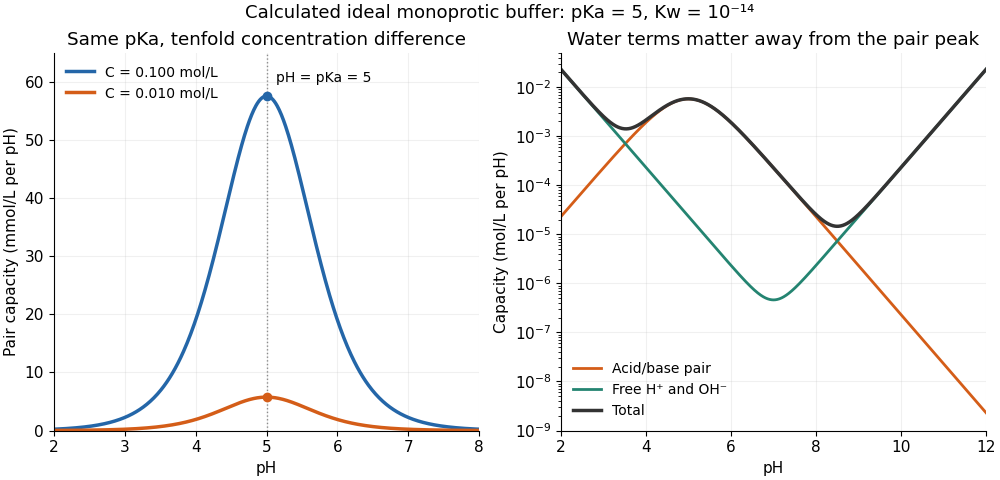

At one unit of pH on either side of pKa, or , giving . The partners still form a buffer solution, but its local resistance is only about one third of the maximum for that analytical concentration. At fixed pH, the pair contribution scales exactly with ; the full buffer capacity contains the additional -independent water contribution. Consequently, extreme dilution does not justify dropping self-ionization of water.
New to topics? Read the docs here!