A buffer solution contains appreciable quantities of a weak acid and its conjugate base, and resists changes in pH caused by small quantities of added chemical acid or chemical base. The conjugate base accepts added protons; the weak acid supplies protons when a chemical base consumes them. Consuming most of either partner undermines the buffering action. See Flowers et al., Chemistry 2e, buffers.
For a separate toy calculation, stipulate pKa for a weak acid ; this is an input, not measured material data. Initially of buffer solution contains of and of its conjugate base . In the ideal concentration approximation, the Henderson-Hasselbalch equation gives initial pH . Add of hydroxide with negligible volume change. The dominant neutralization has one-to-one stoichiometry:Each mole of consumed hydroxide removes one mole of weak acid and forms one mole of conjugate base and water. Thus the inventories after neutralization areThe shared volume cancels from the concentration ratio. The Henderson-Hasselbalch equation therefore predictsThis small increase illustrates how conversion between abundant partners absorbs added chemical base. The calculation neglects the tiny free hydronium and hydroxide inventories, changes during re-establishment of chemical equilibrium, self-ionization of water, and activity coefficient corrections. The displayed inventories approximate the final chemical species distribution; they are not an exact solution of all chemical equilibrium conditions.
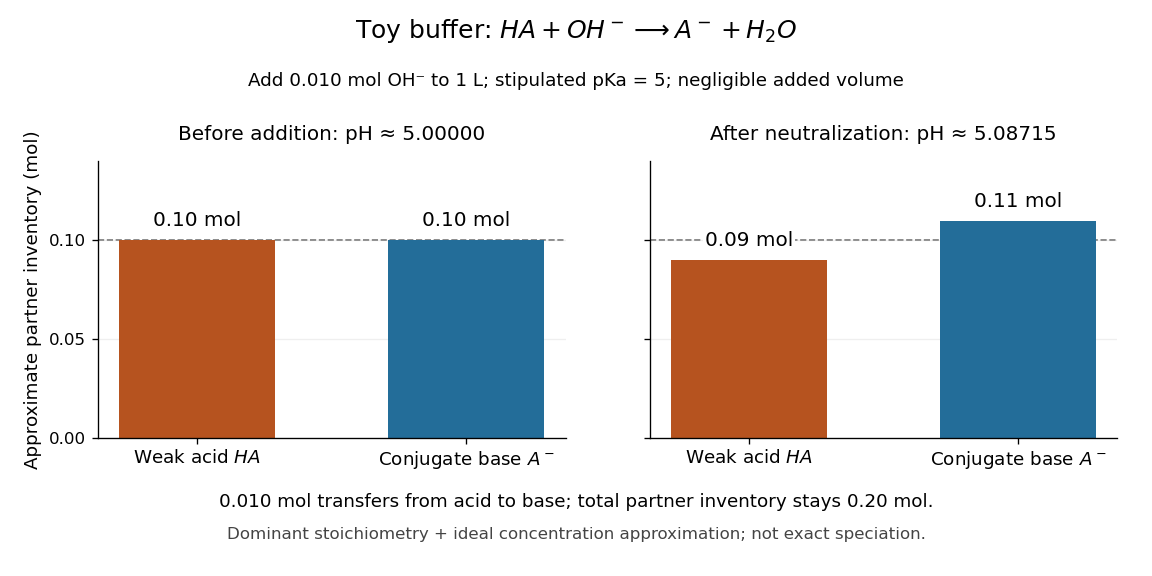

A buffer solution has a finite buffer capacity: its weak acid inventory supplies protection against added chemical base, and its conjugate base inventory supplies protection against added chemical acid. Here an addition approaching of hydroxide uses up the available in the dominant stoichiometry calculation. Close to that limit, the neglected chemical equilibrium contributions matter; once is exhausted, inserting a zero denominator into the Henderson-Hasselbalch equation cannot predict the actual pH. Excess hydroxide and the remaining chemical species require a fresh chemical equilibrium calculation. This is why a buffer solution stabilizes conditions for chemical reactions over a finite range of additions. See Flowers et al., Chemistry 2e, buffer capacity and added base.
For the pair , rearranging the acid dissociation constant gives the activity relationWith thermodynamic activity of water approximated by one and ideal dilute thermodynamic activities for both partners, this yields the familiar Henderson-Hasselbalch equation:The concentrations are at chemical equilibrium; using initial values requires negligible equilibration changes. Below, also neglect self-ionization of water and competing chemical reactions.
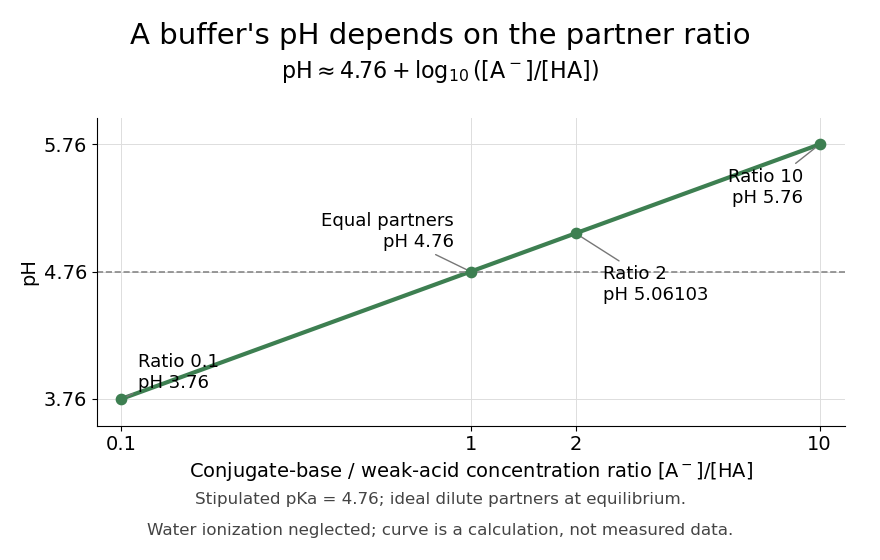
Stipulate for an illustrative weak acid, without identifying it with a measured substance. A conjugate base to weak acid concentration ratio of two givesEqual concentrations give a ratio of one, whose logarithm is zero, hence pH . Multiplying the ratio by ten raises pH by one: ratios , , and give pH values , , and . The ratio controls the ideal prediction, while the absolute quantities control how much added chemical acid or chemical base the buffer solution can accommodate.

Articles by others on the same topic
There are currently no matching articles.