Dilution lowers a solute's concentration by adding solvent. For conserved amount of substance, molar concentration satisfiesBoth and are chemical solution volumes; is the final total, not the added solvent.[ref]
The proof is simply the definition applied before and after. Its useful assumptions are full transfer of the selected portion, no loss or gain of the counted solute, and complete mixing. An ideal chemical solution approximation is not required for this inventory equation. If chemical equilibrium redistributes dissolved chemical species, use a conserved analytical concentration or chemical element inventory rather than assuming each individual species is conserved. This conservation statement does not by itself preserve the pH: a chemical equilibrium may change as the chemical solution is diluted.
Serial dilution repeatedly transfers a measured portion of one well-mixed chemical solution and dilutes that portion to a new final volume. With transferred volume and final volume at step , conserved solute givesThis product follows by repeated substitution. Each step conserves the solute in the portion transferred into its receiving flask, not the entire inventory in the preceding flask. Uniform mixing makes the selected fraction representative.
Continue the original solution mass and volume bookkeeping example. A portion of the stock contains of analytical sodium chloride, corresponding to before rounding. After dilution to , its analytical concentration is . A new portion of that mixed chemical solution contains ; dilution to gives . The two factors and multiply to .
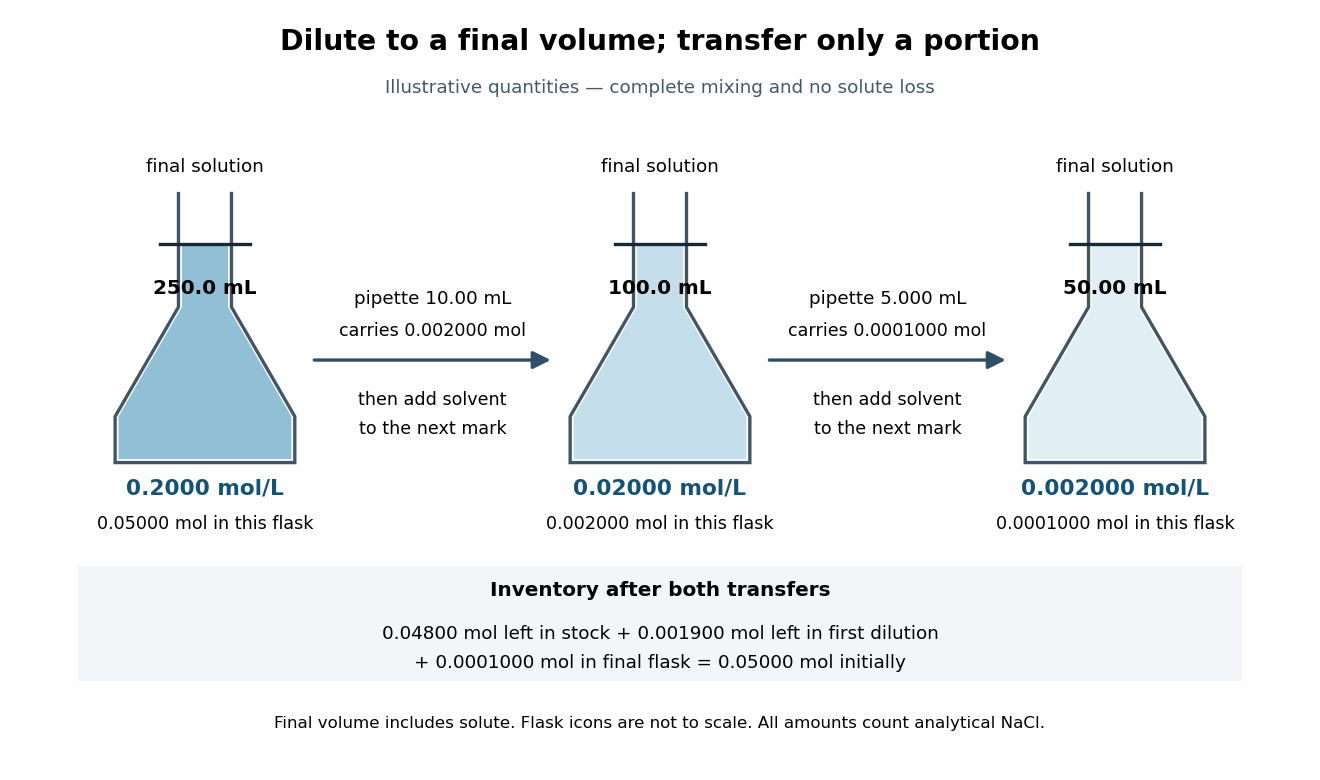

The remaining stock holds ; the remaining first dilution holds . Including the final flask restores the starting inventory:This is a direct check that making a dilute final sample does not destroy the solute. Most of it remains in earlier vessels.
Serial dilution makes a small final concentration accessible using measurable portions instead of a single extremely small transfer. Its limitation is that systematic errors propagate: if each transferred volume is below its intended value while final volumes are correct, two steps give times the intended concentration, a deficit. Repeated readings alone do not remove that bias. The gain in manageable volume therefore depends on calibrated transfer and representative mixing.
Articles by others on the same topic
There are currently no matching articles.