Capture-recapture model
ID: capture-recapture-model

A capture-recapture model is a statistical model for repeated observations of identifiable individuals, including those missed on some occasions. A closed-population capture-recapture model estimates a fixed population cardinality; models allowing individuals to enter or leave can instead describe survival and recruitment. The sampling assumptions determine which likelihood function is appropriate.
For the two-sample closed-population capture-recapture model, condition on the sample sizes and . If the second sample selects distinct individuals from by simple random sampling, then the overlap has the hypergeometric distribution:Here is an integer and the probability mass function is zero outside these bounds. The binomial coefficients count choices of marked and unmarked individuals, divided by all equally likely size- subsets. The hypergeometric distribution has expected valueEquating the observed overlap with this expected value gives the Lincoln-Petersen estimator. The underlying sampling without replacement, probability mass function, and expected value are developed in Raymond P. Guiteras, MIT 14.30 hypergeometric distribution handout, §§1–4 and 8.
For the toy counts , , and , hold the observations fixed and vary the unknown integer . The likelihood function isValues below forty cannot contain the observed set union. Exact comparison of consecutive likelihoods gives two tied maximum-likelihood estimates, and . The Lincoln-Petersen estimator returns ; the Chapman estimator returns and is a different rule for estimation.
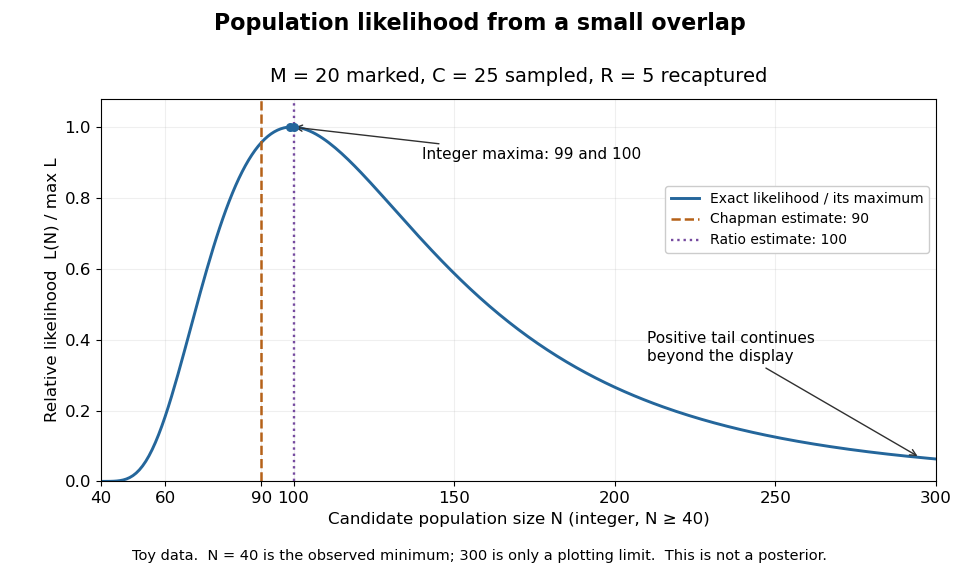
Relative likelihood for the toy overlap: integer maxima at 99 and 100, ratio estimate 100, and Chapman estimate 90
. Details. 
The vertical scale is . This relative likelihood compares how well candidate statistical parameters explain the same observations; it is not a posterior probability. The displayed range is only a plotting window. The likelihood function remains positive for every integer and tends to zero as increases, so the curve has a continuing right tail. The data do not justify truncating statistical inference at three hundred. The conditional hypergeometric distribution formulation also appears in Louis-Paul Rivest and Mamadou Yauck, Small Sample Estimators for Two-way Capture Recapture Experiments, §3, equation (5).
Zero recaptures require care. With and positive , the Lincoln-Petersen estimator has no finite ratio, but the capture-recapture model still gives a valid likelihood function:This likelihood function increases toward one as grows, so there is no finite maximum-likelihood estimate. For the same sample sizes twenty and twenty-five with zero overlap, forty-five distinct individuals would be observed. Lack of overlap supplies a lower bound but very weak information about large population cardinalities.
In more elaborate capture-recapture models, a first-recapture array counts individuals released at occasion and next observed at . A probability of survival and a probability of detection contribute a no-observation continuation factor . The resulting likelihood function depends on both survival and detection; these probabilities need not be separately identifiable at the last observation interval. Missing-count EM for capture-recapture describes one way to fit such a model, and identifiability remains a separate issue from computing an estimator output.
New to topics? Read the docs here!