Cartesian basis under rotation
ID: cartesian-basis-under-rotation

Rotate the standard basis through using the rotation matrix whose columns are the new basis vectors:Here and , so is an orthogonal matrix with , where denotes transpose and is the identity matrix. For the same vector , its coordinate vector in this Cartesian basis isThus and : travel forwards along and a little backwards along to reconstruct . The orthogonal projections onto the two axes give these signed coordinates because the measuring vectors are both perpendicular and of unit length.
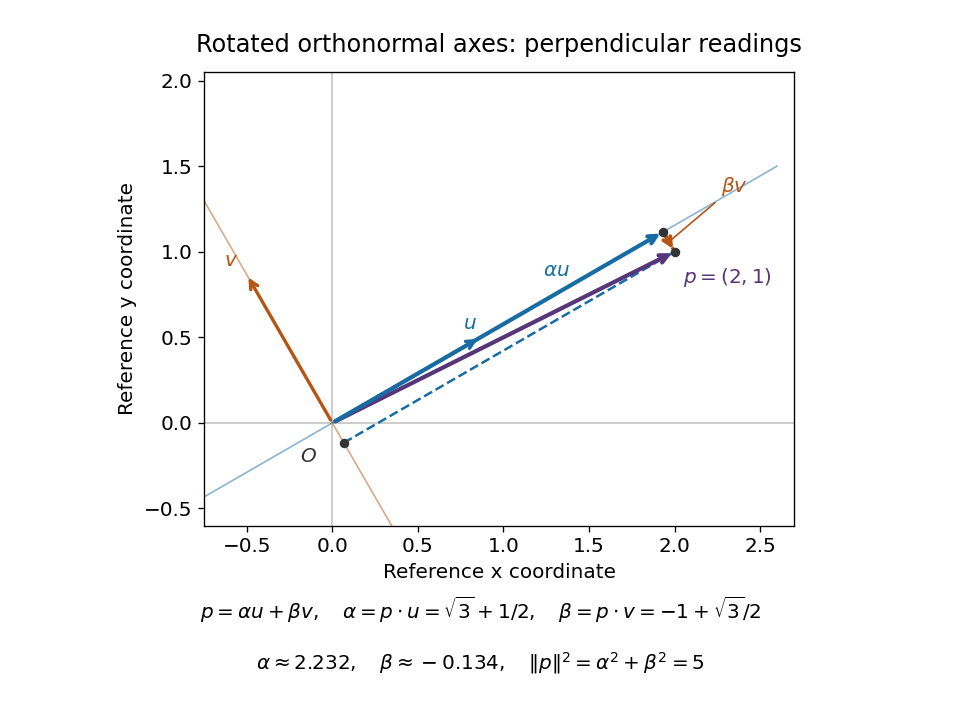

The squared norm remainsThis is useful when choosing axes aligned with a geometric feature: the coordinates change but distances and dot products retain the same sum-of-products formula. The two directions of the change of basis must be kept straight: reconstructs the vector in old coordinates, , and extracts its new coordinates. Applying to the old coordinate vector instead would actively rotate the vector.
A short proof explains both formulas. If , multiplication by gives . Then . Perpendicular unit-length columns make the matrix inverse equal the transpose; this is the computational convenience supplied by a Cartesian basis.
New to topics? Read the docs here!