Constant intensity does not imply independence
ID: constant-intensity-does-not-imply-independence

The same intensity measure can belong to very different point processes. A Poisson point process with a locally finite intensity measure adds two requirements: each finite-intensity window count has the Poisson distribution of mean , and counts in pairwise disjoint observation windows are mutually independent. These requirements determine its probability law; they do not follow from the formula for .[ref]
Lectures on the Poisson Process by Günter Last and others. Section 3.1, Definition 3.1 and Proposition 3.2, printed pp. 19-20: Poisson count laws, independence, and uniqueness
A randomly shifted lattice point process, a unit-rate Poisson point process, and the shared random rate gives dependent point counts construction all satisfy on the real line. Nevertheless, their counts in have respectively variance zero, one, and two. Counts in the disjoint observation windows and have respectively covariance , zero, and . These exact calculations show why measuring mean density cannot identify a spacing or statistical dependence model.
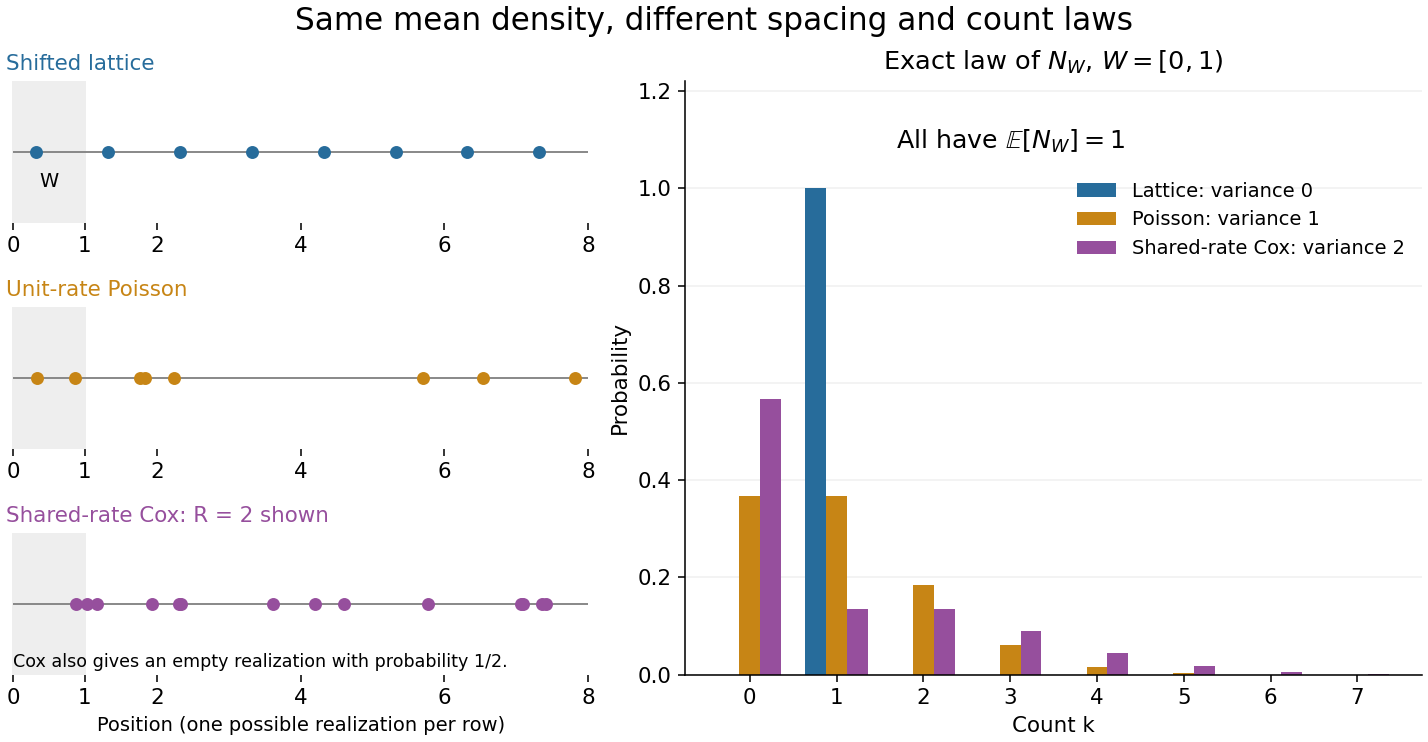
Equal intensity permits regular spacing, Poisson counts, and shared-rate dependence
. All three laws have intensity measure . Left: illustrative realizations of a randomly shifted lattice point process, a unit-rate Poisson point process, and the shared random rate gives dependent point counts construction conditional on rate two; the latter also has a completely empty outcome with probability . Right: exact probability mass functions of the count in , with the axis displayed through seven. Equal expected values of one coexist with variances zero, one, and two. Realizations illustrate spacing; the bars describe laws, not frequencies estimated from those realizations. Details.
New to topics? Read the docs here!