Continuity of probability
ID: continuity-of-probability

Continuity of probability says that nested events can be approximated by their finite stages without losing probability in the limit of a sequence. In a probability space , let . ThenThe sigma-algebra ensures that both limiting events belong to . These are continuity from below of a measure and continuity from above of a measure. The first holds even for an infinite measure; the second requires finite measure of the first set, which is automatic for a probability measure because .[ref]
For a concrete model, toss a fair coin through a sequence of independent Bernoulli trials, and let be the event of at least one head in the first tosses. Its complement is the event of initial tails. On the sample space of infinite head-or-tail sequences,Every finite waiting horizon has positive tail probability, yet the event of waiting forever has probability zero. That intersection is not empty: it contains the all-tails sequence. Thus a zero-probability event need not be impossible as an outcome, and eventual success almost surely does not supply a deterministic deadline. The waiting time for the first head has a geometric distribution with success probability . After ten tosses, the remaining tail probability is exactly ; nine tosses leave .
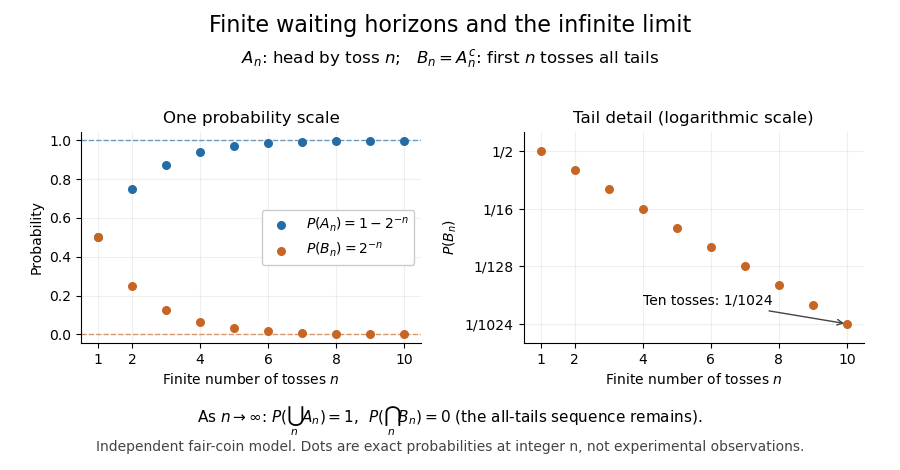
Exact fair-coin model: success by toss n increases to probability one, while the all-tails prefix probability decreases to zero
. Details. 
A proof outline exposes what makes countable additivity stronger than finite additivity of a set function. For increasing events, put and for . These set differences are pairwise disjoint events, their union is , and the first pieces have union . ConsequentlyFor decreasing events, their complements increase to ; applying the increasing result and the complement rule of probability gives . The finite-total-mass condition is essential for this subtraction. For comparison, the counting measure of each set of natural numbers is infinite, although their intersection is empty and has measure zero.
Conversely, on a sigma-algebra, a nonnegative normalized set function satisfying finite additivity of a set function and satisfies countable additivity. For pairwise disjoint events with , the remainders decrease to the empty set, andTaking the limit of a sequence recovers the infinite sum. This equivalence explains why continuity of probability is part of the foundations rather than a separate assumption about smooth curves.
One useful application controls infinitely many possible errors. If events satisfy , then the events decrease, and the union bound gives . Continuity of probability therefore makes : errors occur infinitely often with probability zero. This is the Borel-Cantelli first lemma, and it requires no independence. For the illustrative bounds , the probability of any error at index or later is at most , an explicit truncation guarantee.
The word continuity here concerns nested sets, not the absence of atoms in a probability distribution. For any real-valued random variable , the events decrease to . Hence its cumulative distribution function is right-continuous even when it has jumps, as for a geometric distribution. The nesting hypothesis matters: an arbitrary sequence of events need not admit either displayed interchange of limit and probability.
New to topics? Read the docs here!