Diagonal scaling of Gershgorin discs
ID: diagonal-scaling-of-gershgorin-discs

A positive diagonal matrix , with , is an invertible matrix and changes the coordinate scales through the similarity transformation . Its diagonal entries are still , while . Thus the Gershgorin discs have the same centres but different radii. Matrix similarity preserves the characteristic polynomial and eigenvalues, so the original and scaled disk unions are both valid bounds and may be intersected. Suitable scaling can compensate for badly unbalanced off-diagonal entries; it need not shrink every radius.[ref]
https://cklixx.people.wm.edu/teaching/math408/408-note.pdf. Chi-Kwong Li, Math 408 lecture notes, §6.1: similarity transformations for eigenvalue localization
For example,The original Gershgorin discs are and . Their union is simply the huge first disk; the small second disk contains no eigenvalue. After scaling, both radii are , giving or . The two Gershgorin discs overlap, so their individual eigenvalue counts are not certified. The scaled matrix is a real symmetric matrix, however, so matrix similarity now proves that the original matrix has real eigenvalues in and is an invertible matrix. Directly, both matrices have characteristic polynomial , henceThe scaling changes the available bounds, while these eigenvalues stay fixed.
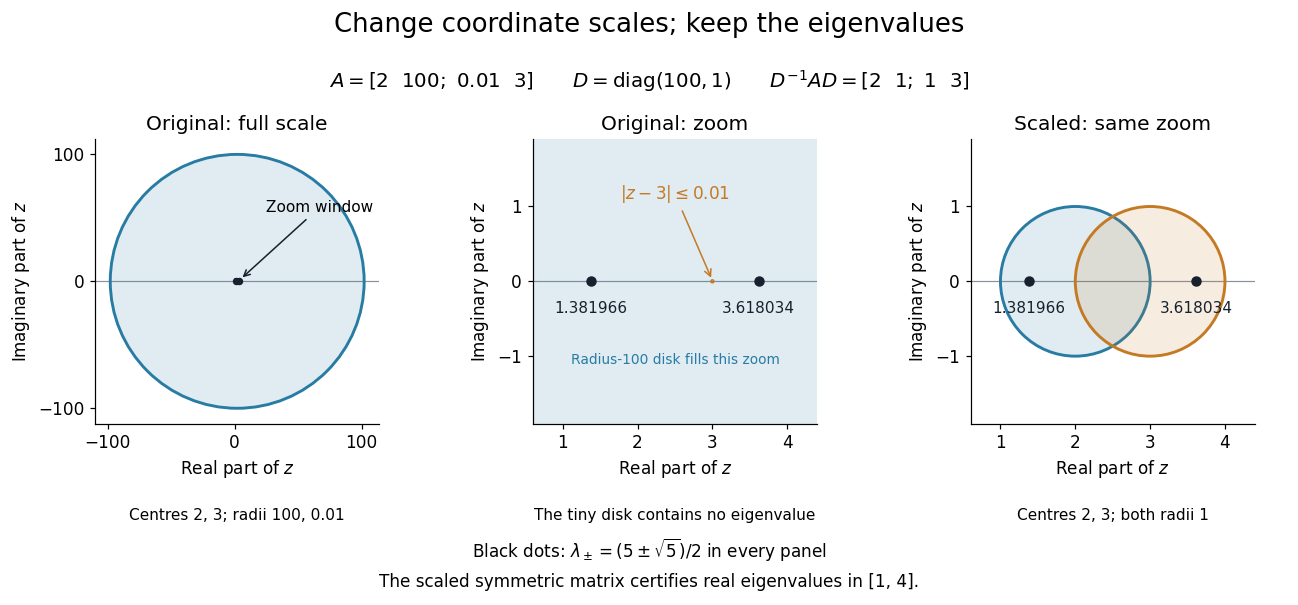
Diagonal similarity scaling replaces a radius-100 Gershgorin disc by two radius-1 discs while preserving both eigenvalues
. Details. 
New to topics? Read the docs here!