Double heterostructure laser
ID: double-heterostructure-laser

A double heterostructure laser electrically pumps its central layer for stimulated emission. Band offsets confine charge carriers; refractive index contrast confines the optical normal mode.[ref]
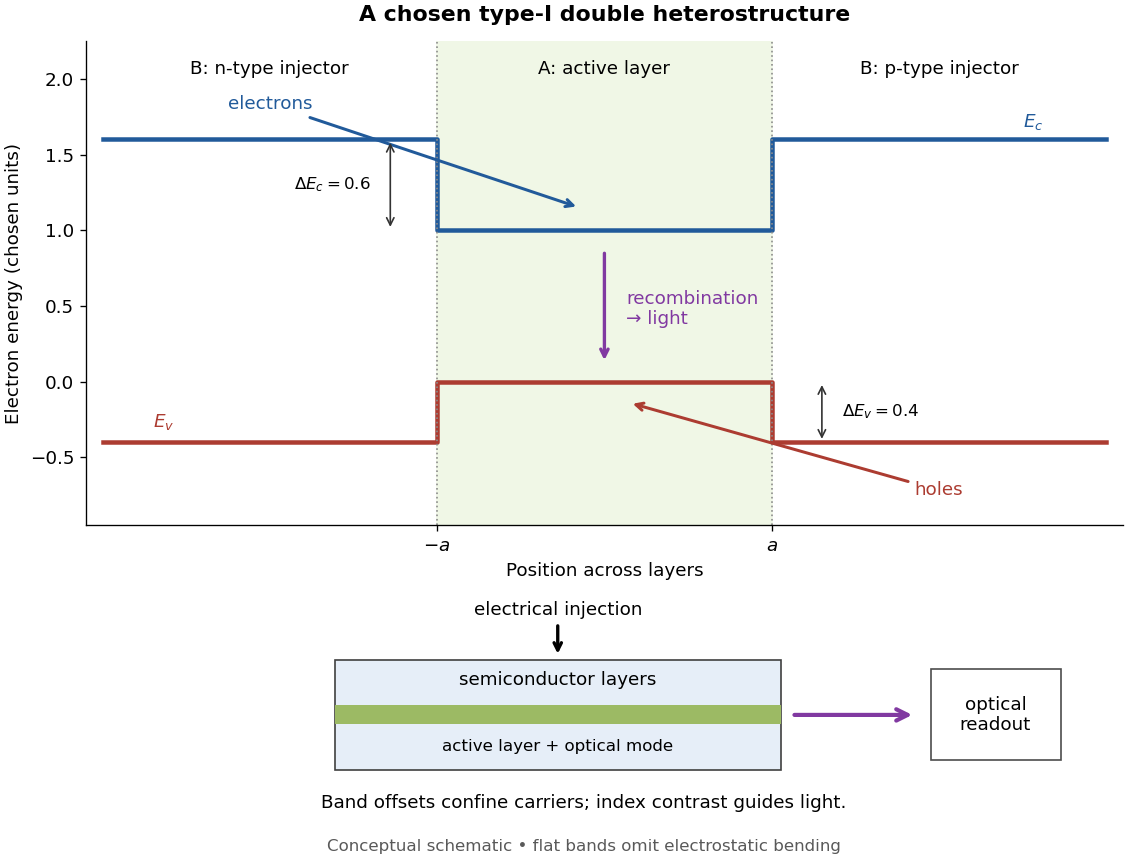
Chosen type-I band alignment: carrier injection and optical readout
. Original schematic using stipulated energy units. The upper panel plots electron energy band edges across the layers; the lower panel separates electrical pumping from the emerging light. Flat segments omit band bending. The curves do not reproduce a historical device. Source. Details.
For an original bookkeeping model, let be the injected pair rate per unit area, the active-layer thickness, its excess pair number density, a recombination lifetime, and an escape time. Before appreciable stimulated emission, supposeChoose two otherwise identical devices with and . The resulting steady state populations are and : improved confinement raises the population by a factor at fixed injection. This linear model assumes equal excess Electron and electron hole densities, fixed lifetimes, and no laser gain clamping.
Optical confinement enters separately. For a chosen optical normal mode, define as its gain-overlap factor with the active layer. With material optical gain , internal loss , and mirror loss , a simple laser threshold condition isFor stipulated losses in inverse-length units, requires , whereas requires . This calculation varies optical overlap only; the preceding population calculation varies carrier escape only. Their combination explains the usefulness of controlling both the energy band profile and the optical normal mode.
Herbert Kroemer proposed the double heterostructure laser in 1963; he did not participate in its 1970 experimental realization.[ref]
Nobel Lecture: Quasielectric fields and band offsets: teaching electrons new tricks by Herbert Kroemer. §IV, p. 787
Zhores I. Alferov describes his group's independent 1963 proposal and later experimental program.[ref] New to topics? Read the docs here!